

TL;DR: The best Postman alternatives in 2026 are Bruno for Git-native, offline API testing, Insomnia for a polished client with Git Sync, and Hoppscotch for an open-source web client you can self-host. Thunder Client fits developers who live in VS Code. Paid plans run from $3 to $12 per user a month, and most have a free tier, as of November 2026.
Postman’s free plan is now very small. Its pricing page now lists the Free plan as 1 user, with Team at $19 per user a month billed annually, as of November 2026.
That pushes a lot of small teams to look around. If two people share collections, you now pay.
Other complaints are older. Postman wants you signed in and syncing to its cloud. Collections live in Postman’s workspace, not next to your code. And the app has grown heavy as it added AI, flows and API governance features.
The good news is that the alternatives are strong now. Several are open source, store collections as plain files in your repo, and cost a third of Postman’s Team price.
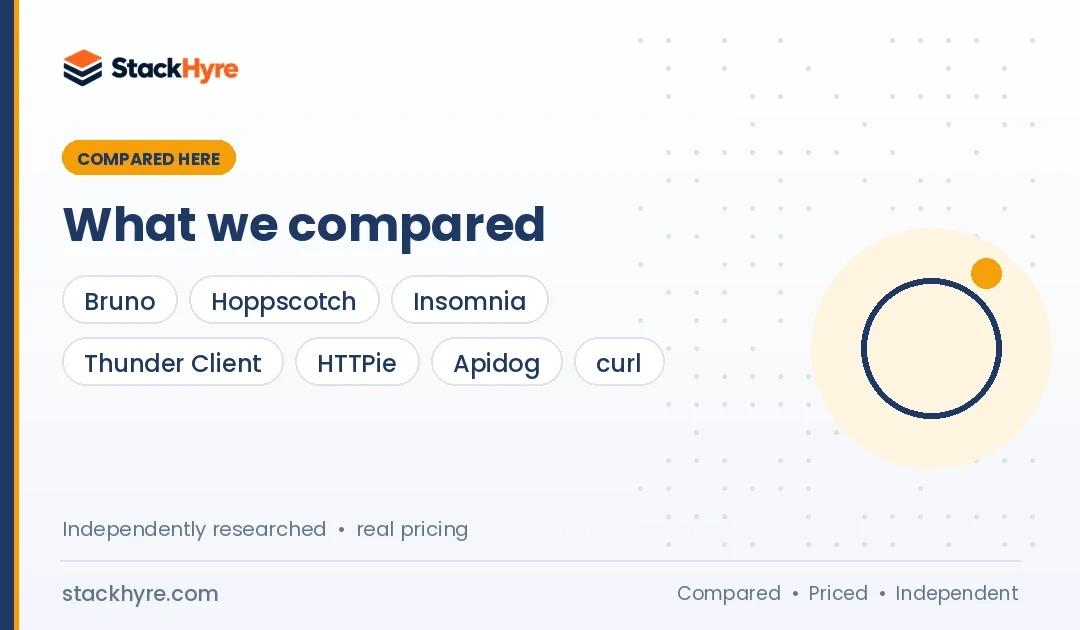
I compared 7 Postman alternatives on pricing, storage model, protocols and how easy it is to move your collections. If you’re also trimming your communications or monitoring bills, see my guides to Twilio alternatives and Datadog alternatives.
Quick Comparison: 7 Best Postman Alternatives
| Tool | Best For | Starting Price | Key Feature |
|---|---|---|---|
| Bruno | Git-native, offline testing | Free; Pro $6/user/mo | Collections as plain files |
| Insomnia | Polished client with Git Sync | Free; Pro $12/user/mo | Local Scratch Pad |
| Hoppscotch | Open-source web client | Free; Business $6/user/mo | Self-host option |
| Thunder Client | Testing inside VS Code | Free; Starter $3/user/mo | No limit on CI/CD runs |
| HTTPie | Terminal and simple desktop use | Free CLI | Readable command syntax |
| Apidog | Design, mock and test in one | Check pricing | API design first |
| curl plus scripts | Zero cost and full control | Free | Works everywhere |
What Makes a Good Postman Alternative?
A good Postman alternative lets you send and test API requests without forcing your data into someone else’s cloud. Look for Postman collection import, support for REST, GraphQL and gRPC, environment variables, a collection runner for CI, and a fair price for teams. Storing collections as files in Git is the biggest upgrade most teams get from switching.
Here’s what I weigh most.
Where your collections live. Postman stores them in its cloud workspace. Bruno writes them as files on disk. Insomnia lets you pick local, cloud or Git. File-based storage means code review, branches and history for free.
Import quality. You probably have dozens of Postman collections. Check that your scripts, variables and auth settings come across, not only the URLs.
CI support. Your tests should run headless in a pipeline. Look for a CLI runner and report output your CI can read.
Team pricing. Price per seat matters once you pass a handful of developers.
Best Open-Source Postman Alternatives
#1 Bruno: Best for Git-native, offline API testing
Bruno is the alternative I’d try first. It fixes the main thing people dislike about Postman: the forced cloud.
What it does well. Bruno saves each request as a plain text file in a folder you choose. You commit that folder with your code. No account is needed to start, and the core app is open source on GitHub.
Key features:
- HTTP, REST, GraphQL and gRPC support
- Unlimited collection runner on the free plan
- Scripting, code generation, docs and request history
- OpenAPI import, with 5 OpenAPI syncs a month on free
- A CLI for running collections in CI
Pricing. Bruno’s pricing page lists the Open Source plan at $0, Pro at $6 per user a month, Ultimate at $11 and Enterprise at $18, billed annually, as of November 2026. The free plan supports public Git providers only and 2 workspaces. Data-driven testing and report generation need a paid plan.
Best for: Teams that want API tests reviewed in pull requests like any other code.
Limitations. There’s no hosted workspace for sharing with non-developers. Mock servers and monitors are not the focus, so you may need other tools for those.
#2 Hoppscotch: Best open-source web client with self-hosting
Hoppscotch is a fast API client that runs in the browser, and you can host it yourself.
What it does well. It opens instantly in a browser tab, and there are desktop apps too. The self-host option lets you keep everything inside your own network, which helps with security reviews. The code is public on GitHub.
Key features:
- REST, GraphQL and realtime protocols such as WebSocket
- Collections, environments and a collection runner
- Team workspaces and real-time collaboration on Business
- API docs publishing and mocking on Business
- SAML SSO, SCIM and audit logs on Enterprise
Pricing. The Hoppscotch pricing page lists Free at $0, Business at $6 per user a month and Enterprise at $11 per user a month, billed annually, as of November 2026. Self-hosting is set up from the GitHub docs.
Best for: Teams that want a shared web client and are happy to self-host it.
Limitations. Running it yourself means you own updates, backups and auth. The scripting and testing features are lighter than Postman’s.
#3 Insomnia: Best polished client with Git Sync
Insomnia, owned by Kong, is the closest feel to Postman with more control over storage.
What it does well. You choose where projects live: local only, cloud, or Git Sync. The Scratch Pad is local only and, in Insomnia’s words, “free forever.” The code is on GitHub.
Key features:
- REST, GraphQL, gRPC and WebSocket requests
- Git Sync for unlimited projects, free for up to 3 users
- Mock servers with 1,000 free requests a month
- Inso CLI for running tests in CI
Pricing. Insomnia’s pricing page lists Essentials at $0, Pro at $12 per user a month and Enterprise at $45 per user a month, as of November 2026. Enterprise is self-serve up to 50 users. Extra mock requests cost $10 per 25,000 after the free allowance.
Best for: Teams that like Postman’s interface but want Git storage and a cheaper seat.
Limitations. Git Sync is free for only 3 users. Past that, Pro costs $12 a seat, which is still cheaper than Postman Team but not by much.
Best Lightweight and Editor-Based Postman Alternatives
#4 Thunder Client: Best for testing inside VS Code
Thunder Client is a VS Code extension, so you never leave your editor.
What it does well. It’s light, quick and right next to your code. Collections can be saved in your workspace so they go into Git with the project.
Key features:
- REST and GraphQL requests from inside VS Code
- Unlimited environments and imports on every plan
- CLI with no limit on CI/CD collection runs
Pricing. The Thunder Client pricing page lists Free at $0, Starter at $3, Business at $7 and Enterprise at $16 per user a month, billed annually, as of November 2026. Free caps you at 10 collections, 50 requests per collection and 50 local runner runs per user a month.
Best for: Solo developers and small teams who work in VS Code all day.
Limitations. The free plan limits hit fast on a real project. It’s tied to VS Code and its forks, so teammates on JetBrains need something else.
#5 HTTPie: Best for terminal-first developers
HTTPie started as a friendlier curl, and the CLI is still its best part.
What it does well. Commands read like plain English, JSON is the default, and output is colored and formatted. The HTTPie CLI is open source. There’s also a desktop and web app for people who prefer a window.
Key features:
- Simple syntax for headers, JSON bodies and auth
- Sessions to reuse cookies and headers
- Plugins for extra auth types
Pricing. The CLI is free. For the desktop and web app, check the current plans on the HTTPie site.
Best for: Developers who debug APIs from the terminal and script requests in shell.
Limitations. It’s not a full test suite. There’s no collection runner with assertions like Postman’s.
Best All-in-One Postman Alternative
#6 Apidog: Best for design, mock and test in one tool
Apidog goes the other way from Bruno. It tries to replace Postman, Swagger Editor and a mock server at once.
What it does well. You design the API spec, generate mocks from it, write tests and publish docs in one place. It imports Postman collections and OpenAPI files.
Key features:
- Design-first API editing with OpenAPI
- Automatic mock servers from the spec
- Automated test scenarios and docs publishing
Pricing. The pricing page did not load plan details when I checked in November 2026. See the current plans on Apidog’s pricing page.
Best for: Teams that design APIs first and want one tool from spec to test.
Limitations. It’s cloud-based like Postman, so it doesn’t solve the “my collections live in someone else’s workspace” problem.
#7 curl plus test scripts: Best zero-cost fallback
Sometimes the best Postman alternative is no GUI at all.
What it does well. curl is installed nearly everywhere and handles every HTTP feature you’ll need. Pair it with your test framework, and your API tests run in the same suite as your unit tests.
Key features:
- Every HTTP method, header and auth type
- Runs in any CI with no extra install
- Tests sit in your repo with your code
Pricing. Free.
Best for: Backend teams that already write integration tests in code.
Limitations. No visual history, no easy sharing with QA or product people, and more typing.
How Do Postman Alternatives Compare on Team Pricing?
Per seat, every tool here is cheaper than Postman Team at $19 per user a month. Thunder Client Starter is $3, Bruno Pro and Hoppscotch Business are $6, and Insomnia Pro is $12. For a 10-person team on annual billing, that’s a gap of several hundred to over a thousand dollars a year.
| Tool | Free Plan | Entry Paid Plan | 10 Users per Year | Storage Model |
|---|---|---|---|---|
| Postman | 1 user | Team $19/user/mo | $2,280 | Postman cloud |
| Insomnia | Git Sync up to 3 users | Pro $12/user/mo | $1,440 | Local, cloud or Git |
| Bruno | Open source, public Git | Pro $6/user/mo | $720 | Files on disk |
| Hoppscotch | Free forever | Business $6/user/mo | $720 | Cloud or self-host |
| Thunder Client | 10 collections | Starter $3/user/mo | $360 | VS Code workspace |
Prices are from each vendor’s pricing page, billed annually, as of November 2026. Thunder Client Starter is a single-user plan, so a team would more likely need Business at $7, which works out to $840 a year for 10 users.

How Should You Choose the Right Postman Alternative?
Start with where you want your collections to live. If the answer is “in Git, next to the code,” pick Bruno. If you want a shared web client you control, pick Hoppscotch. If you want Postman’s feel at a lower price, pick Insomnia. If you never leave VS Code, pick Thunder Client.
Then plan the move.
1. Export everything from Postman. Export each collection and environment as JSON. Do it before your plan changes, so you don’t lose shared workspaces.
2. Test the import on your worst collection. Pick the one with the most pre-request scripts and auth logic. Basic requests import cleanly almost everywhere. Scripts are where things break, because each tool has its own scripting API.
3. Rewrite scripts in small batches. Postman’s pm.* scripting functions don’t always have exact matches. Budget time to fix tests by hand.
4. Move secrets out of collections. If collections go into Git, keep API keys in local environment files that are ignored by Git, or in a secret manager.
5. Wire up CI. Run the new tool’s CLI in your pipeline before you switch everyone over.
6. Check security needs. If you need SSO, SCIM or audit logs, confirm which paid plan includes them.
How I Evaluated These Postman Alternatives
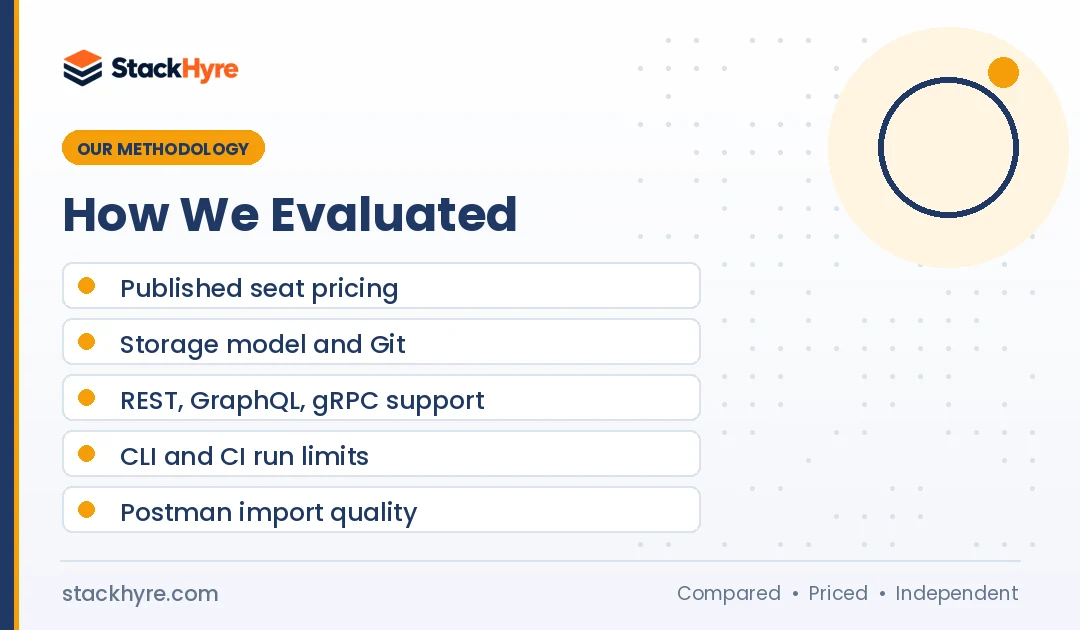
I did not run a benchmark for this guide. I compared each tool using published pricing, documentation and public code repositories, and I label vendor claims as the vendor’s. My editorial policy explains how I work.
- Pricing. I read every vendor’s pricing page in November 2026 and used only listed prices.
- Storage model. I checked whether collections live in a vendor cloud, on disk, in Git, or self-hosted.
- Protocols. I noted support for REST, GraphQL, gRPC and WebSocket.
- CI and CLI. I checked for a headless runner and limits on runs.
- Migration effort. I looked at Postman import support and how scripts carry over.
The Bottom Line
Bruno is my top Postman alternative for most developer teams. It keeps collections in Git, works offline and costs $6 per user on Pro. Insomnia is the easiest switch if your team likes Postman’s interface. Hoppscotch fits teams that want a self-hosted web client, and Thunder Client is great for VS Code users on a budget.
Export your Postman collections this week, import your hardest one into Bruno or Insomnia, and see what breaks.
Testing APIs is one line item. If you’re auditing the rest of the stack, see my picks for cheaper Twilio alternatives and the best Datadog alternatives for monitoring.
Frequently Asked Questions
What is the best free Postman alternative?
Bruno is the best free Postman alternative for most developers. Its open-source plan includes an unlimited collection runner, REST, GraphQL and gRPC support, and stores collections as files you commit to Git. Hoppscotch is a strong free choice if you want a web client, and Insomnia’s free plan includes Git Sync for up to 3 users.
Can I import Postman collections into Bruno or Insomnia?
Yes. Bruno, Insomnia, Hoppscotch, Thunder Client and Apidog all support importing Postman collections. Requests, folders and environments usually come across cleanly. Pre-request and test scripts often need manual fixes, because each tool has its own scripting functions. Test your most complex collection first before you move the whole team.
Is Postman still free in 2026?
Postman still has a Free plan, but its pricing page now lists it as 1 user, as of November 2026. Teams that share collections need the Team plan at $19 per user a month billed annually, or a cheaper alternative such as Bruno, Hoppscotch or Insomnia.
Which Postman alternative works offline?
Bruno works fully offline and needs no account, because it saves requests as files on your disk. Insomnia’s Scratch Pad is local only. The HTTPie CLI and curl also run without any cloud connection. These are good picks if your company restricts sending API data to third-party clouds.
Can I self-host a Postman alternative?
Yes. Hoppscotch offers a self-host option with setup docs on GitHub, so you can run the client inside your own network. Bruno doesn’t need hosting at all, since collections live in your Git repo. Self-hosting means you handle updates, backups and access control yourself.
Related Articles

The StackHyre Editorial Team writes about proxies, web scraping and email infrastructure. We compare providers using published pricing, official documentation and third-party reviews. All content is for educational and informational purposes only.