
TL;DR: The best Datadog alternatives in 2026 are Grafana Cloud for open standards and a generous free tier, New Relic for usage-based pricing with 100 GB free, and SigNoz for an open-source, OpenTelemetry-native stack you can self-host. Dynatrace suits enterprises that want automation, and Better Stack and Honeycomb fit smaller or tracing-focused teams. Paid plans start around $19 to $150 a month, as of November 2026.
Datadog is excellent. It’s also one of the easiest tools to overspend on.
Its pricing page lists Infrastructure Pro at $15 per host a month billed annually, or $18 on demand, as of November 2026. APM adds $31 per host on top. Logs cost $0.10 per GB to ingest, then $1.70 per million events to index on an annual plan.
Each line is reasonable. Together, across 50 hosts with APM and busy logs, they add up fast. And because each product bills on its own meter, the total is hard to predict.
That’s why so many teams look for a Datadog alternative. Some want lower cost. Others want open standards like OpenTelemetry so they’re never locked in again.
I compared 7 Datadog alternatives on pricing model, open-source options, OpenTelemetry support and migration effort. If you’re also reviewing other developer tools, see my guides to Twilio alternatives and Postman alternatives.
Quick Comparison: 7 Best Datadog Alternatives
| Tool | Best For | Starting Price | Pricing Model |
|---|---|---|---|
| Grafana Cloud | Open standards, big free tier | Free; Pro $19/mo platform fee | Per series and per GB |
| New Relic | All-in-one, usage-based | Free with 100 GB/mo | Per GB plus per user |
| SigNoz | Open-source, OpenTelemetry-native | Free self-host; Cloud $49/mo | Per GB and per sample |
| Dynatrace | Enterprise automation | $29/host/mo infrastructure | Per host hour or GiB hour |
| Better Stack | Small teams, logs plus uptime | Free tier | Per GB plus per responder |
| Honeycomb | Tracing and debugging | Free up to 20M events | Per event |
| Elastic Observability | Teams already on Elasticsearch | Check pricing | Resource or usage based |

What Makes a Good Datadog Alternative?
A good Datadog alternative covers the signals you actually use, usually metrics, logs and traces, at a cost you can predict. Look for OpenTelemetry support so you can switch again later, a pricing model that matches how your system grows, solid dashboards and alerting, and a self-hosted or open-source path if data control matters.
Here’s what I’d weigh.
Pricing model. Datadog bills mostly per host plus per GB and per event. Grafana bills per active metric series and per GB. New Relic bills per GB plus per user. Honeycomb bills per event. The cheapest model depends on your shape: many small containers, a few big hosts, or a flood of logs.
OpenTelemetry. OpenTelemetry is the open standard for traces, metrics and logs. If you instrument with it, you can send data to any backend that accepts OTLP. That’s the single best defense against lock-in.
What you’ll lose. Datadog has hundreds of integrations and polished features like security monitoring. List the ones you rely on before you move.
Who runs it. Self-hosting saves license cost but adds storage, upgrades and on-call work for your team.
Best Datadog Alternatives for Open Standards and Lower Cost
#1 Grafana Cloud: Best for open standards and a generous free tier
Grafana Cloud is the managed version of the open-source LGTM stack: Loki for logs, Grafana for dashboards, Tempo for traces and Mimir for metrics.
What it does well. Everything is built on open-source projects and open protocols. If you ever leave the cloud service, you can run the same stack yourself. Grafana dashboards are the de facto standard many teams already know.
Key features:
- Metrics, logs, traces and profiles in one place
- Prometheus and OpenTelemetry compatible
- Same stack available as open source on GitHub
- Automatic volume discounts at scale
Pricing. Grafana’s pricing page lists a free tier with 10k active metric series, 50 GB of logs and 50 GB of traces a month, each kept 14 days, as of November 2026. Pro has a $19 a month platform fee. Metrics start at $6.50 per 1k series. Logs and traces are split into process ($0.05 per GB), write ($0.40 per GB) and retain ($0.10 per GB) charges.
Best for: Teams that want open standards, already use Prometheus, or want a big free tier to start.
Limitations. Metric cardinality can surprise you. One label with many values can multiply active series and your bill. You’ll also build more dashboards yourself than in Datadog.
#2 SigNoz: Best open-source, OpenTelemetry-native option
SigNoz is the closest thing to an open-source Datadog in one app.
What it does well. It puts metrics, logs and traces in one UI, built natively on OpenTelemetry. You can self-host the open-source edition for free, or use SigNoz Cloud.
Key features:
- APM, logs, metrics, traces and alerts in one product
- OpenTelemetry-native ingestion
- Self-hosted Community edition at no license cost
- Simple usage pricing on Cloud with no per-host fee
Pricing. The SigNoz pricing page lists Cloud Teams from $49 a month, which includes $49 of usage, as of November 2026. Logs and traces are $0.30 per GB ingested, and metrics are $0.10 per million samples. Eligible startups pay $19 a month for the first 12 months. Enterprise starts at $4,000 a month.
Best for: Teams moving to OpenTelemetry that want one app and the option to self-host.
Limitations. The integration catalog is far smaller than Datadog’s. Self-hosting at scale means running and tuning its storage backend yourself.
#3 New Relic: Best all-in-one with usage-based pricing
New Relic is the most direct full-platform swap for Datadog, with a very different bill.
What it does well. You pay for data ingested and for users, not for hosts. So adding hosts doesn’t raise the bill by itself. The free tier is large enough for real small-team use.
Key features:
- APM, infrastructure, logs, browser and mobile monitoring
- Free tier with 100 GB a month and one full platform user
- Unlimited basic users at no cost
- OpenTelemetry ingestion supported
Pricing. New Relic’s pricing page lists 100 GB a month free, then $0.40 per GB on the original data option, or $0.60 per GB for Data Plus, as of November 2026. Core users are $49 a month. Full platform users on Standard are $10 for the first and $99 for each extra, up to 5. On Pro, a full platform user is $349 a month on an annual commitment.
Best for: Teams with many hosts but few engineers who need full platform access.
Limitations. Full platform seats get expensive on Pro. If your whole team needs full access, the per-user line can outgrow the data bill.
Best Datadog Alternatives for Enterprise Teams
#4 Dynatrace: Best for enterprise automation
Dynatrace competes with Datadog at the top of the market, with a heavy focus on automatic discovery and AI-driven root cause.
What it does well. Its OneAgent auto-instruments hosts and services, and its Davis AI engine groups related problems. For big, complex estates, that cuts setup work.
Key features:
- Full-stack monitoring with automatic instrumentation
- Infrastructure, application, log and user monitoring
- Hourly billing by host or by memory
Pricing. Dynatrace’s pricing page lists Full-Stack Monitoring at $58 a month per 8 GiB host, billed at $0.01 per memory GiB hour, as of November 2026. Infrastructure Monitoring is $29 a month per host, billed at $0.04 per hour. Log ingest and processing is $0.20 per GiB.
Best for: Large enterprises that value automation over hand-built dashboards.
Limitations. It’s rarely cheaper than Datadog for small teams. Memory-based billing means large hosts cost more.
#5 Elastic Observability: Best if you already run Elasticsearch
Elastic makes sense when your logs already live in Elasticsearch.
What it does well. Search over logs is its home turf. You get APM, metrics and logs on the same Elastic stack, hosted or self-managed.
Key features:
- Strong full-text log search and analytics
- APM and infrastructure monitoring on the same stack
- Hosted, serverless or self-managed options
Pricing. Elastic’s pricing page lists hosted as resource based and serverless as usage based, with details on separate pages. Check the current numbers there before you compare.
Best for: Teams with Elasticsearch skills or an existing ELK setup.
Limitations. Running Elasticsearch yourself is real work. Sizing clusters takes practice.
Best Datadog Alternatives for Small Teams and Debugging
#6 Better Stack: Best for small teams that want logs plus uptime
Better Stack bundles logs, metrics, uptime monitoring and incident management at small-team prices.
What it does well. You get status pages, on-call and log search in one tool. The free tier is enough for a side project.
Key features:
- Uptime monitors, heartbeats and status pages
- Logs, traces and metrics with SQL-style querying
- On-call scheduling and incident alerts
Pricing. Better Stack’s pricing page lists a free tier with 10 monitors, 1 status page, 3 GB each of logs and traces kept 3 days, and 30 GB of metrics, as of November 2026. Responder licenses are $29 a month on the annual plan or $34 monthly. Telemetry is billed per GB, with several rate columns on the page, so check which applies to your plan.
Best for: Startups that want monitoring, logs and on-call without three vendors.
Limitations. APM depth is lighter than Datadog or New Relic. Big enterprises may outgrow it.
#7 Honeycomb: Best for tracing and debugging production
Honeycomb is built for one job: figuring out why production is slow or broken.
What it does well. It handles high-cardinality data well, so you can slice traces by user ID, build or any field you send. It’s a strong match for OpenTelemetry tracing.
Key features:
- Fast queries over high-cardinality event data
- BubbleUp to spot what’s different about slow requests
- Event-based pricing with no per-host fee
Pricing. Honeycomb’s pricing page lists a free plan up to 20M events a month, and Pro starting at $150 a month for 50M events, up to 750M, as of November 2026.
Best for: Engineering teams that debug distributed systems with traces.
Limitations. It’s not a full infrastructure monitoring suite. Many teams pair it with Grafana or Prometheus for metrics.
How Do Datadog Alternatives Compare on Price?
The models differ too much for one fair number, so compare the unit you grow by. If you add hosts, per-host pricing from Datadog and Dynatrace hurts most. If you add log volume, per GB pricing matters. If you add engineers, New Relic’s per-user pricing matters. Pick the model that grows slowest for you.
| Tool | Host or Base Fee | Logs | Free Tier |
|---|---|---|---|
| Datadog | $15/host/mo (Infra Pro, annual) | $0.10/GB ingest plus $1.70/M events indexed | Check pricing page |
| Grafana Cloud | $19/mo platform fee | $0.05 process, $0.40 write, $0.10 retain per GB | 50 GB logs, 10k series |
| New Relic | No host fee; users from $10 | $0.40/GB after 100 GB | 100 GB/mo |
| SigNoz Cloud | $49/mo including usage | $0.30/GB | Self-host free |
| Dynatrace | $29/host/mo infrastructure | $0.20/GiB ingest | Trial |
| Honeycomb | Pro from $150/mo | Per event | 20M events/mo |
All prices are from each vendor’s pricing page as of November 2026. Check Datadog’s pricing page for its current free tier details.

How Should You Choose the Right Datadog Alternative?
Start from what’s driving your Datadog bill. If it’s hosts, look at New Relic, Grafana Cloud or SigNoz, which don’t charge per host. If it’s logs, compare per GB ingest and retention. If it’s lock-in, move to OpenTelemetry first and pick any backend that accepts OTLP. Enterprises wanting automation should trial Dynatrace.
Then plan the migration in steps.
1. Read your Datadog usage page. Find which products and meters cost the most. That’s where a switch saves money.
2. Instrument with OpenTelemetry. Replace Datadog-specific tracing libraries with OpenTelemetry SDKs. You can still send to Datadog during the move, so nothing breaks.
3. Run the OpenTelemetry Collector. The Collector can send the same data to two backends at once. Dual-ship for a few weeks and compare.
4. Rebuild your top dashboards and alerts. Don’t port everything. Rebuild the 10 dashboards and alerts people actually use, and drop the rest.
5. Cut log noise. Drop debug logs and sample high-volume traces at the Collector. This lowers the bill on any vendor.
6. Decide on self-hosting honestly. Self-hosting Grafana or SigNoz saves license cost, but someone must own storage, upgrades and on-call. Price that time in.
How I Evaluated These Datadog Alternatives
I did not run a load test or benchmark for this guide. I compared each tool using published pricing pages, product docs and public repositories, and I label vendor claims as the vendor’s. My editorial policy has more detail.
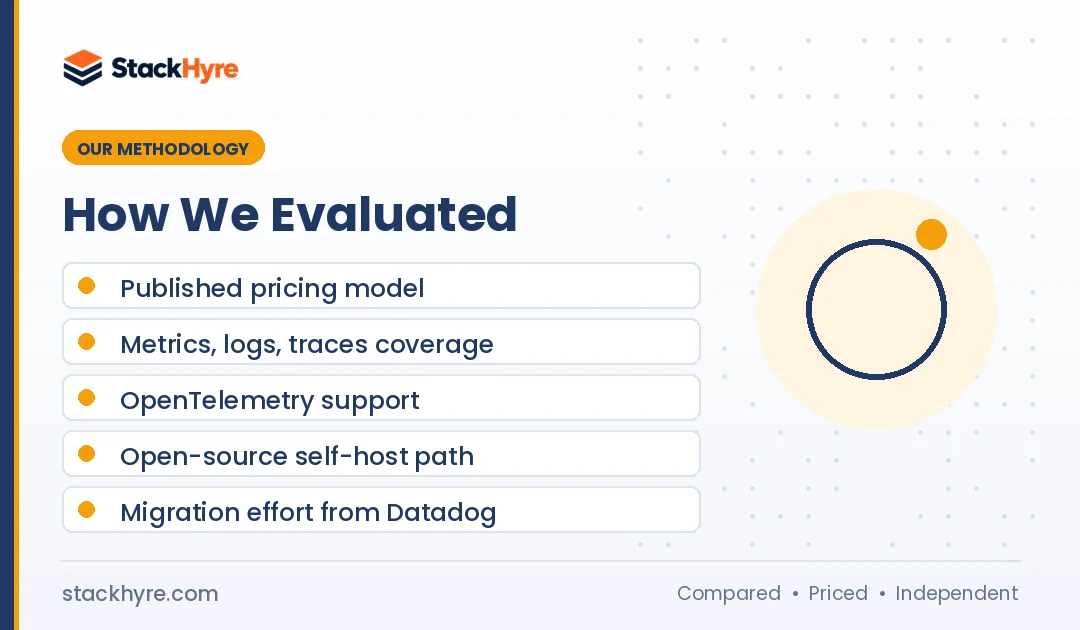
- Pricing model. I read each pricing page in November 2026 and noted the unit each tool bills by.
- Signal coverage. I checked support for metrics, logs, traces and alerting.
- Open standards. I checked OpenTelemetry and Prometheus support.
- Self-host path. I noted which tools have an open-source edition.
- Migration effort. I looked at what you’d need to rebuild coming from Datadog.
The Bottom Line
For most teams leaving Datadog, Grafana Cloud is my first pick. It’s built on open standards, has a big free tier and starts at $19 a month. SigNoz is the best open-source, all-in-one option, and New Relic fits teams with many hosts and few full users. Dynatrace suits large enterprises, Better Stack suits small teams, and Honeycomb is the tracing specialist.
Whatever you pick, instrument with OpenTelemetry first. Then dual-ship data for two weeks and compare before you cancel.
For the rest of your stack, see my picks for Postman alternatives for API testing and Twilio alternatives for SMS and voice.
Frequently Asked Questions
What is the cheapest Datadog alternative?
Self-hosted SigNoz or the open-source Grafana stack have no license cost, but you pay for servers and engineering time. For a managed service, Grafana Cloud and New Relic both have large free tiers: Grafana includes 50 GB of logs a month and New Relic includes 100 GB of data. Grafana Cloud Pro starts at a $19 monthly platform fee.
Is there an open-source alternative to Datadog?
Yes. SigNoz is an open-source, OpenTelemetry-native platform with metrics, logs and traces in one app. The Grafana stack, with Prometheus or Mimir, Loki and Tempo, is another popular choice. Both can be self-hosted for free, but you take on the work of running storage, upgrades and alerting.
How hard is it to migrate off Datadog?
It depends on how much you use Datadog-specific agents and libraries. The safest path is to switch instrumentation to OpenTelemetry, then use the OpenTelemetry Collector to send data to Datadog and the new tool at the same time. Rebuild your most used dashboards and alerts, compare for a few weeks, then cut over.
Why is Datadog so expensive?
Datadog bills each product separately, so costs stack up. Infrastructure Pro is $15 per host a month on annual billing, APM adds $31 per host, and logs cost $0.10 per GB to ingest plus $1.70 per million events to index. Growing hosts, containers and log volume all raise the bill at once.
Which Datadog alternative is best for Kubernetes?
Grafana Cloud is a strong fit because Kubernetes teams often already use Prometheus metrics, which Grafana supports natively. SigNoz and New Relic also work well with OpenTelemetry on Kubernetes. Watch metric cardinality in any tool, because pod and container labels can multiply your series count and cost.
Related Articles

The StackHyre Editorial Team writes about proxies, web scraping and email infrastructure. We compare providers using published pricing, official documentation and third-party reviews. All content is for educational and informational purposes only.