
TL;DR: The best Twilio alternatives in 2026 are Telnyx for the lowest published SMS rate on its own network, Plivo for an easy API swap, and Bandwidth for US carrier-grade voice and SMS. Bird is the budget pick for sending, while Sinch, Vonage and Infobip suit global and enterprise teams. US SMS base rates run about $0.0035 to $0.0083 per segment before carrier fees, as of November 2026.
Twilio is still the default for SMS and voice APIs. But the bill adds up faster than most teams expect.
Twilio’s US SMS pricing page lists $0.0083 per outbound segment as of November 2026. Carrier fees sit on top of that. Verizon alone adds $0.005 per outbound message, and Twilio now charges $0.001 for each message that ends in a failed status.
So a message you think costs under a cent can land closer to 1.3 cents. At a million messages a month, that gap is real money.
I compared 7 Twilio alternatives on published pricing, SDKs, number costs and how hard the switch is. If you also run API testing or monitoring in the same stack, my guides to Postman alternatives and Datadog alternatives cover those tools the same way.
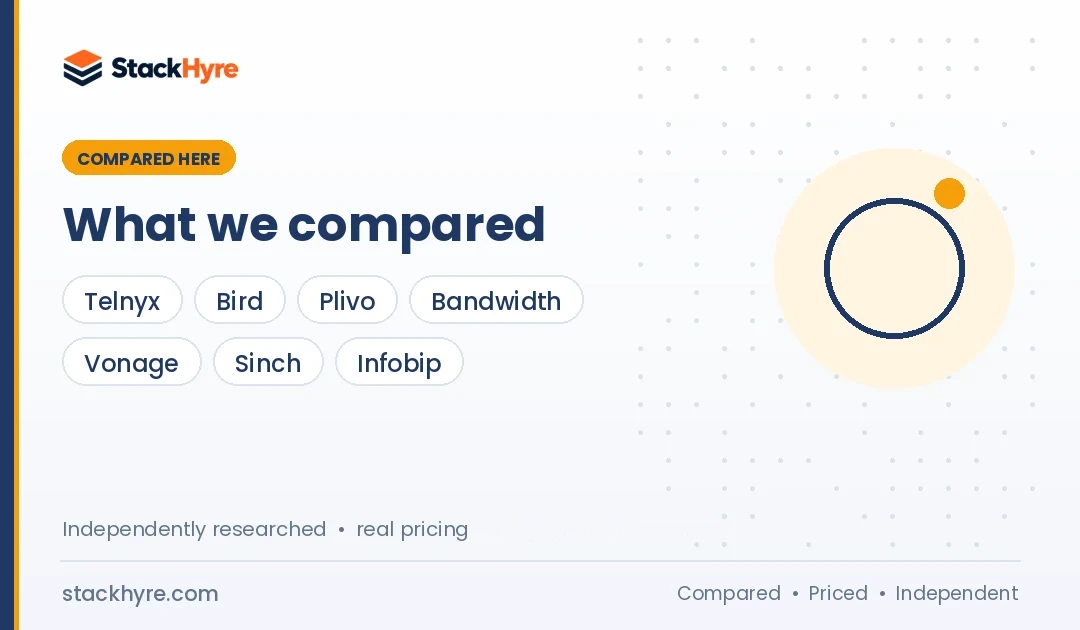
Quick Comparison: 7 Best Twilio Alternatives
| Provider | Best For | US SMS Base Rate | Key Feature |
|---|---|---|---|
| Telnyx | Lowest cost on an owned network | $0.004 per part (local) | Carrier fees passed through at cost |
| Plivo | Simple API swap from Twilio | $0.0077 per message | $0.50/mo long code numbers |
| Bandwidth | US voice and SMS at scale | $0.004 per 10DLC message | Owns its US network |
| Bird | Cheap outbound sending | $0.0035 per segment | $0.0010 inbound rate |
| Sinch | Global reach and operator ties | $0.0078 per message | Same rate in and out |
| Vonage | Voice plus video plus SMS | Check the rate sheet | Broad API catalog |
| Infobip | Enterprise omnichannel | Check the calculator | Per-network pricing in portal |
What Makes a Good Twilio Alternative?
A good Twilio alternative sends the same messages and calls for less money, without forcing a rewrite. Look for clear per-segment pricing, carrier fees shown up front, cheap phone numbers, solid SDKs in your language, and 10DLC registration help. Owned network infrastructure is a bonus, because it usually means better routing control and fewer middlemen taking a cut.
Here’s how I’d break that down.
Total cost per delivered message. Base rate is only half the story. Every US provider I checked passes through carrier fees, and they look almost identical across vendors. So the base rate and number price are where you actually save.
API shape. Twilio’s API is the pattern most teams know. Plivo and Telnyx both use REST APIs with webhooks for delivery receipts, so the mental model carries over. You still change endpoints, auth and payload field names.
Compliance help. US A2P 10DLC registration is mandatory for business texting on local numbers. A provider that walks you through brand and campaign registration saves you weeks.
Voice quality and coverage. If you run calls too, check where the provider owns its network and where it resells someone else’s.
Best Twilio Alternatives for Lower Messaging Costs
#1 Telnyx: Best for the lowest cost on an owned network
Telnyx is the pick I’d look at first if your main complaint about Twilio is price.
What it does well. Telnyx publishes a simple message: $0.004 a part, then carrier fees at cost. That’s less than half of Twilio’s base rate. It also runs its own private network and offers voice, SIP trunking, IoT SIMs and number porting under one account.
Key features:
- Messaging, voice, SIP trunking and wireless from one API
- Server SDKs for the common languages
- A public pricing API, so you can pull rates into your own cost models
- Automatic volume discounts at higher message counts
Pricing. Telnyx lists US SMS at $0.004 per part for local senders, $0.0055 for toll-free and $0.007 for short code, plus carrier fees, as of November 2026. Numbers are $1.00 per month. Its own example puts 1,000,000 parts at $7,800 a month including a blended carrier passthrough of $0.0038.
Best for: High-volume SMS senders and teams that want voice and messaging on one owned network.
Limitations. The portal has more knobs than Twilio’s, which can slow a small team down at first. Docs are good but the community around them is smaller, so you’ll find fewer Stack Overflow answers.
#2 Bird: Best for cheap outbound sending
Bird, the company formerly known as MessageBird, has the lowest base sending rate I found.
What it does well. Bird’s US SMS pricing page lists $0.0035 per segment to send on long code and toll-free, and $0.0010 to receive. No monthly plan is required at those pay-as-you-go rates.
Key features:
- SMS, WhatsApp, email and other channels in one platform
- Pay-as-you-go pricing with no monthly plan required
- Published 10DLC fees, so you can budget registration up front
Pricing. As of November 2026, Bird charges $0.0035 per outbound segment on long code and toll-free, $0.0070 on short code, and $0.0010 inbound. Carrier fees are extra. Bird lists 10DLC brand registration at $4.50, campaign vetting at $15.00, and campaign subscriptions from $1.50 to $30.00 per month. Number rental is billed separately.
Best for: Outbound-heavy use cases like alerts, OTP codes and notifications where cost per send matters most.
Limitations. Bird is built as a broad customer messaging platform, so the developer experience is less focused than Telnyx or Plivo. Voice is not its core strength.
#3 Plivo: Best for a simple swap from Twilio
Plivo feels the most like Twilio to work with, which makes it the easiest migration on this list.
What it does well. The API concepts map closely: you send a message with a POST, get delivery receipts by webhook, and control calls with XML responses. Its number pricing is also cheap.
Key features:
- SMS, MMS, voice and verify APIs
- Server SDKs for the common languages
- XML call control similar in spirit to TwiML
- Long code numbers at $0.50 per month
Pricing. Plivo’s US SMS pricing page lists $0.0077 per message for long codes and short codes, and $0.0079 for toll-free, as of November 2026. The same rate applies in and out. Long code numbers are $0.50 a month, toll-free $1.00, and a short code costs $500 a month plus a $1,500 one-time fee. Carrier surcharges are added on top.
Best for: Teams that want to leave Twilio fast with minimal code changes and lower number costs.
Limitations. The per-message saving over Twilio is small. If you send millions of messages, Telnyx or Bandwidth will usually save more.
Best Twilio Alternatives for Voice and US Scale
#4 Bandwidth: Best for US voice and SMS at scale
Bandwidth runs its own US network, and that’s the whole pitch.
What it does well. Owning the network means Bandwidth controls routing for voice and messaging in the US. Its published 10DLC rate is also low.
Key features:
- Voice, messaging, 911 and number APIs
- Owned US network for routing control
- Low published 10DLC and voice rates
Pricing. Bandwidth’s pricing page lists outbound SMS at $0.004 for US 10DLC, $0.007 for toll-free and $0.008 for short code, as of November 2026. US local voice is $0.0100 per minute outbound and $0.0055 inbound. Number pricing is on request, and taxes and fees are extra.
Best for: US-focused companies with real voice volume, like contact centers and calling apps.
Limitations. Bandwidth is sales-led. Full pricing needs a quote, and the self-serve experience is thinner than Twilio’s. International coverage is not its focus.
#5 Vonage: Best for voice, video and SMS together
Vonage, now part of Ericsson, covers the widest mix of communication APIs after Twilio.
What it does well. You get SMS, voice, video, verify and messaging channels in one catalog. If you need video calls in your app plus SMS alerts, Vonage covers both without a second vendor.
Key features:
- SMS, Voice, Video, Verify and Messages APIs
- Server SDKs for the common languages
- Add-ons such as an audit API and auto-redaction
Pricing. The Vonage SMS pricing page did not show a US per-message rate when I checked in November 2026. It points to a downloadable global price sheet and your dashboard. Add-ons are listed: the Audit API at $550 a month and Auto-redact at $1,100 a month. Check the current rate sheet before you model costs.
Best for: Product teams that need video and voice inside an app, not only texting.
Limitations. Pricing is harder to see than Telnyx, Plivo or Bird. That makes quick cost comparisons slower.
Best Twilio Alternatives for Global and Enterprise Teams
#6 Sinch: Best for global reach
Sinch is one of the largest messaging providers by operator connections, which matters if you text across many countries.
What it does well. Sinch has direct ties with carriers in many markets and covers SMS, voice, verification and email. It also owns Mailgun after its Pathwire acquisition, so you can keep messaging and email under one company.
Key features:
- SMS, voice, verification and conversation APIs
- Same published rate for inbound and outbound
- Email through Mailgun in the same group
Pricing. Sinch’s SMS pricing page lists $0.0078 per message in and out for 10DLC and toll-free, and $0.009 for short code, as of November 2026. Carrier fees apply. Sinch says it updates prices at midnight UTC.
Best for: Companies texting users in many countries that want one vendor for global routes.
Limitations. US rates are close to Twilio’s, so you switch for reach, not savings. The product line is large and the docs are spread across several brands.
#7 Infobip: Best for enterprise omnichannel
Infobip is the enterprise choice when SMS is one channel among many.
What it does well. Infobip bundles SMS, WhatsApp, RCS, voice, email and customer engagement tools. Large brands use it to run messaging across regions with one contract.
Key features:
- SMS, WhatsApp, RCS, voice and email channels
- Per-network pricing visible in the portal
- A free trial to test sending
Pricing. Infobip’s SMS pricing calculator shows an average price per country based on network and volume. It did not display a fixed US rate on the page itself in November 2026. Pick the United States in the calculator, or check per-network rates in the portal.
Best for: Enterprises that want one vendor for many channels and regions.
Limitations. It’s overkill for a startup sending OTP codes. Expect a sales process for anything beyond the trial.
How Much Can You Actually Save Over Twilio?
On US SMS, the saving comes from the base rate, not carrier fees. Carrier fees from AT&T, T-Mobile and Verizon look nearly the same at every provider I checked. Twilio’s base is $0.0083 per segment, while Telnyx and Bandwidth list $0.004 and Bird lists $0.0035. That’s roughly half the base cost.
Here’s a simple way to see it. These are base rates only, before carrier fees, from each vendor’s page as of November 2026.
| Provider | Base per outbound SMS | Base cost for 1M messages | Local number per month |
|---|---|---|---|
| Twilio | $0.0083 | $8,300 | $1.15 |
| Plivo | $0.0077 | $7,700 | $0.50 |
| Sinch | $0.0078 | $7,800 | Check pricing |
| Telnyx | $0.004 | $4,000 | $1.00 |
| Bandwidth | $0.004 | $4,000 | On request |
| Bird | $0.0035 | $3,500 | Billed separately |
Twilio’s local number price comes from its US voice pricing page, which lists $1.15 per month and outbound local calls at $0.0140 per minute.
Carrier fees then add a similar amount everywhere. Twilio lists AT&T at $0.0035, T-Mobile at $0.0045 and Verizon at $0.005 per outbound SMS. Plivo and Telnyx list nearly the same figures.
My take: if you send under 50,000 messages a month, the saving is small and switching costs more in engineering time. Above a few hundred thousand, it’s worth a serious look.

How Should You Choose the Right Twilio Alternative?
Pick based on what you send, where you send it and how much engineering time you can spend. Outbound alerts in the US point to Telnyx, Bird or Bandwidth. A quick, low-risk move points to Plivo. Global texting points to Sinch or Infobip. In-app video and voice point to Vonage.
Then work through these checks.
1. Map your Twilio usage. List every product you use: Programmable SMS, Voice, Verify, Conversations, Studio. Twilio Studio flows and Conversations have no one-to-one copy elsewhere, so they take the most work to move.
2. Plan 10DLC re-registration. Your brand and campaigns are registered through your provider. Moving means registering again with the new one, and approval can take time. Budget for the new provider’s fees too.
3. Port numbers carefully. Port a few test numbers first. Keep Twilio live until the new provider confirms delivery on real traffic.
4. Wrap your provider. Put SMS and voice calls behind one internal interface. Then you can send a share of traffic to the new vendor and roll back in minutes if delivery drops.
5. Compare delivery, not only price. Watch delivery receipts by carrier for a few weeks. A cheaper route that drops messages costs you more in support tickets.
6. Check the SDK. Make sure there’s a maintained server SDK for your language and webhook signature checks for inbound traffic.
How I Evaluated These Twilio Alternatives
I did not run send tests or buy numbers for this guide. I compared each provider using published information, and I note where a vendor makes a claim about itself. You can read more in my editorial policy.
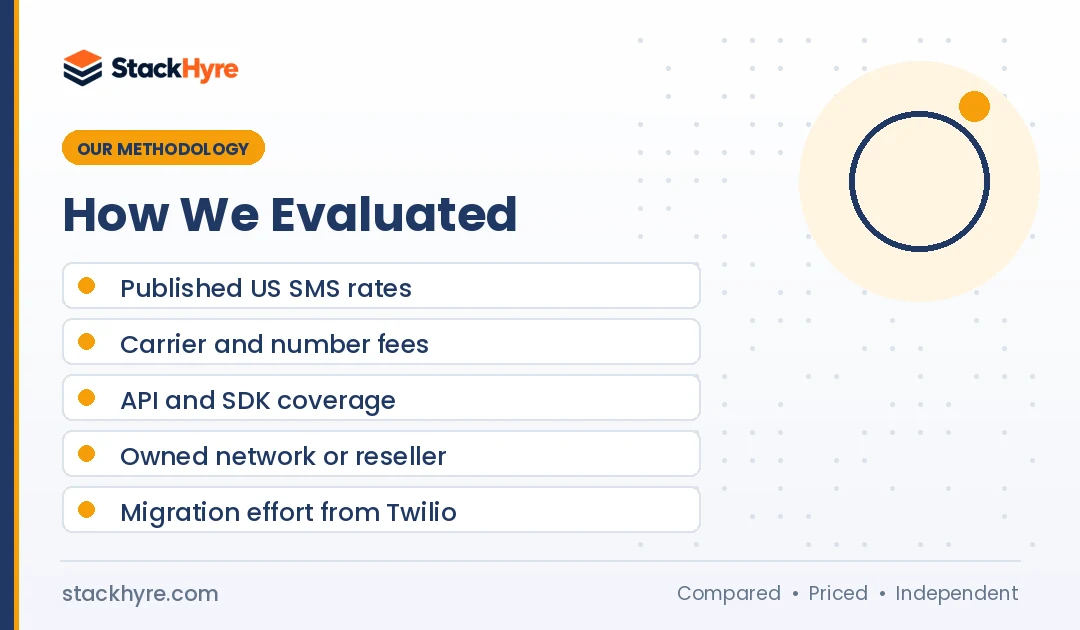
- Published pricing. I read each vendor’s US SMS pricing page in November 2026 and used only the rates shown there.
- Total cost. I checked carrier fees, number rental, failed message fees and 10DLC fees where listed.
- API and SDKs. I read the API docs for request style, webhooks and SDK coverage.
- Network. I noted which providers say they run their own network.
- Migration effort. I looked at how closely each API maps to Twilio’s model.
Where a vendor did not publish a price, I say so and link the pricing page instead of guessing.
The Bottom Line
If your Twilio bill is the problem, Telnyx is my first pick. It cuts the US base SMS rate roughly in half and runs on its own network. Bird is even cheaper for outbound-only sending. Plivo is the safest move if you want to switch fast with few code changes. Bandwidth wins for US voice at scale, and Sinch or Infobip fit global and enterprise needs.
Start by wrapping your SMS calls behind one interface. Then send 10% of traffic to the new provider and compare delivery for two weeks.
If you’re reviewing the rest of your developer stack, see my picks for cheaper Datadog alternatives and the best Postman alternatives for API testing.
Frequently Asked Questions
What is the cheapest Twilio alternative for SMS?
Based on published US rates in November 2026, Bird lists the lowest base outbound rate at $0.0035 per segment. Telnyx and Bandwidth follow at $0.004. All three add carrier fees on top, which are similar across providers. For a mix of low cost and strong developer tools, Telnyx is the one I’d look at first.
Is it hard to migrate from Twilio?
Basic SMS and voice are usually a few days of work, because most providers use similar REST APIs and webhooks. The slow parts are 10DLC re-registration, porting numbers and replacing Twilio Studio flows or Conversations. Wrap your provider calls behind one interface so you can shift traffic gradually and roll back if delivery drops.
Do Twilio alternatives charge carrier fees too?
Yes. US carriers such as AT&T, T-Mobile and Verizon charge per-message fees for A2P traffic, and every provider passes them through. The amounts on Twilio, Plivo and Telnyx pricing pages are nearly the same. Your real saving comes from the provider’s base rate and phone number price, not from carrier fees.
Which Twilio alternative is best for voice calls?
Bandwidth is my pick for US voice at scale because it runs its own US network and lists local outbound calls at $0.0100 per minute. Telnyx is also strong, with voice and SIP trunking on its private network. Vonage fits if you need voice plus video inside your own app.
Do I need to re-register 10DLC when switching providers?
In most cases, yes. Your A2P 10DLC brand and campaigns are tied to the messaging provider that submitted them. When you move, the new provider will usually submit or transfer them, and you may pay new registration and vetting fees. Plan for approval time before you move live traffic.
Related Articles

The StackHyre Editorial Team writes about proxies, web scraping and email infrastructure. We compare providers using published pricing, official documentation and third-party reviews. All content is for educational and informational purposes only.