
TL;DR: DataImpulse is the cheapest way to start, at a flat $1/GB with a $5 entry. Its traffic never expires. Evomi wins on volume at $0.49/GB on its $49 plan, and Rayobyte drops to $0.70/GB from 1,000 GB. Below I compare 8 budget providers on real cost at 10, 100 and 1,000 GB. I also flag the pricing traps to avoid. Prices are as of October 2026.
Residential proxies have never been cheaper. Proxyway’s 2026 market research found per-GB rates fell by up to 75% between 2023 and 2025. In early 2026, prices stopped falling and started to climb again.
So timing and plan choice matter. The same report put the median price at $3.75/GB at 5 GB and $2.25/GB at 500 GB. Several providers on my list beat those numbers by a wide margin.
But the cheapest headline price isn’t always the cheapest bill. Traffic can expire. Targeting can cost extra. Some low-cost pools come from hijacked devices. In July 2026 the FBI seized hundreds of NetNut domains after researchers tied the service to a botnet.
I compared published pricing, billing rules and independent benchmark data to find options that are cheap and actually usable. For a full breakdown of how proxy pricing works across every type, see my proxy pricing guide. To weigh premium and budget providers together, start with my list of the best proxy providers.
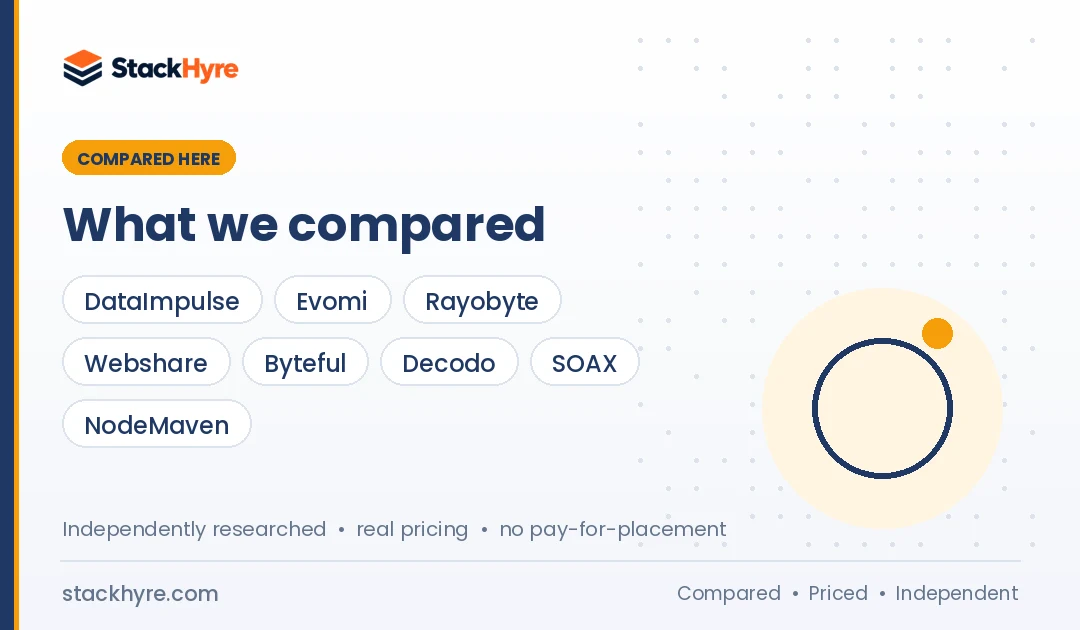
Quick Comparison: 8 Cheap Residential Proxies in 2026
| Provider | Best For | Starting Price | Key Feature |
|---|---|---|---|
| DataImpulse | Lowest entry cost | $5 for 5 GB ($1/GB) | Traffic never expires |
| Evomi | Lowest monthly volume price | $49 for 100 GB ($0.49/GB) | $0.99/GB pay as you go from 15 GB |
| Rayobyte | Cheapest at 1 TB+ | $3.50/GB, $0.70/GB from 1,000 GB | City, ZIP and ASN targeting on every tier |
| Webshare | Cheap self-serve plans | $3.50 for 1 GB | $1.40/GB at 3,000 GB |
| Byteful | Fast budget pool | $32.50 for 10 GB ($3.25/GB) | Fastest response in Proxyway’s 2026 test |
| Decodo | Premium quality on a budget | $11.25 for 3 GB ($3.75/GB) | 99.92% success rate in Proxyway’s test |
| SOAX | Low rates on committed spend | $1.50/GB on the $1,500 Scale plan | Advanced rotation rules |
| NodeMaven | Cheap test of clean IPs | $3.50 trial for 750 MB | Unused traffic rolls over |
What Makes a Residential Proxy Truly Cheap?
A residential proxy is truly cheap when each successful request costs little. The price per gigabyte is only part of it. That means a fair rate at your real volume and traffic that doesn’t expire. Targeting should be in the price. The success rate should be high enough that you rarely pay for failed requests. And ethical sourcing keeps a low price from turning into a risk.
Price at your volume. Most providers quote their lowest rate, which often needs 1,000 GB or more. If you use 20 GB a month, that rate means nothing to you. Look at the price for your actual tier.
Success rate. A failed request still burns bandwidth. Proxyway’s 2026 benchmark found a median success rate of 74.43% on hard targets like Amazon, Google and Instagram. A pool that fails more often costs more per useful page.
Expiry and minimums. Non-expiring traffic protects you if your usage swings month to month. Monthly plans with expiring credits only make sense if you use them fully.
Sourcing. Proxyway found grey-market storefronts selling botnet-sourced traffic for under $0.50/GB, some near $0.15/GB. Those IPs can vanish overnight and may expose you to legal risk. I’d stay away.
What Do Cheap Residential Proxies Actually Cost?
At 10 GB a month, cheap residential proxies cost about $10 to $50. At 100 GB, expect roughly $49 to $500. At 1,000 GB, prices range from about $490 to $2,000. The cheapest option changes with your volume, so price your real monthly usage before you pick a provider.
I worked out these totals from each provider’s published pricing as of October 2026. They exclude VAT and promo codes.
| Provider | 10 GB | 100 GB | 1,000 GB |
|---|---|---|---|
| DataImpulse | $10 | $100 | $800 |
| Evomi (Core) | $14.85 (15 GB minimum) | $49 | About $490 on the plan |
| Rayobyte | $35 | $200 | $700 |
| Webshare | $27.50 | $225 | $1,500 |
| Byteful | $32.50 | $275 | Custom quote |
| Decodo | $35 | $275 | $2,000 |
| SOAX | $50 (Sandbox) | $500 (Team) | $1,500 (Scale) |
NodeMaven isn’t in the table because it doesn’t publish every tier. Its lowest rate, about $2.20/GB, applies only on its largest plan.
Cheapest Residential Proxies for Small Budgets
#1 DataImpulse: Best for the Lowest Entry Cost
DataImpulse is the easiest way to buy residential traffic for a few dollars. If you’re just starting, this is my pick.
What it does well. DataImpulse’s residential page sells traffic at a flat $1/GB with no subscription and no monthly minimum. Unused gigabytes never expire. In Proxyway’s 2026 research, it scored a 99.74% success rate and the fastest response on hard targets.
Key features:
- 90M+ residential IPs in 195 countries, per DataImpulse
- No subscription and traffic that never expires
- HTTP(S) and SOCKS5 support
- 7-day refund policy
Pricing. As of October 2026, new customers can start with a $5 intro plan for 5 GB. The Basic plan costs $50 for 50 GB. The Advanced plan costs $800 for 1 TB, or $0.80/GB.
Best for: Hobby projects, small scrapers and anyone whose monthly usage jumps around.
Limitations. Country targeting is free, but the page marks some deeper targeting options with an “extra costs” note. Confirm what city or ASN targeting costs before you count on it. There’s no free trial.
#2 Webshare: Best for Cheap Self-Serve Plans
Webshare keeps prices low at every tier, from 1 GB up to 3 TB.
What it does well. Webshare’s residential page lists 80M+ IPs in 195 countries. Targeting goes down to city, ZIP and ASN. Proxyway measured a 99.28% success rate, right at the median.
Key features:
- Nine published tiers from 1 GB to 3,000 GB
- Country, state, city, ZIP and ASN targeting
- Free plan with 10 shared proxies to try the dashboard
- 99.97% uptime, per Webshare
Pricing. As of October 2026, Webshare charges $3.50 for 1 GB and $27.50 for 10 GB. The rate falls to $2.25/GB at 100 GB, $1.50/GB at 1,000 GB and $1.40/GB at 3,000 GB.
Best for: Developers who want a cheap monthly plan without talking to sales.
Limitations. The page shows big “savings” against struck-through prices. Compare the current price, not the discount. The residential page doesn’t say whether bandwidth expires.
#3 NodeMaven: Best for a Cheap Test of Clean IPs
NodeMaven isn’t the lowest price per GB. But its trial is a cheap way to try high-quality IPs.
What it does well. NodeMaven says its IP Quality Filter screens IPs in real time before you get them. Sticky sessions last up to 24 hours. Unused traffic rolls over, so you don’t lose what you paid for.
Key features:
- $3.50 paid trial with 750 MB
- Real-time IP quality screening
- Sticky sessions up to 24 hours
- Traffic rollover and cashback on used GB
Pricing. As of October 2026, NodeMaven’s pricing page lists the trial at $3.50. The smallest monthly plan costs $8.50 for 2 GB. Its lowest rate, about $2.20/GB, applies only on its largest plan.
Best for: Account managers who want clean IPs and a low-cost way to check them.
Limitations. Small plans cost around $4 or more per GB. NodeMaven wasn’t in Proxyway’s 2026 benchmark, so the quality figures are the vendor’s own.
Cheapest Residential Proxies at High Volume
#4 Evomi: Best for the Lowest Monthly Volume Price
Evomi has the lowest published per-GB rate I found on a self-serve plan.
What it does well. Evomi’s residential page sells Core Residential at $49 a month for 100 GB. Extra gigabytes cost $0.49 each. Pay-as-you-go traffic never expires.
Key features:
- 54M+ residential IPs in 195+ countries, per Evomi
- Monthly plan or pay as you go
- One-day trial on the plan card
- Premium pool with ISP-level targeting from $2.20/GB
Pricing. As of October 2026, Core Residential costs $0.49/GB on the $49, 100 GB plan. Pay as you go costs $0.99/GB from 15 GB and $0.79/GB from 1,000 GB.
Best for: Teams that use at least 100 GB every month.
Limitations. You need a 15 GB minimum on pay as you go and a 100 GB plan for the lowest rate. Refunds are capped at 10% of your allowance or 1 GB. Proxyway benchmarked Evomi’s Premium pool, not Core, so Core performance is less proven.
#5 Rayobyte: Best for 1 TB and Up
Rayobyte gets very cheap at scale, and you don’t need a subscription.
What it does well. Rayobyte’s residential page uses pay-as-you-go tiers that drop fast. City, ZIP and ASN targeting come with every tier, so you don’t pay extra for local data.
Key features:
- 50M+ opted-in devices each month, per Rayobyte
- 190+ countries with deep targeting included
- Sticky sessions up to 120 minutes
- Free trial with no credit card
Pricing. As of October 2026, Rayobyte charges $3.50/GB for 1 to 49 GB and $2.00/GB from 50 GB. The rate falls to $1.50/GB from 250 GB and $0.70/GB from 1,000 GB. Enterprise deals start from $0.50/GB.
Best for: High-volume scrapers who need local targeting.
Limitations. Proxyway measured a 98.02% success rate and a 1.86-second response time, the slowest in its residential test. Small buyers pay $3.50/GB, which isn’t cheap.
#6 SOAX: Best for Low Rates on Committed Spend
SOAX offers low rates, but only if you commit to a monthly spend and use it fast.
What it does well. SOAX’s pricing page uses one rate for residential and mobile traffic. Higher plans cut the price sharply. Proxyway measured a 99.78% success rate, well above the median.
Key features:
- One rate across residential and mobile
- Rotate per request, after N requests or on error
- Targeting by country, region, city, ISP and ASN
- Free Sandbox plan with no subscription fee
Pricing. As of October 2026, Tier 1 traffic costs $5/GB on Sandbox and $3.00/GB on the $200 Builder plan. Team ($500) cuts it to $2.20/GB, and Scale ($1,500) to $1.50/GB.
Best for: Teams with steady, predictable usage of 500 GB or more.
Limitations. Credits expire after 60 days on monthly plans. There’s no free trial. Small users pay $5/GB on Sandbox. Skip SOAX unless your volume is steady.
Best Budget Residential Proxies for Performance
#7 Byteful: Best for a Fast Budget Pool
Byteful is a newer provider that posted standout speed in independent tests.
What it does well. In Proxyway’s 2026 research, Byteful had the fastest global response time at 0.41 seconds. It also had the best success rate on hard targets at 81.23%. Byteful’s residential page says bandwidth never expires, even if you cancel.
Key features:
- 35M+ residential IPs in 195+ countries, per Byteful
- 1 GB free trial
- Country, region, city and ISP targeting on all plans
- Sticky sessions up to 24 hours
Pricing. As of October 2026, Byteful charges $3.25/GB for 10 GB ($32.50) and $3.00/GB for 25 GB. The 100 GB plan costs $2.75/GB. Larger volumes need a custom quote.
Best for: Budget buyers scraping hard targets where speed and success rate matter.
Limitations. Byteful’s per-GB rate is higher than DataImpulse or Evomi. It has a smaller pool than the big providers and no published price above 100 GB.
#8 Decodo: Best for Premium Quality on a Budget
Decodo isn’t the cheapest. But it’s the cheapest top-tier performer I found.
What it does well. Decodo scored a 99.92% success rate and a 0.53-second response time in Proxyway’s 2026 benchmark. That puts it near the top of the market at mid-market prices. Small plans start at just $11.25.
Key features:
- 115M+ IPs in 195+ locations, per Decodo
- Rotating and sticky sessions on every plan
- 3-day free trial with 100 MB
- Pay-as-you-go option at $4/GB
Pricing. As of October 2026, Decodo’s residential pricing starts at $3.75/GB for 3 GB. It drops to $2.75/GB at 100 GB and $2.00/GB at 1,000 GB.
Best for: Budget-minded teams that can’t afford many failed requests.
Limitations. At 1 TB, Decodo costs more than twice Rayobyte’s rate. Sticky sessions last up to 30 minutes. Read my full Decodo review for the details.

How Should You Choose a Cheap Residential Proxy?
Estimate your monthly gigabytes first, then price that exact volume at each provider. Favor non-expiring traffic if your usage varies. Check what targeting costs and how the provider sources its IPs. Then run a small trial to measure your cost per successful request. That’s how I’d pick a cheap residential proxy.
Estimate your volume. A small scraper that pulls text pages uses far less than a crawler that loads images and scripts. Your volume decides which provider is cheapest, as the cost table above shows.
Watch for expiring credits. SOAX credits expire after 60 days. DataImpulse, IPRoyal, Byteful and Evomi pay-as-you-go traffic don’t expire. If your usage is spiky, non-expiring traffic saves money.
Check for promo pricing. Some providers show prices against struck-through “regular” rates. Bright Data’s current residential rate, for example, is a 50% promo that runs for three months. Budget for the price after the promo ends.
Avoid grey-market pools. If a price is far below $0.50/GB, ask how the IPs are sourced. Google’s Threat Intelligence Group found one large network built through hidden app SDKs and trojanized apps. Google advises that providers should offer auditable proof of user consent.
Try before you scale. Use a free or paid trial on your real targets. My list of proxy free trials shows which providers let you try for free. For a full checklist, read my guide on how to choose a proxy provider.
Ask if you need residential at all. Plenty of easy targets work fine with datacenter IPs at a fraction of the cost. My list of the best datacenter proxies covers that cheaper route.
How I Evaluated These Cheap Residential Proxies
I didn’t run my own speed tests. I compared each provider’s published pricing, billing rules and docs as of October 2026. I used Proxyway’s Proxy Market Research 2026 as my main source for independent performance data.
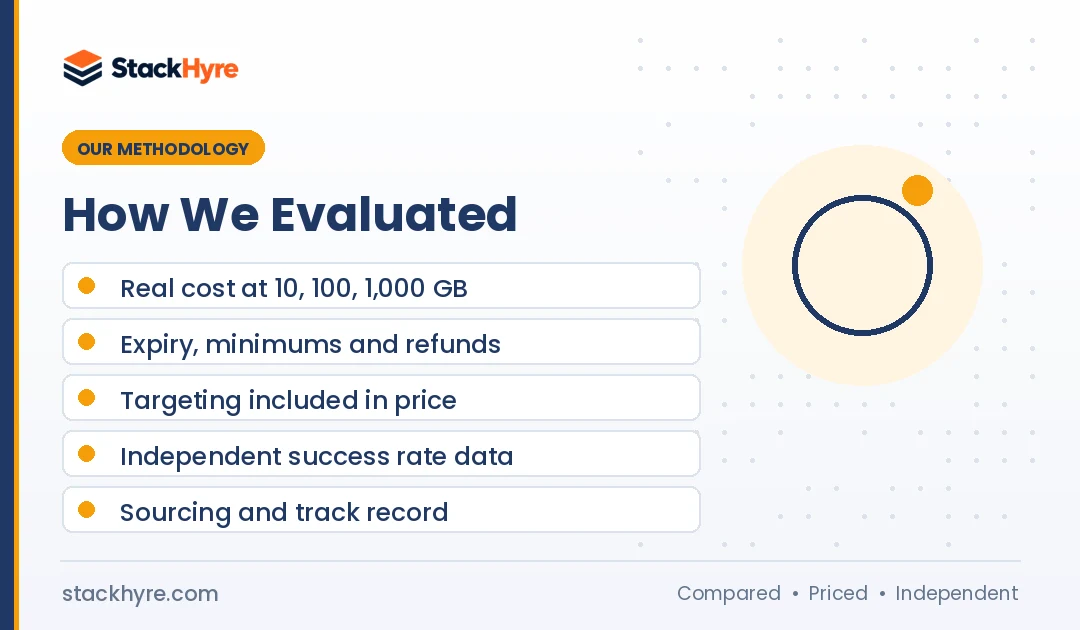
I scored each provider on five factors:
- Real cost at 10, 100 and 1,000 GB
- Billing fairness, including expiry, minimums and refunds
- Targeting included in the base price
- Independent performance such as success rate and speed
- Sourcing and trust, including consent claims and company track record
I left out NetNut because its domains were seized in July 2026. I also skipped storefronts that don’t explain how they source IPs. Pool sizes come from vendors unless I name an independent source.
The Bottom Line
DataImpulse is my pick for small budgets. You can start with $5, pay $1/GB and keep unused traffic forever. Evomi is cheapest if you use 100 GB or more each month, at $0.49/GB on its $49 plan. Rayobyte is the best deal at 1 TB and up, with deep targeting included.
If you scrape hard targets, a slightly higher price can be cheaper per successful request. Byteful and Decodo both score near the top of independent benchmarks.
Price your real monthly volume, check expiry rules, and run a trial before you commit. For a deeper look at what proxies cost across every type, read my proxy pricing guide. To compare premium picks, see my list of the best residential proxies.

Frequently Asked Questions
What is the cheapest residential proxy in 2026?
As of October 2026, Evomi has the lowest published self-serve rate: $0.49/GB on its $49, 100 GB plan. For small buyers, DataImpulse is cheapest to start, at $5 for 5 GB with no subscription. At 1 TB and above, Rayobyte charges $0.70/GB on pay as you go. The cheapest choice depends on your monthly volume.
Are cheap residential proxies safe to use?
Cheap residential proxies can be safe if the provider explains how it sources IPs and gets user consent. Be careful with prices far below $0.50/GB. Proxyway found grey-market sellers offering botnet-sourced traffic near $0.15/GB. Those pools can disappear suddenly and may expose you to legal risk. Pick providers with clear policies and a track record.
Do cheap residential proxies work for web scraping?
Yes, many cheap residential proxies work well for scraping. In Proxyway’s 2026 tests, DataImpulse scored a 99.74% success rate at $1/GB. Byteful had the best success rate on hard targets like Amazon and Google. Results vary by target, so try them on your own sites. Track cost per successful request, not only price per GB.
Does residential proxy traffic expire?
It depends on the provider. DataImpulse, IPRoyal and Byteful say their traffic never expires. Evomi’s pay-as-you-go traffic also doesn’t expire. SOAX credits expire after 60 days on monthly plans. Check the expiry rule before you buy a large plan. Unused traffic can wipe out a low per-GB price.
How much residential proxy bandwidth do I need?
It depends on page size and request volume. A text-only page uses far less data than a full page with images, video and scripts. Blocking images in your scraper can cut usage sharply. Run a short trial and measure your average page size. Multiply it by your monthly request count to size your plan.
Related Articles


Daniel Brooks writes about proxies, web scraping and email infrastructure at StackHyre. He compares providers on published pricing, documentation and independent benchmarks so you can pick the right setup without overpaying.