
TL;DR: Decodo, formerly Smartproxy, is one of the best value proxy providers in 2026, and my default pick for most small teams. Residential plans run from $3.75/GB on a 3 GB plan to $2.00/GB at 1,000 GB, and independent tests show success rates above 99%. The weak spots are a 1 GB cap on pay as you go, strict refund terms and a few product limits. Below I cover products, pricing, test data, pros, cons and alternatives.
Decodo advertises 115M+ residential IPs across 195+ locations. That’s a big claim. The good news is that independent testing backs up most of it.
In April 2026, Proxyway’s benchmark found 2.85 million unique residential IPs from 3.6 million requests, with a 99.92% global success rate. Proxyway rated Decodo 9.3 out of 10.
Still, no provider fits everyone. Decodo has billing rules you should understand before you pay. And some product types have gaps.
This review is part of my guide to the best proxy providers. If you want to see how Decodo stacks up against the wider market, read my proxy pricing breakdown too.
I didn’t run my own tests. I went through Decodo’s published pricing, docs and terms, plus independent benchmarks and user reviews. All prices are as of October 2026.
Decodo at a Glance: Products and Starting Prices
| Product | Best For | Starting Price | Key Feature |
|---|---|---|---|
| Residential proxies | Scraping protected sites | $3.75/GB (3 GB plan) | 115M+ IPs claimed, ZIP and ASN targeting |
| Mobile proxies | Mobile-first sites and apps | From $2.25/GB at volume | 10M+ IPs claimed in 160+ locations |
| ISP proxies (static residential) | Long sessions, account work | $9.99 for 3 dedicated IPs | Shared or dedicated options |
| Datacenter proxies | Easy, high-volume targets | $0.60/GB (10 GB plan) | 500K+ IPs claimed |
| Web Data API | Scraping without proxy setup | Free plan, then $19/month | Scrape, search, map and crawl endpoints |
| Site Unblocker | Sites with heavy anti-bot | From $0.95 per 1K requests | Handles blocks for you |
What Is Decodo?
Decodo is a proxy and web data provider that was called Smartproxy until April 2025. It sells residential, mobile, ISP and datacenter proxies, plus scraping APIs and an unblocker. It’s built for small businesses, developers and mid-size data teams. What it sells you on: strong success rates, fair per-GB pricing and an easy dashboard. From what I’ve read, it delivers on all of those.
The rebrand was reported by Proxyway in April 2025. The company said the new name reflects the next phase of its journey. It also merged its scraping APIs into a single subscription.
If you used Smartproxy before, the core service is the same. Old Smartproxy reviews still describe the same network and support team.
Decodo serves customers worldwide but, per Proxyway, doesn’t serve underage users or customers in Russia.
What Products Does Decodo Offer?
Decodo offers four proxy types and two scraping tools. Residential proxies are the flagship, and country, state, city, ZIP and ASN targeting come included. Mobile, ISP and datacenter proxies cover other jobs. The Web Data API and Site Unblocker do the scraping for you, so you don’t have to manage proxies yourself.
Residential proxies
This is Decodo’s main product. Its residential proxy page says targeting by continent, country, state, city, ZIP code and ASN is included in all plans at no extra cost.
- Rotating or sticky sessions, which Decodo says can last “minutes to days”
- HTTP(S) and SOCKS5 support
- IPs sourced through what Decodo calls “transparent opt-in programs”
- Code samples for Python, Node.js, cURL, Go, PHP and Java
Proxyway found that you can’t combine city and ASN filters. ZIP targeting works in the US only.
Mobile proxies
Decodo claims 10M+ mobile IPs across 160+ locations. Proxyway’s April 2026 test saw 1.19 million unique mobile IPs and found 99.50% of the pool was truly mobile, based on IP2Location data.
ISP proxies
ISP proxies are static IPs registered to internet providers. Decodo sells them as dedicated (per IP) or shared (per GB or per IP). All plans support SOCKS5 and HTTP(S).
Locations cover the US, Canada, Brazil, Colombia, much of Western Europe, Australia, Hong Kong and Japan. Dedicated plans add Czechia and South Korea.
Datacenter proxies
Decodo claims over 500K datacenter IPs. You can pay per GB with unlimited IPs, pay per shared IP, or buy dedicated IPs. Per the datacenter pricing page, dedicated IPs are offered in the US, UK, Germany and Japan.
Web Data API and Site Unblocker
The Web Data API includes scrape, search, map and crawl endpoints. You switch on JavaScript rendering and premium proxies only when you need them. The Site Unblocker is a proxy-style endpoint that deals with CAPTCHAs and blocks for you.
If you mostly want finished data rather than raw IPs, check it against my list of the best web scraping APIs.
How Much Does Decodo Cost?
Decodo residential proxies cost $3.75/GB on the smallest 3 GB plan and drop to $2.00/GB on a 1,000 GB plan, as of October 2026. Pay as you go costs $4/GB, but you can only buy it in 1 GB steps. Datacenter traffic starts at $0.60/GB. Dedicated ISP IPs start at $3.33 each. Prices exclude VAT.
Here are the monthly residential plans from Decodo’s pricing page:
| Plan | Price per GB | Monthly Total |
|---|---|---|
| 3 GB | $3.75 | $11.25 |
| 10 GB | $3.50 | $35 |
| 25 GB | $3.25 | $81.25 |
| 50 GB | $3.00 | $150 |
| 100 GB | $2.75 | $275 |
| 250 GB | $2.50 | $625 |
| 1,000 GB | $2.00 | $2,000 |
| Pay as you go | $4.00 | 1 GB at a time |
A few billing rules you should know about:
- Pay as you go uses a wallet. One wallet credit equals one dollar. You can buy only 1 GB at a time.
- You can’t mix models. You can’t hold a monthly plan and pay as you go at the same time.
- Plan changes wait. Upgrades and cancellations kick in at the next billing cycle.
Other product prices
- Datacenter, pay per GB: $0.60/GB for 10 GB, dropping to $0.38/GB at 10,000 GB.
- Dedicated datacenter: listed from $2.50 per IP.
- ISP, dedicated: $9.99 for 3 IPs ($3.33 each), dropping to $2.00 per IP at 2,000 IPs.
- ISP, shared: from $1.30/GB or $0.27 per IP.
- Mobile: Decodo lists mobile from $2.25/GB at higher volume. Proxyway’s review lists entry plans from $7.50, or $3.75/GB. Check the current price on Decodo’s site.
- Web Data API: a free plan with up to 10K pages, then $19 per month and up.
Proxyway also warns that shared datacenter add-ons, like extra traffic, threads and refreshes, can push the final price up a lot. So price out your full setup before you buy.
Free trial and refunds
Decodo offers a 3-day trial with 100 MB of residential traffic. After that, the plan switches on automatically unless you cancel before the trial ends.
The 14-day money-back guarantee has tight rules. It covers only your first purchase. You must not have used the trial. You must ask within 14 days and use no more than 20% of a regular plan’s traffic, or 10% on Enterprise. Read those rules twice before you count on a refund.

How Does Decodo Perform in Independent Tests?
Decodo performs at the top of the market in independent tests. Proxyway’s April 2026 benchmark found a 99.92% global success rate for residential and mobile proxies. Residential responses averaged 0.53 seconds for a small page. Rotating datacenter proxies hit 99.94% success but were slower on downloads. These numbers come from Proxyway. I’m reporting them, not producing them.
Here are the key figures from Proxyway’s Decodo review, last updated August 2026:
| Product | Unique IPs Seen | Success Rate | Avg Response |
|---|---|---|---|
| Residential (Apr 2026) | 2,853,543 | 99.92% global, 99.32% US | 0.53 s (6 KB page) |
| Mobile (Apr 2026) | 1,190,939 | 99.92% global | 0.74 s (6 KB page) |
| Rotating datacenter (Apr 2026) | 30,847 US IPs | 99.94% | 0.35 s |
| Dedicated ISP (Apr 2025) | 100 US IPs | 100% over 7 days | 0.22 s |
Two details stand out to me. First, Proxyway found Decodo’s residential pool second in size only to Oxylabs. Second, 98.97% of the residential IPs it saw were truly residential.
There’s one weak spot. Proxyway saw only 30,847 unique rotating datacenter IPs, while Decodo advertises 100K for that product. Proxyway also called rotating datacenter speeds “not terribly fast.”
AIMultiple’s Decodo review came to a similar view. It ranked Decodo as the value leader for residential bandwidth per dollar from 10 GB to 10 TB. Keep in mind that AIMultiple discloses Decodo is a subscriber to its benchmarking services.
What Are Decodo’s Pros and Cons?
Decodo’s biggest strengths are high success rates, fair residential pricing, free advanced targeting and fast 24/7 support. Its main weaknesses are the 1 GB pay-as-you-go cap, strict refund conditions, limited filter combinations and a rotating datacenter pool that’s smaller than advertised. Most of the cons only bite in specific use cases. For general scraping, they barely matter.
Pros
- Top-tier success rates. Above 99% across residential, mobile and datacenter in Proxyway’s tests.
- Good value. Residential rates drop from $3.75/GB to $2.00/GB as you scale.
- Free targeting. City, ZIP and ASN filters come with all residential plans.
- Strong support. Proxyway calls 24/7 live chat and email one of Decodo’s best points.
- Easy setup. The dashboard, docs and setup widgets are friendly for beginners.
- Good reputation. Decodo holds a 4.2 TrustScore on Trustpilot from over 2,100 reviews.
Cons
- Pay-as-you-go limits. You can buy only 1 GB at a time, at $4/GB.
- Strict refunds. Usage caps and first-purchase rules shut out a lot of requests.
- Auto-activating trial. You have to cancel before day 3 or you get charged.
- Filter limits. City and ASN can’t be combined. Multi-country targeting is limited.
- Datacenter gaps. Rotating datacenter speeds were modest, and dedicated datacenter locations are few.
- Mixed ISP feedback. Some Trustpilot reviewers say static IPs got flagged as datacenter or felt pricey.
What About KYC, Ethics and Security?
Decodo doesn’t make every customer go through identity checks. Per Proxyway, KYC kicks in when its safeguards flag you or when you want access to sensitive targets, like some business, streaming or email domains. I think that’s a fair middle ground. Signup stays fast, and the checks land where abuse risk is higher.
On sourcing, Decodo says residential IPs come from opt-in programs. Proxyway also found a low fraud score for Decodo’s pool compared with the global average, which Decodo points out on its pricing page.
Why should you care? In July 2026, the FBI seized NetNut’s domains after research tied it to a botnet. Buying from a provider with clear sourcing protects your project from a sudden shutdown.
And check each target site’s terms and your local laws before you scrape or manage accounts. A proxy doesn’t change those rules.
Who Should Use Decodo, and Who Should Skip It?
I’d recommend Decodo to small and mid-size teams that need reliable residential or mobile proxies at fair prices. It works well for scraping, SEO monitoring, price tracking and ad checks. Skip it if you need traffic that doesn’t expire, flexible refunds, enterprise contracts with deep compliance reviews, or very cheap bulk datacenter traffic.
Decodo is a good fit if you:
- Use 10 GB to 1,000 GB of residential traffic each month
- Need city, ZIP or ASN targeting without paying extra
- Want fast live chat support at any hour
- Prefer one dashboard for proxies and scraping APIs
Skip Decodo if you:
- Use traffic in bursts and hate losing unused GB at month end
- Want to buy large pay-as-you-go blocks without a subscription
- Need a refund policy without usage caps
- Need huge enterprise volumes with dedicated account managers and custom contracts
How I Reviewed Decodo
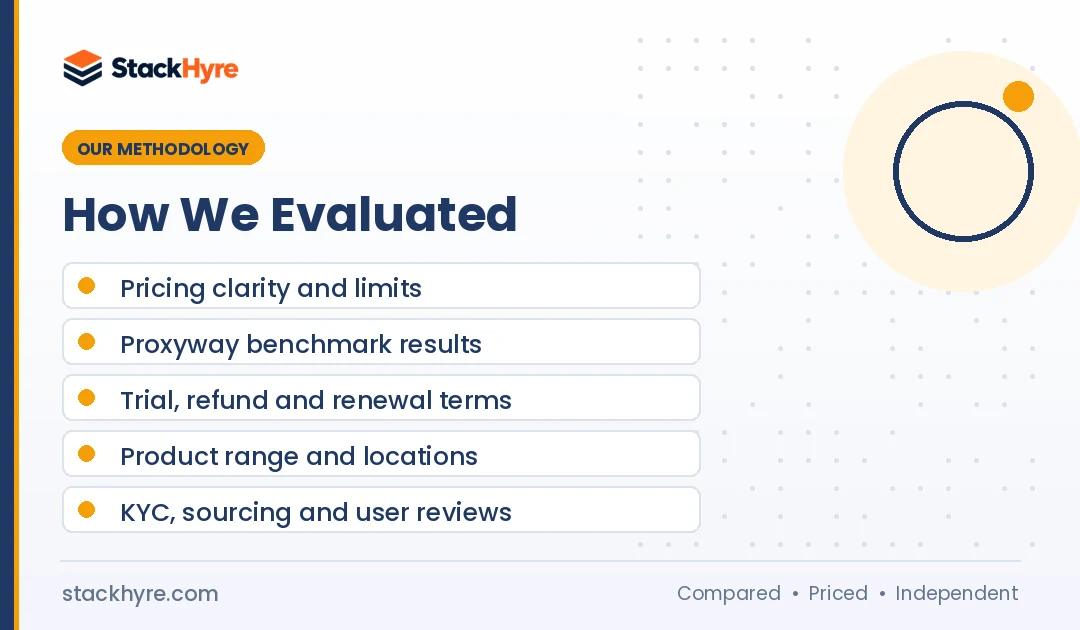
I didn’t buy a plan or run my own tests for this review. I compared Decodo’s published pricing, product pages, refund terms and docs. Then I checked them against independent benchmarks from Proxyway and AIMultiple, and user reviews on Trustpilot.
Here’s what I looked at:
- Pricing clarity. Are rates, limits and add-ons easy to understand?
- Independent performance. What do third-party benchmarks show?
- Billing fairness. How do trials, refunds and renewals work?
- Product range. Which proxy types and tools can you get?
- Trust. What do KYC rules, sourcing claims and user reviews say?
Vendor claims are labeled as Decodo’s own. My editorial policy explains how I handle sources and updates.
What Are the Best Decodo Alternatives?
The best Decodo alternatives are Oxylabs and Bright Data for enterprise scale, IPRoyal for traffic that doesn’t expire, Webshare for free and budget datacenter proxies, and NodeMaven for clean IPs in account work. Each one beats Decodo in one area and gives something up in another.
- Oxylabs: One subscription, from $30 per month, covers every product. Residential runs from $6/GB to $2.50/GB.
- Bright Data: Claims 400M+ residential IPs. Pay as you go shows $4/GB with a 50% promotion.
- IPRoyal: Residential traffic never expires. Read my IPRoyal review.
- Webshare: Free plan with 10 proxies. See my Webshare review.
- NodeMaven: Filters for clean IPs, rolls over unused traffic and offers a $3.50 paid trial.
For the full list with pricing, see my guide to the best Decodo alternatives.
The Bottom Line
Decodo earns its reputation. Independent tests show success rates above 99%, a large and real residential pool, and fast support. Residential pricing is fair at every tier, and advanced targeting costs nothing extra.
The catches are in the billing. Pay as you go is capped at 1 GB per purchase, the trial switches on by itself, and refunds come with strict usage limits. If you’re fine on a monthly plan, none of this will bother you much.
My verdict: Decodo is a strong default choice for most small and mid-size proxy buyers in 2026. Start with the trial or the 3 GB plan and run it on your real targets. If it doesn’t fit, compare it with the best residential proxies or my top proxy providers list.
Frequently Asked Questions
Is Decodo legit?
Yes. Decodo is the former Smartproxy, an established proxy provider that rebranded in April 2025. Proxyway rated it 9.3 out of 10 and measured success rates above 99% in its 2026 tests. It also holds a 4.2 TrustScore on Trustpilot from over 2,100 reviews. As with any provider, use it within the target site’s terms and your local law.
How much does Decodo cost per GB?
As of October 2026, Decodo residential proxies cost $3.75/GB on the 3 GB plan and drop to $2.00/GB on the 1,000 GB plan. Pay as you go costs $4/GB, bought 1 GB at a time. Datacenter traffic starts at $0.60/GB on a 10 GB plan. Prices exclude VAT and can change, so check Decodo’s pricing page.
Does Decodo have a free trial?
Yes. Decodo offers a 3-day free trial with 100 MB of residential traffic. The plan switches on automatically after the trial unless you cancel first. Using the trial also rules you out of the 14-day money-back guarantee. The Web Data API has a separate free plan with up to 10K pages per month.
Does Decodo require KYC?
Not by default. According to Proxyway, Decodo triggers identity checks through its own safeguards or when you ask for access to sensitive targets, like certain business, streaming or email domains. Most users can sign up and start using proxies without uploading ID. If your project touches restricted categories, expect a check.
Is Decodo better than Oxylabs?
For small and mid-size users, Decodo is usually the better value, with lower entry prices and simpler plans. Oxylabs suits large teams that want enterprise support and one subscription across proxies and scraping APIs. Proxyway found Oxylabs has the only larger residential pool in its tests. Pick based on your monthly volume and how much support you need.
Related Articles

Daniel Brooks writes about proxies, web scraping and email infrastructure at StackHyre. He compares providers on published pricing, documentation and independent benchmarks so you can pick the right setup without overpaying.