
TL;DR: My pick for most teams is Decodo. It pairs top independent benchmark scores with plans from $3.75/GB. Oxylabs is the one I’d choose for enterprise scraping, and Bright Data has the widest toolset. On a tight budget, look at Webshare and Rayobyte, which drop below $2/GB at volume. I compare 8 providers here on price, pool size, targeting, sessions and sourcing. Prices are as of October 2026.
Bots now make up most web traffic. The Imperva 2025 Bad Bot Report found automated traffic hit 51% of all internet traffic. It also found 21% of bot attacks used residential proxies.
So websites look hard at where your traffic comes from. A datacenter IP is easy to flag. A residential IP looks like a normal person at home.
The catch is that residential providers are not all alike. Some run clean, consented pools with honest pricing. Others bury costs in expiring credits or get their IPs from malware. In July 2026, the FBI seized hundreds of NetNut domains after researchers tied the service to a botnet.
For this guide I compared published pricing, documentation, sourcing policies and independent benchmark data for each provider below. If you want the full market across every proxy type, read my guide to the best proxy providers. Not sure which kind of proxy you need yet? My guide to proxy types explains each one.
Quick Comparison: The 8 Best Residential Proxies in 2026
| Provider | Best For | Starting Price | Key Feature |
|---|---|---|---|
| Decodo | Best overall value | $3.75/GB (3 GB plan) | 99.92% success rate in Proxyway’s 2026 benchmark |
| Oxylabs | Enterprise scraping | $30/month subscription | Largest advertised pool at 175M+ IPs |
| Bright Data | Advanced tooling | $4/GB pay as you go (promo) | 400M+ monthly IPs, per Bright Data |
| SOAX | Flexible rotation rules | $200/month (Builder) | Rotate per request, per N requests or on error |
| NodeMaven | Clean IPs for accounts | $3.50 paid trial (750 MB) | IP quality filter and 24-hour sticky sessions |
| IPRoyal | Non-expiring traffic | $7/GB (1 GB) | Sticky sessions up to 7 days |
| Webshare | Self-serve budgets | $3.50/GB (1 GB) | Falls to $1.40/GB at 3,000 GB |
| Rayobyte | Cheap high volume | $3.50/GB pay as you go | $0.70/GB at 1,000 GB+ |
What Makes a Great Residential Proxy Provider?
A great residential proxy provider gives you a large pool of real home IPs that were sourced with consent. It gets a high success rate on hard targets and lets you target by country, city and ASN. It offers both rotating and sticky sessions, clear per-GB pricing, and traffic that does not expire too fast. In my view, proof of sourcing matters as much as speed.
Everyone quotes pool size, but treat it as a starting point. Proxyway’s 2026 market research found the median advertised residential pool was 54 million IPs. What you can actually reach depends on your country and your targeting.
Success rate tells you more. In the same research, the median infrastructure success rate was 99.28%. Against real targets like Amazon, Google and Instagram, the median fell to 74.43%. That gap is why I always tell people to trial a provider on their own targets.
Most buyers skip sourcing. Don’t. Google’s Threat Intelligence Group found IPIDEA built its network through app SDKs and trojanized apps. Google says any provider that claims ethical sourcing should offer transparent, auditable proof of consent.
Last, read the billing rules. Does traffic expire? Does targeting cost extra? Is KYC required? Those details move your real cost more than the headline price does.
Best Residential Proxies for Large-Scale Scraping
#1 Decodo: Best for Overall Value
Decodo, the former Smartproxy, gives you near-top benchmark results at mid-market prices.
What it does well. Decodo scored a 99.92% global success rate and a 0.53-second average response time in Proxyway’s 2026 benchmark. Only Oxylabs beat it on success rate. Decodo also returned the most unique US IPs in that test. The dashboard is simple, and you can be set up in minutes.
Key features:
- 115M+ IPs in 195+ locations, per Decodo
- Rotating and sticky sessions on every plan
- Targeting down to city level
- 3-day free trial with 100 MB for new users
Pricing. As of October 2026, Decodo’s residential pricing starts at $3.75/GB on the 3 GB plan ($11.25 a month). It drops to $2.75/GB at 100 GB and $2.00/GB at 1,000 GB. Pay as you go costs $4/GB. Prices exclude VAT.
Best for: Teams that want strong success rates without signing an enterprise contract.
Limitations. Decodo’s FAQ says sticky sessions hold an IP for up to 30 minutes. That’s short if you run logged-in accounts. You also can’t hold a monthly plan and pay as you go at the same time.
#2 Oxylabs: Best for Enterprise Scraping
Oxylabs is my pick for large teams that need the biggest pool and solid compliance paperwork.
What it does well. Oxylabs posted the best global success rate, 99.93%, in Proxyway’s 2026 research. It also returned the most unique global IPs, over 3.2 million across 3.6 million requests. Its advertised pool of 175 million IPs was the largest in the report.
Key features:
- 175M+ advertised residential IPs
- One subscription that covers all Oxylabs products
- Free welcome credit of $5 toward any product
- Rotating or sticky sessions on the same pool
Pricing. As of October 2026, Oxylabs’ pricing page lists one subscription at $30, $100 or $500 a month. Enterprise starts from $2,500. Residential traffic costs $6/GB at the lowest volume and falls to $2.50/GB above 1,000 GB.
Best for: Enterprise data teams scraping at high volume across many countries.
Limitations. Proxyway notes Oxylabs dropped its pay-as-you-go plan, so the entry point is higher. Ask whether unused balance carries over before you commit. If your project is small, you’ll pay more per GB here than elsewhere.
#3 Bright Data: Best for Advanced Tooling
Bright Data is the broadest platform here. You get proxies, scraping APIs and datasets under one account.
What it does well. Bright Data says its network includes 400M+ monthly residential IPs in 195 countries. It has detailed targeting and a deep set of add-on tools. Proxyway reports Bright Data reached about $300 million in annualized revenue, so this vendor isn’t going anywhere soon.
Key features:
- 400M+ monthly residential IPs, per Bright Data
- Detailed geo targeting options
- Scraping browser, unblocker and dataset products
- Deposit match up to $500 for new accounts
Pricing. As of October 2026, Bright Data’s residential pricing shows $4/GB pay as you go. That’s a 50% promo off the usual $8. Monthly plans start at $499 for 141 GB. The promo runs for three months.
Best for: Teams that want proxies and scraping tools from the same vendor.
Limitations. Bright Data sat out Proxyway’s 2026 benchmarks, so there’s no independent success-rate data. Prices jump back once the promo ends. And expect a KYC review before you can reach some targets.
Best Residential Proxies for Targeting and Account Work
#4 SOAX: Best for Flexible Rotation Rules
SOAX gives you more say over when and how IPs rotate than most of its rivals.
What it does well. SOAX’s residential page lets you rotate per request, after N requests, after a set time, or on error. You can also lock a session to one node. In Proxyway’s research, SOAX had the best US success rate at 99.92%.
Key features:
- Targeting by country, region, city, ISP and ASN
- Rotate on error, on time or per request
- HTTP, HTTPS and SOCKS5 support
- One rate across residential and mobile traffic
Pricing. As of October 2026, SOAX’s pricing page lists Builder at $200 a month with Tier 1 traffic at $3.00/GB. Team costs $500 ($2.20/GB) and Scale costs $1,500 ($1.50/GB). The free Sandbox plan charges $5/GB with no subscription.
Best for: Scrapers who need custom rotation logic for tricky targets.
Limitations. Credits expire after 60 days on monthly plans. There’s no free trial. SOAX also stopped selling ISP proxies, so you’ll need a second vendor for static IPs.
#5 NodeMaven: Best for Clean IPs on Accounts
NodeMaven puts IP quality ahead of raw pool size.
What it does well. NodeMaven says its IP Quality Filter screens each IP in real time before you get it. That matters for social and ecommerce accounts, where one flagged IP can get you banned. Sticky sessions last up to 24 hours, which fits long logged-in workflows.
Key features:
- 30M+ residential and 250K mobile IPs, per NodeMaven
- Real-time IP quality screening
- Sticky sessions up to 24 hours
- Unused traffic rolls over to the next period
Pricing. As of October 2026, NodeMaven’s pricing page lists a $3.50 paid trial for 750 MB. The smallest monthly plan is $8.50 for 2 GB. The lowest rate, about $2.20/GB, only applies on its largest plan.
Best for: People running many accounts who’d rather pay for clean IPs than chase the lowest price.
Limitations. NodeMaven wasn’t in Proxyway’s 2026 benchmark, so its success claims are its own. The pool is smaller than the big three. Small plans cost more per GB than Webshare or Rayobyte.
#6 IPRoyal: Best for Non-Expiring Traffic
IPRoyal is the safe call if you buy traffic in bursts and hate watching unused gigabytes disappear.
What it does well. IPRoyal’s pricing page says traffic never expires. Sticky sessions can keep the same IP for up to 7 days, the longest on this list. In Proxyway’s research, IPRoyal had the lowest share of flagged IPs in an IPinfo check, at 16.70% globally.
Key features:
- 64M+ residential IPs in 195+ countries, per IPRoyal
- Traffic that does not expire
- Sticky sessions up to 7 days
- Pay as you go or subscription with 5% off
Pricing. As of October 2026, IPRoyal subscriptions cost $7.00/GB for 1 GB and $5.25/GB for 10 GB. Pay as you go adds about 5%. Custom plans get down to $1.75/GB, but only from 10 TB.
Best for: Freelancers and small teams whose usage swings month to month.
Limitations. Proxyway measured a 96.11% success rate and a 1.24-second response time, both below the median. Mid-volume pricing is high next to Decodo or Webshare.
Best Value Residential Proxies
#7 Webshare: Best for Self-Serve Budgets
Webshare is a clean, self-serve option with low prices at every tier.
What it does well. Webshare’s residential page lists 80M+ IPs in 195 countries. You can target by country, state, city, ZIP and ASN. Proxyway measured a 99.28% success rate and a 0.86-second response time, both close to the median.
Key features:
- 80M+ residential IPs, per Webshare
- City, ZIP and ASN targeting
- Free plan with 10 shared proxies to test the dashboard
- 99.97% uptime, per Webshare
Pricing. As of October 2026, Webshare charges $3.50/GB for 1 GB, $2.25/GB for 100 GB and $1.50/GB for 1,000 GB. The lowest listed rate is $1.40/GB at 3,000 GB.
Best for: Developers and small teams who want low prices and no sales calls.
Limitations. The residential page doesn’t say what sticky session options you get or whether bandwidth expires. Check both in the dashboard before you buy a big plan.
#8 Rayobyte: Best for Cheap High Volume
Rayobyte has some of the lowest published high-volume rates you’ll find from an established vendor.
What it does well. Rayobyte’s residential page includes city, ZIP and ASN targeting on every tier. Pricing is pay as you go, so no subscription is needed. The rate drops fast as your volume grows.
Key features:
- 50M+ opted-in devices each month, per Rayobyte
- 190+ countries with city, ZIP and ASN targeting
- Sticky sessions up to 120 minutes
- Free trial with no credit card required
Pricing. As of October 2026, Rayobyte charges $3.50/GB for 1 to 49 GB and $2.00/GB from 50 GB. The rate drops to $1.50/GB from 250 GB and $0.70/GB from 1,000 GB. Enterprise deals start from $0.50/GB.
Best for: High-volume scrapers who care most about cost per gigabyte.
Limitations. Proxyway measured a 98.02% success rate and a 1.86-second response time, the slowest in its residential test. Plan for more retries on hard targets.
Want to go even cheaper? My list of cheap residential proxies covers providers that start near $1/GB, plus the traps I’d steer clear of.

How Should You Choose the Right Residential Proxy?
Pick a residential proxy by matching it to the job. Scraping needs a big rotating pool and a high success rate. Account work needs long sticky sessions and clean IPs. Then work out the real cost per GB at your monthly volume. Check whether traffic expires, and trial each provider on your own targets before you commit.
Start with your use case. Rotating sessions fit scraping, price checks and SERP tracking. Sticky sessions fit logins, carts and social accounts. If you need one IP for days, an ISP proxy may be the better fit. My guide to the best ISP proxies covers that, and rotating vs static proxies walks through the trade-off.
Price your real volume. Proxyway’s 2026 research put the median price at $3.75/GB at 5 GB. It fell to $3.00/GB at 50 GB and $2.25/GB at 500 GB. I use those numbers as a sanity check. If a quote lands far above them, ask why.
Check expiry and minimums. IPRoyal and NodeMaven roll traffic over. SOAX credits expire after 60 days. Subscriptions can also leave you paying for traffic you never touch.
Check targeting depth. City, ZIP and ASN targeting help with local SEO and ad checks. Some vendors include it on every plan. Others charge extra or save it for higher tiers.
Ask about sourcing and KYC. Good providers explain how users agree to share bandwidth. Many also run identity checks before you can hit sensitive targets. That friction is a good thing, because it keeps abusers out of the pool you share.
Match the proxy type to the site. Plenty of targets don’t need residential IPs at all. My residential vs datacenter comparison shows when cheaper datacenter IPs will do the job. For scraping-specific picks, see my guide to the best proxies for web scraping.
How I Evaluated These Residential Proxies
I didn’t run my own speed tests for this guide. I compared each provider’s published pricing pages, documentation and policies as of October 2026. Then I checked performance claims against independent data, mainly Proxyway’s Proxy Market Research 2026.
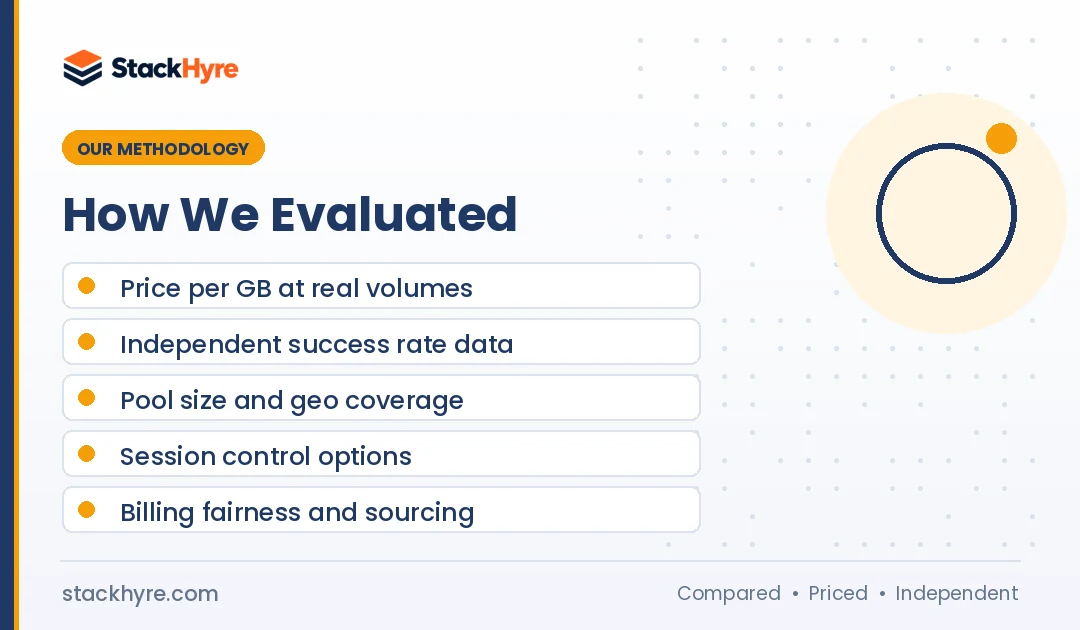
I scored each provider on six factors:
- Price per GB at entry level and at 50 to 1,000 GB
- Independent performance data such as success rate and response time
- Pool size and geo coverage, labeled as vendor claims
- Session control, including rotation options and sticky session length
- Billing fairness, such as traffic expiry, trials and refunds
- Sourcing and trust, including KYC and consent policies
I left NetNut out because its domains were seized in July 2026. Pool sizes and quality claims come from the vendors unless I name an independent source. Prices change often, so check each vendor’s page before you buy.
The Bottom Line
Decodo is the residential proxy I’d recommend to most buyers. It pairs near-top independent success rates with fair pricing from $3.75/GB. If you’re an enterprise team that needs the largest pool and can commit to a subscription, go with Oxylabs. Bright Data makes sense when you also want scraping tools from the same vendor.
For account work, NodeMaven and IPRoyal give you longer sticky sessions and traffic that rolls over. On a tight budget, Webshare and Rayobyte both fall well below $2/GB at volume.
Whatever you pick, start small. Run a trial against your real targets and track success rate and cost per successful request. Then scale. To compare residential with every other proxy type, see my full list of the best proxy providers.

Frequently Asked Questions
What are residential proxies?
Residential proxies send your traffic through IP addresses that internet providers give to real homes. Websites see a normal household user, not a server. That makes them harder to block than datacenter IPs. People use them for scraping, price monitoring, ad checks and account work, because sites in those areas often flag traffic from hosting ranges.
How much do residential proxies cost in 2026?
Most residential proxies cost between $2 and $7 per GB as of October 2026. Proxyway’s 2026 research found a median of $3.75/GB at 5 GB and $2.25/GB at 500 GB. Budget providers go lower at high volume. Always check traffic expiry and targeting fees, since they change what you really pay.
Which residential proxy provider has the largest pool?
Bright Data advertises 400M+ monthly residential IPs, the biggest claim on my list. Among providers in Proxyway’s 2026 research, Oxylabs had the largest advertised pool at 175 million IPs. It also returned the most unique IPs in testing. Keep in mind pool size is a vendor claim, and the usable pool in your target city may be far smaller.
Are residential proxies legal to use?
Residential proxies are legal in most countries when the provider sources IPs with user consent. How you use them matters too. Scraping public data is usually fine, but breaking a site’s terms or local privacy laws can get you in trouble. Pick vendors with clear consent and KYC policies, and stay away from services tied to malware-built botnets.
Should I choose rotating or sticky residential proxies?
Go with rotating sessions for scraping, price checks and rank tracking, where a new IP per request cuts block rates. Go with sticky sessions for logins, checkouts and social accounts, where a changing IP can set off security checks. Most providers on this list offer both. Sticky session length runs from 30 minutes at Decodo to 7 days at IPRoyal.
Related Articles

Daniel Brooks writes about proxies, web scraping and email infrastructure at TechHyre. He compares providers on published pricing, documentation and independent benchmarks so you can pick the right setup without overpaying.