
TL;DR: My picks for the best Decodo alternatives in 2026 are Oxylabs and Bright Data for large scraping teams, IPRoyal for traffic that never expires, Webshare and Evomi for tight budgets, and NodeMaven for clean IPs on account work. Residential prices run from under $1/GB on bulk economy plans to about $7/GB on small packs. Below I compare eight providers on price, refund terms, pool claims and fit.
Decodo, the provider formerly known as Smartproxy, is hard to beat on value. In its April 2026 tests, Proxyway measured a 99.92% success rate on Decodo’s global residential pool.
So why look elsewhere? Usually it isn’t about quality. It’s about fit.
Some buyers want traffic that never expires. Some want a bigger enterprise contract with more compliance paperwork. Others want a lower price per GB, a free plan, or a provider built for multi-account work.
Decodo’s own terms also push some people away. Its pay-as-you-go residential option sells only 1 GB at a time, and its refund window comes with usage caps.
This guide is part of my best proxy providers guide, and it goes well with my breakdown of how proxy pricing works. Below you’ll find eight alternatives, what each one does better than Decodo, and where each one falls short.
All prices are as of October 2026. I took them from each vendor’s public pricing page or a dated, independent source.
Quick Comparison: The Best Decodo Alternatives in 2026
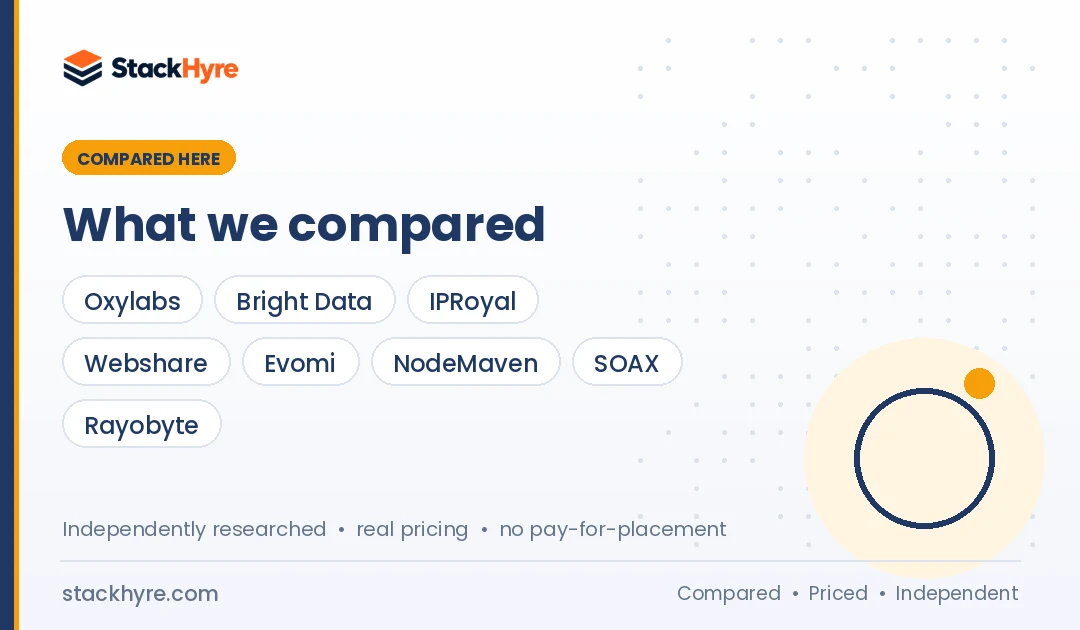
| Provider | Best For | Starting Price | Key Feature |
|---|---|---|---|
| Oxylabs | Enterprise scraping | $30/month credit plan | One subscription covers every product |
| Bright Data | Largest pool and compliance | $4/GB pay as you go (promo) | 400M+ residential IPs claimed |
| IPRoyal | Non-expiring traffic | $7/GB for 1 GB | Residential GB never expire |
| Webshare | Budget datacenter and free plan | Free, then $2.99 for 100 proxies | Permanent free tier |
| Evomi | Cheapest bulk residential | $0.49/GB on a 100 GB plan | Swiss-based, free trial |
| NodeMaven | Clean IPs for account work | $3.50 paid trial (750 MB) | IP quality filter, traffic rollover |
| SOAX | Geo-tiered residential and mobile | From $0.35/GB on Tier 3 geos | One rate for residential and mobile |
| Rayobyte | US-based AI data buyers | $3.50/GB pay as you go | Very low bulk “Scale” tier |
What Makes a Great Decodo Alternative?
A good Decodo alternative beats Decodo on the one thing you care about most and doesn’t lose on the basics. That might be a lower real cost per GB, traffic that never expires, a larger pool, stricter compliance or a better trial. It should still match what Decodo does well: high success rates, fair targeting, solid docs and 24/7 support.
Decodo sets a high bar. Proxyway rated it 9.3 out of 10 and called it a strong all-rounder. So most “alternatives” are really trade-offs, not upgrades.
Here’s what I looked for in each option:
- Real price per GB. Not the headline rate, but what you pay at your actual volume.
- Traffic rules. Does unused data expire at the end of the month, or roll over?
- Trial and refund terms. Can you test before you commit real money?
- Pool quality. Independent tests count more than advertised IP totals.
- Ethical sourcing and KYC. A provider that verifies customers and explains where IPs come from is safer to build on.
Why Do People Switch From Decodo?
Most people leave Decodo over billing terms or a small feature gap, not bad performance. The usual reasons are the 1 GB limit on pay-as-you-go residential purchases, monthly plans with no stated rollover, refund caps, and needing a bigger enterprise vendor. A few users also report ISP proxy issues in public reviews.
Decodo’s refund policy only covers your first purchase. You have to ask within 14 days and use no more than 20% of a regular plan’s traffic. The free trial doesn’t qualify.
The free trial itself gives you 100 MB for 3 days. Decodo says the plan then turns on automatically unless you cancel.
On Trustpilot, Decodo holds a 4.2 TrustScore from over 2,100 reviews. The complaints mention sticky sessions that drop, some static IPs flagged as datacenter, and ISP prices that feel high.
Proxyway flagged a few limits too. City and ASN filters can’t be combined, and dedicated datacenter proxies are US-only. If any of these hit your use case, an alternative makes sense.
If you want the full picture first, read my in-depth Decodo review.
Premium Alternatives for Large Scraping Projects
These two cost more at low volume. In return you get bigger infrastructure, more scraping tools and enterprise-grade contracts.
#1 Oxylabs: Best for enterprise scraping at scale
If you’ve outgrown Decodo and want one vendor for proxies and scraping APIs, Oxylabs is my premium pick.
What it does well. Oxylabs moved to a single subscription that covers every product. You buy a monthly plan and spend it on residential, mobile, ISP, datacenter or scraping APIs. Proxyway’s tests found Decodo’s residential pool was second only to Oxylabs in size, so Oxylabs is one of the few vendors with a larger measured pool.
Key features:
- One subscription covers proxies, Web Unblocker and scraping APIs
- Residential, mobile, ISP, dedicated ISP and datacenter proxies
- Per-unit rates fall as your volume grows
- $5 in free welcome credits to test any product
Pricing. As of October 2026, Oxylabs’ pricing page lists plans at $30, $100 and $500 per month, plus Enterprise from $2,500. Residential runs from $6/GB at the lowest band down to $2.50/GB at 1,000 GB and above. Mobile runs from $7.50/GB to $3.50/GB. The page doesn’t say whether unused usage carries over, so ask before you commit.
Best for: Data teams that want proxies and scraping APIs on one bill, with enterprise support.
Limitations. Small users pay more per GB than they would at Decodo. There’s no pay-as-you-go option on the pricing page, only monthly plans.
#2 Bright Data: Best for the largest pool and compliance checks
Bright Data is the biggest name in the market. It vets customers strictly and advertises a huge pool.
What it does well. Bright Data claims 400M+ rotating residential IPs in 195 countries. Country, state, city and ZIP targeting are free. It also runs a formal KYC process for residential access, which can include a video call. That matters if your legal team asks how your vendor vets its users.
Key features:
- 400M+ residential IPs claimed, with free ZIP-level targeting
- Free trial where trial traffic is not billed
- Many payment options, including PayPal, wire and AWS Marketplace
- Large lineup of scraping APIs and datasets
Pricing. As of October 2026, Bright Data shows residential pay as you go at $4/GB with a 50% promotion, against a list price of $8/GB. Monthly plans start at $499 for 141 GB. There’s no public mobile price, so you’ll need to contact sales for mobile.
Best for: Enterprises that need the widest coverage and a vendor with mature compliance.
Limitations. List prices are high once the promotions end. KYC takes time before you can use residential IPs on many targets.
Value Alternatives for Residential Traffic
These providers go after Decodo on price. Each takes a different angle: non-expiring data, a free plan or bulk rates.
#3 IPRoyal: Best for traffic that never expires
For light users, IPRoyal fixes Decodo’s biggest pain point. Your residential data doesn’t expire.
What it does well. IPRoyal says on its residential pricing page that “your traffic is available until you decide to use it.” If you scrape in bursts, you stop losing unused GB at the end of each month. Sticky sessions last up to 7 days, longer than most rivals.
Key features:
- Non-expiring residential traffic
- Sticky sessions of up to 7 days
- 64M+ residential IPs claimed across 195+ locations
- HTTP(S) and SOCKS5, with an API for automation
Pricing. As of October 2026, residential costs $7/GB for 1 GB on a subscription, $5.25/GB at 10 GB, and down to $1.75/GB for custom plans from 10 TB. Pay-as-you-go rates are about 5% higher. ISP proxies start at $1.80 per proxy for 24 hours on the ISP pricing page.
Best for: Freelancers and small teams whose usage changes month to month.
Limitations. Small packs cost more per GB than Decodo. Proxyway measured a 96.11% global success rate, which trails Decodo. There’s no residential trial.
My full IPRoyal review has the details.
#4 Webshare: Best for budget datacenter proxies and a free plan
Webshare is the cheapest way to start. Its free plan has no time limit.
What it does well. The Webshare free plan includes 10 shared proxies and 1 GB of monthly bandwidth. You don’t need a credit card. That makes it an easy way to test your code before you pay anyone.
Key features:
- Free plan with 10 proxies and 1 GB per month
- Low-cost datacenter proxy lists
- Rotating residential and static residential (ISP) plans
- HTTP and SOCKS5 support
Pricing. As of October 2026, 100 datacenter proxies cost $2.99 per month. Rotating residential starts at $3.50/GB on a 1 GB plan and drops to $1.40/GB at 3,000 GB. Static residential starts at $6 per month for 20 proxies.
Best for: Developers, students and small projects that need cheap IPs fast.
Limitations. Shared datacenter IPs get blocked on well-protected sites. Webshare has fewer scraping APIs than Decodo.
See my Webshare review for more.
#5 Evomi: Best for the cheapest bulk residential traffic
Evomi is a Swiss provider with some of the lowest published residential rates I found.
What it does well. Evomi splits residential into two tiers. Core Residential is the budget option. Premium Residential is aimed at harder sites. Every proxy product has a free trial, according to Evomi’s pricing page.
Key features:
- Core Residential at a very low monthly rate
- Premium Residential and mobile for harder targets
- Static residential with shared, private and “virgin” IP options
- Scraper API where failed requests are not charged
Pricing. As of October 2026, Core Residential costs $49 per month for 100 GB, or $0.49/GB. Pay as you go starts at $0.99/GB. Premium Residential and mobile cost $3.98/GB pay as you go, or as low as $2.20/GB on the largest plans.
Best for: High-volume scraping of lightly protected sites where cost per GB matters most.
Limitations. The trial turns into a paid plan if you don’t cancel. Refunds are capped at 10% of your data or 1 GB, whichever is smaller. And there’s less independent benchmark data on Evomi than on Decodo.
Specialist Alternatives for Specific Jobs
These aren’t general Decodo clones. Each one wins in a narrower lane.
#6 NodeMaven: Best for clean IPs in account management
NodeMaven is all about IP quality. That matters when one flagged IP can get an account locked.
What it does well. NodeMaven filters its pool for clean IPs. On its pricing page, the company claims a 95% clean IP rate and a 99.54% average success rate. Those are vendor figures, not independent tests. Unused traffic rolls over to the next period, which Decodo doesn’t advertise.
Key features:
- IP quality filtering on residential and mobile traffic
- Unused traffic rolls over each billing period
- One traffic balance works on residential and mobile
- Static ISP proxies on 30-day terms
Pricing. As of October 2026, residential and mobile start from about $2.20/GB, but only on the largest plan. A 20 GB plan costs $4.50/GB. A paid trial costs $3.50 for 750 MB. ISP proxies are listed at $2.33 per IP for 30 days.
Best for: Social media managers, ad buyers and anyone pairing proxies with an antidetect browser.
Limitations. There’s no free trial. Small plans cost more per GB than Decodo.
#7 SOAX: Best for geo-tiered residential and mobile pricing
SOAX charges one rate for residential and mobile, and the price changes by country tier.
What it does well. On SOAX’s pricing page, residential and mobile share a single per-GB rate. Cheaper countries cost less. That helps if you mostly target lower-cost regions. You can also filter by country, region, city and ISP.
Key features:
- Same per-GB price for residential and mobile
- Three geo tiers with different rates
- Country, region, city and ISP targeting
- No-commitment Sandbox plan for testing
Pricing. As of October 2026, Tier 1 countries cost $5.00/GB on Sandbox, $3.00/GB on Builder and $1.50/GB on Scale. Tier 3 countries start at $2.00/GB on Sandbox and go as low as $0.35/GB on Enterprise.
Best for: Teams that need mobile IPs at residential prices.
Limitations. SOAX no longer lists ISP or datacenter proxies. There’s no free trial.
#8 Rayobyte: Best for US-based buyers feeding AI pipelines
Rayobyte is a US provider that now goes after very high-volume data buyers.
What it does well. In October 2026, Proxyway reported that Rayobyte repositioned for AI and launched $0.0095/GB residential IPs. That low “Scale” tier only opens after a compliance review, per Rayobyte’s pricing page. A Premium Residential tier is available right away.
Key features:
- Premium Residential with pay as you go
- Scale Residential for bulk, after compliance review
- Datacenter, ISP and mobile products
- Free trials on most self-serve products
Pricing. As of October 2026, Premium Residential costs $3.50/GB for 1 to 49 GB on pay as you go, with lower rates at higher volume. Scale pricing depends on your monthly commitment. Check the current price on Rayobyte’s pricing page, because its plans changed several times in 2026.
Best for: AI and analytics teams that move huge volumes of simple pages.
Limitations. Frequent price changes make planning harder. The cheapest tier sits behind a review, so you can’t get it instantly.
A Warning: Avoid NetNut
Some older lists still name NetNut as a Decodo alternative. Don’t use it. On July 2, 2026, KrebsOnSecurity reported that the FBI seized hundreds of NetNut domains. The seizure followed research linking NetNut to the Popa botnet of compromised devices. It’s a good reminder to check how any provider sources its IPs.
How Should You Choose the Right Decodo Alternative?
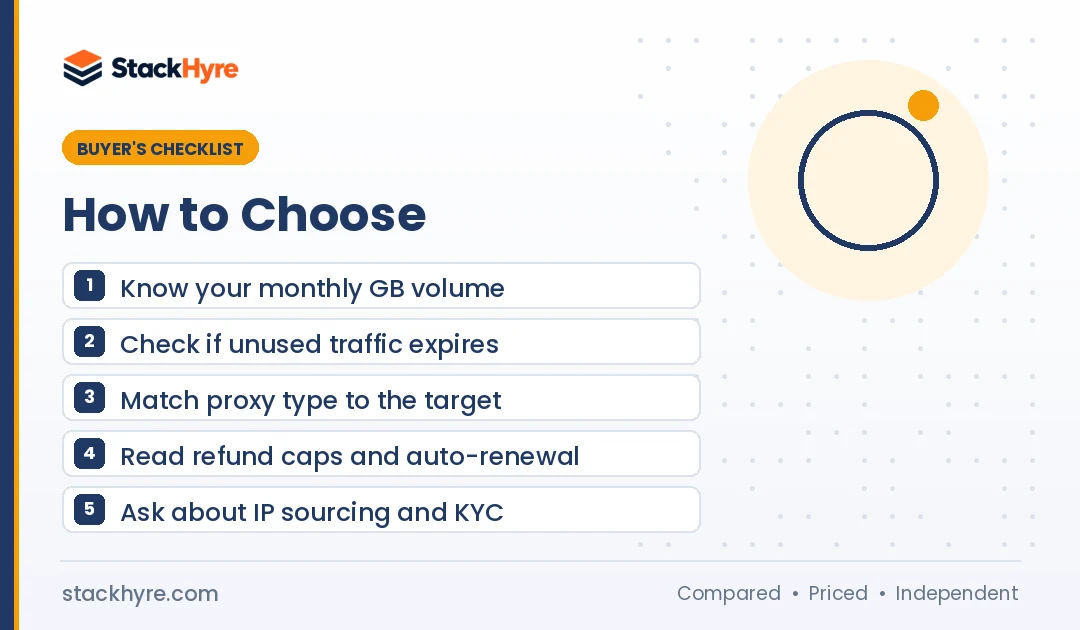
Start with why you’re leaving Decodo, then pick the provider that fixes that. If unused data is the problem, choose IPRoyal or NodeMaven. If price is the problem, compare Evomi, Webshare and SOAX at your real volume. If scale or compliance is the problem, move to Oxylabs or Bright Data. And always test with a trial first.
Here’s how I’d narrow it down:
- Estimate your monthly GB. Rates at 5 GB and 500 GB can differ by more than half. My cheap residential proxies guide shows where the real low prices are.
- Check traffic expiry. Monthly plans that reset can cost you more than a higher rate with rollover.
- Match the proxy type to the target. Datacenter IPs work on easy sites. Residential or mobile IPs suit protected ones.
- Read the refund terms. Look for usage caps, time windows and auto-renewal rules.
- Ask about sourcing and KYC. A vendor that verifies customers and explains consent is a safer long-term bet.
- Run a short trial. Check which vendors offer a free or low-cost trial.
For a full checklist with red flags, see how to choose a proxy provider.
How I Evaluated These Decodo Alternatives
I didn’t run my own speed tests for this guide. I compared published pricing, product docs, refund and trial terms, and independent benchmarks instead. Every price comes from the vendor’s own page or a dated, reputable source, as of October 2026.
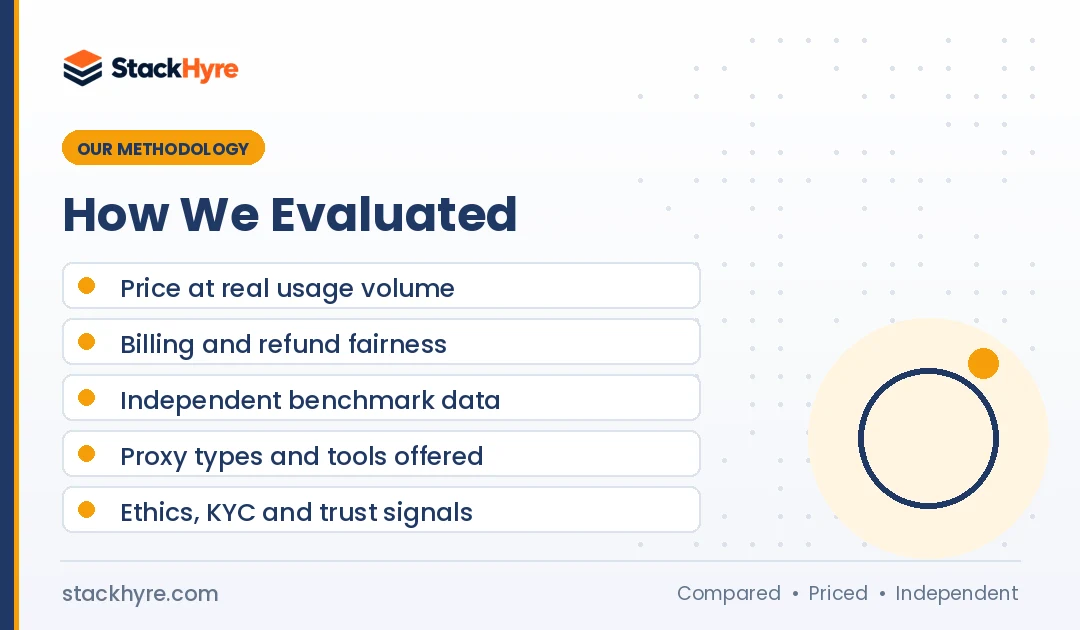
I scored each provider on five points:
- Price at real volume. I compared rates at small, medium and large plans, beyond the headline number.
- Billing fairness. I checked traffic expiry, rollover, auto-renewal and refund caps.
- Independent performance data. I used Proxyway’s published benchmarks where they exist.
- Product range. I noted which proxy types and scraping tools each vendor sells.
- Ethics and trust. I looked at KYC, sourcing statements and public security news.
Vendor claims, like pool sizes and success rates, are labeled as the vendor’s. You can read more in my editorial policy.
The Bottom Line
Decodo is still one of the best value proxy providers in 2026. Most buyers switch because of billing terms, not quality.
If you need enterprise scale, go with Oxylabs for one bill across all products, or Bright Data for the largest pool and strict vetting. If you hate losing unused data, IPRoyal’s non-expiring traffic is the simplest fix. On a tight budget, start with Webshare’s free plan or Evomi’s bulk Core Residential tier. For account management, I think NodeMaven’s clean IP focus is worth a $3.50 trial.
Whatever you pick, test it on a small plan before you scale. Then compare your options against my full ranking of proxy providers.
Frequently Asked Questions
Is Decodo the same as Smartproxy?
Yes. Smartproxy rebranded as Decodo in April 2025, according to Proxyway. The company changed its name, logo and visual identity, and it bundled its scraping APIs into one subscription. The proxy products, dashboard and support team carried over. If you see older reviews of Smartproxy, they describe the same service under its old name.
What is the cheapest alternative to Decodo?
For residential traffic, Evomi’s Core Residential plan is among the cheapest at $0.49/GB on a 100 GB monthly plan, as of October 2026. For datacenter proxies, Webshare charges $2.99 for 100 proxies and has a free plan. Cheap tiers often only suit easier targets. Test them on your real sites before you commit to a large plan.
Which Decodo alternative has traffic that does not expire?
IPRoyal is the clearest choice. Its residential pricing page says your traffic stays available until you use it. NodeMaven also rolls unused traffic into the next billing period. Decodo’s pricing page sells monthly plans and doesn’t advertise rollover. If your usage swings a lot from month to month, non-expiring data can lower your real cost.
Is Oxylabs better than Decodo?
Oxylabs is better for large teams that want enterprise support and one subscription covering proxies and scraping APIs. Decodo is usually the better value for small and medium users. Proxyway rated Decodo 9.3 out of 10 and found its residential pool second in size only to Oxylabs. It comes down to your budget, your volume and how much support you need.
Should I avoid any proxy providers in 2026?
Yes. Avoid NetNut. On July 2, 2026, the FBI seized hundreds of NetNut domains after research linked the service to the Popa botnet, as KrebsOnSecurity reported. More broadly, I’d steer clear of any provider that can’t explain where its residential IPs come from. Look for clear consent-based sourcing, customer KYC and a public abuse policy before you buy.
Related Articles



Daniel Brooks writes about proxies, web scraping and email infrastructure at StackHyre. He compares providers on published pricing, documentation and independent benchmarks so you can pick the right setup without overpaying.