TL;DR: Pick Bright Data if you want deep targeting, pay as you go billing or ready-made datasets. Pick Oxylabs if you want the best independent 2026 benchmark results, mobile proxies and simple self-serve plans from $30 a month. Residential costs $4/GB pay as you go on Bright Data during a promo, versus $6/GB to $2.5/GB on Oxylabs plans, as of October 2026. Below I compare price, performance, products, KYC and my pick by use case.
Bright Data and Oxylabs are the two premium names in the proxy market. Proxyway’s Proxy Market Research 2026 puts Bright Data at an annualized revenue of $300M, growing 50% year over year.
Oxylabs, on the other hand, topped the same report’s residential benchmark. It posted a 99.93% global success rate.
On paper they look alike. Both sell residential, ISP and datacenter proxies. Both run scraping APIs. Both go after large companies.
But in 2026 they split in three big ways. Oxylabs moved to one credit subscription in October. Bright Data made residential KYC mandatory for new zones in July. And Bright Data dropped mobile proxies in April, per Proxyway.
Those changes decide which one fits you. I walk through each difference below, with sourced prices and third-party test data.
If neither feels right, my ranking of the best proxy providers covers the wider market. If you want to understand how billing models work first, read my proxy pricing guide.
Bright Data vs Oxylabs: Quick Comparison
| Factor | Bright Data | Oxylabs |
|---|---|---|
| Best for | Advanced targeting, datasets, pay as you go | Top performance, mobile IPs, simple plans |
| Residential price | $4/GB PAYG (promo, list $8/GB) | $6/GB Starter to $2.5/GB Enterprise |
| Entry point | Pay as you go, plans from $499/mo | $30/mo Starter, $5 welcome credit |
| Mobile proxies | Discontinued April 2026 (per Proxyway) | Yes, $7.5/GB to $3.5/GB |
| Advertised residential pool | 400M+ monthly IPs (vendor claim) | 175M IPs (vendor figure, per Proxyway) |
| Residential KYC | Required for new zones since July 7, 2026 | Free credit for verified companies |
| Pay as you go | Yes | No, monthly plans only |
| Key feature | ZIP, ASN and OS targeting, datasets | One subscription covers every product |
What Is the Main Difference Between Bright Data and Oxylabs?
The main difference is how you get in and how you pay. Bright Data offers pay as you go and the deepest targeting, but you need to pass business KYC for residential proxies. Oxylabs sells everything through one monthly subscription from $30, includes mobile proxies, and led Proxyway’s 2026 residential benchmark. I’d send feature-heavy enterprise projects to Bright Data. I’d send teams that want strong performance on simple plans to Oxylabs.
Here’s the short version of who each one is built for:
- Bright Data is a full data platform. It sells proxies, unblocking APIs, scraper APIs, managed collection and ready-made datasets.
- Oxylabs is a proxy and scraping infrastructure company. It sells proxies, a Web Scraper API, Web Unblocker and Agent Browser.
Both are premium. Neither is the cheap option. If budget is your main worry, check them against my list of Bright Data alternatives.
How Do Bright Data and Oxylabs Compare on Pricing?
Bright Data is cheaper for small, one-off residential jobs. Its pay as you go rate is $4/GB during its current promo. Oxylabs is cheaper for steady monthly use at mid volumes, with residential dropping to $4/GB on its $500 plan. For static IPs, Bright Data’s starting ISP and datacenter prices are a bit lower. Always check the live pages, because both run promos all the time.
The table below uses each vendor’s own pricing pages, as of October 2026. Bright Data figures come from its pricing overview and residential pricing page. Oxylabs figures come from the Oxylabs pricing page.
| Product | Bright Data (from) | Oxylabs (Starter to Enterprise) |
|---|---|---|
| Residential | $4/GB PAYG with promo code | $6/GB to $2.5/GB |
| Mobile | Not offered | $7.5/GB to $3.5/GB |
| ISP (static residential) | $1.3/IP | $1.5/IP to $1.1/IP |
| Datacenter | $0.9/IP | $1/IP to $0.6/IP, or $0.6/GB to $0.40/GB |
| SERP scraping | SERP API from $1 per 1,000 requests | /Search from $1 per 1,000 searches |
| Unblocking | Unlocker API from $1 per 1,000 requests | Web Unblocker $7.2/GB to $3/GB |
| Scraping browser | Browser API from $5/GB | Agent Browser from $8/GB on Starter |
A few notes so you read this table fairly.
Bright Data’s promo. The $4/GB residential rate uses the RESIGB50 coupon. The banner says 50% off for 3 months. The struck-through list price is $8/GB. Monthly plans run $499 (141 GB), $999 (332 GB) and $1,999 (798 GB), with promo pricing shown. Bright Data’s own page shows other starting figures in a few spots too, so confirm the price at checkout.
Oxylabs’ single subscription. Oxylabs rebuilt its pricing in October 2026, as PricingSaaS recorded. Plans cost $30, $100, $500 and from $2,500 a month. Your plan level sets your rate on every product. The Agent Browser rate comes from UsagePricing’s snapshot of the new plans.
Expiry. Proxyway’s Oxylabs review says plans expire at the end of the cycle, and there’s no pay as you go. For small jobs, Bright Data’s pay as you go gets around that.
Volume discounts. At $500 a month, Oxylabs residential is $4/GB. Bright Data’s $499 plan shows $4/GB with its promo, and $7/GB at list price. So at mid volume, I’d expect Oxylabs to come out cheaper once the promo ends.
Which Has Better Performance: Bright Data or Oxylabs?
Oxylabs has the stronger recent independent data. In Proxyway’s 2026 benchmark it hit a 99.93% global residential success rate and a 0.60 s average response. Bright Data didn’t take part in that benchmark. Proxyway’s last Bright Data tests, from March 2024, showed a 98.96% success rate and 1.12 s response. Both are reliable. But you’re comparing numbers from different years, so keep that in mind.
Here’s what the independent tests show.
Oxylabs, 2026. Proxyway’s 2026 market research ran a 21-day global residential test. Oxylabs returned 3,241,404 unique IPs from 3.6 million requests, the most of any provider. Its mobile network hit a 99.84% global success rate.
Bright Data, 2024 tests. Proxyway’s Bright Data review, updated May 2026, still uses benchmark data from March 2024. Residential averaged 98.96% success and 1.12 s. Shared datacenter proxies reached 99.96% success at 0.26 s.
Proxyway also noted that Bright Data’s results “changed little in two years” while rivals got better. Its shared datacenter proxies scored just 5.83% success on Amazon in those tests.
Pool size. Bright Data claims 400M+ monthly residential IPs. Oxylabs’ advertised pool is 175M, per Proxyway. Treat both as vendor figures. The unique IPs seen in real tests tell you more than any headline pool size.
My take: Oxylabs has proven 2026 numbers. Bright Data is probably still strong, but you should test it on your own targets before you trust it.
How Do Their Proxy Types and Scraping Tools Compare?
Both sell residential, ISP and datacenter proxies plus scraping APIs. Oxylabs adds mobile proxies, which Bright Data discontinued in April 2026, according to Proxyway. Bright Data adds ready-made datasets, managed data collection and finer targeting, including ZIP, ASN and OS filters. If you need mobile IPs, go with Oxylabs. If you’d rather buy data than collect it yourself, go with Bright Data.
Proxy networks.
- Bright Data: Residential, ISP and datacenter. Proxyway lists 1.3M ISP and 1.3M datacenter IPs. Dedicated residential IPs are available.
- Oxylabs: Residential, mobile, ISP and datacenter, including dedicated ISP and datacenter options.
Targeting. Bright Data gives you free country, state, city, ZIP and ASN targeting on residential. Proxyway adds OS targeting to that list. Oxylabs offers country, city, ASN, US ZIP and coordinates. Proxyway notes that some Oxylabs filters can’t be combined, like country plus ASN on mobile.
Scraping tools.
- Bright Data: Unlocker API, Crawl API, SERP API, Browser API, Scraper APIs, Scraper Studio, datasets from $250 per 100K records, and managed data acquisition.
- Oxylabs: Web Scraper API with /Search and /Scrape endpoints, dedicated Google, Amazon and LLM scrapers, Web Unblocker and Agent Browser.
For a wider look at scraping tools, read my comparison of the best web scraping APIs. For 4G and 5G options beyond Oxylabs, see my list of the best mobile proxies.
Account and support. Proxyway measured Bright Data email replies at about 14 minutes. It got an Oxylabs live chat reply in about 2 minutes. Proxyway also flags that Oxylabs lacks two-factor authentication and session management. The same reviewer calls Bright Data’s dashboard and API powerful but complex.

Which Is Easier to Start With: Bright Data or Oxylabs?
For most small teams, Oxylabs is easier to start with. It gives you $5 in welcome credit and a $30 entry plan. Bright Data now requires a human-reviewed KYC check for every new residential zone, as of July 7, 2026. You need a company email, funds in the account and company registration documents. ISP, datacenter and Unlocker products stay open to you without residential KYC.
Bright Data onboarding. The residential network access policy sets these rules:
- Accounts with personal email domains are not eligible.
- You must add funds before you apply. KYC is not available in trial modes.
- Compliance may ask for a government ID and a video call.
- Approved access is limited to your stated use case. Other domains return “Access denied.”
- Bright Data aims to reply within 48 hours.
Proxyway also reports a 7-day trial, for companies only.
Oxylabs onboarding. The Oxylabs free trial page offers a “$5 welcome credit for verified company registrations.” Proxyway lists a 7-day trial for companies on residential and mobile, plus a 3-day refund window. Paid Starter plans are self-serve from $30.
Legal track record. Bright Data has defended public data collection in court. In January 2024, a US federal judge granted Bright Data summary judgment on Meta’s breach of contract claim. The court found Meta’s terms did not bar logged-off scraping of public data, as summarized by law firm Farella Braun + Martel. That ruling doesn’t make every project legal. Check each site’s terms and your local law.
Ethics. Strict KYC is a hassle, but I see it as a trust signal. It keeps abusive traffic off the network. For the opposite case, look at NetNut, whose domains the FBI seized, as KrebsOnSecurity reported on July 2, 2026. Researchers had tied it to a botnet of at least two million infected devices.
Bright Data or Oxylabs: Which Should You Choose by Use Case?
Choose Bright Data if you need pay as you go, ZIP or OS targeting, or ready-made datasets, and you can pass business KYC. Choose Oxylabs if you need mobile proxies or the best published 2026 residential results. It’s also the easier fit if you like a simple $30 to $500 monthly plan. For large enterprise contracts, get quotes from both. Negotiated rates beat list prices.
| Use case | Better pick | Why |
|---|---|---|
| Large-scale web scraping | Oxylabs | Top 2026 success rate and unique IP count |
| Small one-off residential job | Bright Data | Pay as you go, no monthly plan |
| Mobile app or ad testing | Oxylabs | Sells mobile proxies; Bright Data does not |
| Local SEO and ZIP-level checks | Bright Data | Free ZIP, ASN and OS targeting |
| Buying data instead of scraping | Bright Data | Datasets and managed collection |
| Freelancer or no registered company | Neither, consider alternatives | Both favor verified companies |
| Static ISP IPs at low volume | Bright Data | Lower starting price per IP |
| Static IPs at high volume | Oxylabs | Enterprise ISP from $1.1/IP, datacenter from $0.6/IP |
Are There Good Alternatives to Both?
Yes. Decodo is the closest mid-market rival. It scored a 99.92% global residential success rate in Proxyway’s 2026 research, just behind Oxylabs. Its residential plans start at $3.75/GB on a 3 GB plan, as of October 2026. For account work, NodeMaven filters IPs for reputation. If you want traffic that doesn’t expire, IPRoyal is a safe pick.
Here’s how the main options line up, based on each vendor’s pricing page:
- Decodo: Residential from $3.75/GB on small plans, mobile from $2.25/GB, per the Decodo pricing page.
- NodeMaven: A $3.50 paid trial for 750 MB, with rates near $2.20/GB on its largest plans, per NodeMaven.
- IPRoyal: Residential traffic that never expires, from $7/GB for 1 GB, per the IPRoyal pricing page.
If you’re a freelancer or a small team, both premium vendors are probably more than you need. My Oxylabs alternatives list covers flexible, lower-cost options. For pure residential picks, see the best residential proxies.
How I Compared Bright Data and Oxylabs
I didn’t run my own speed tests. I compared each vendor’s published pricing pages, product docs and access policies, checked in October 2026. Performance data comes from Proxyway’s 2026 market research and its individual reviews. Where the test data comes from different years, I say so.
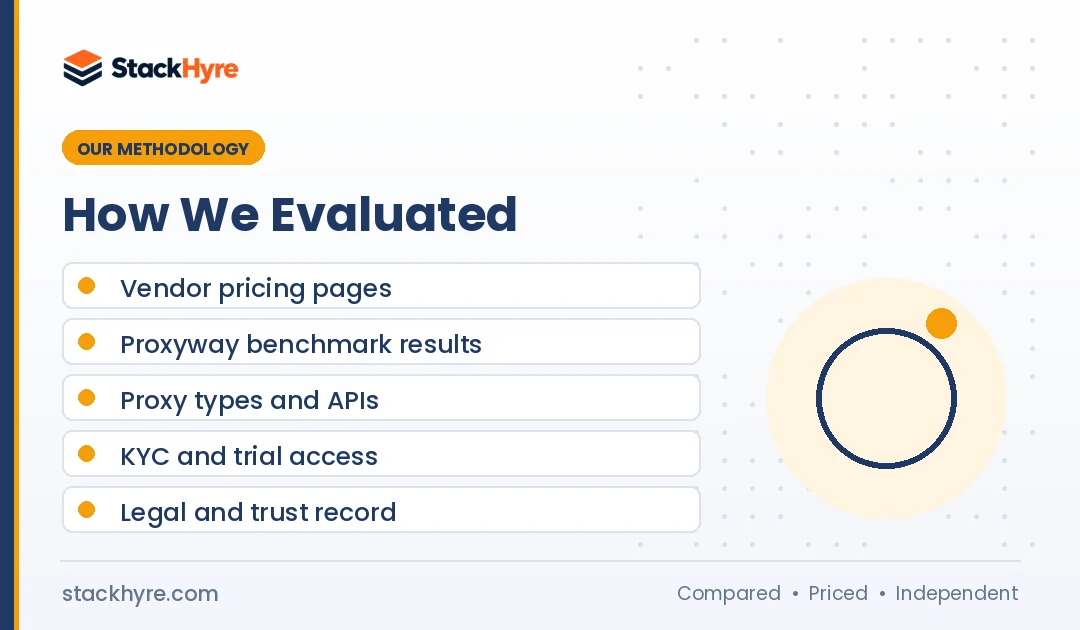
I compared both providers on five areas:
- Price: Starting and volume rates per product, from vendor pages.
- Performance: Independent success rates, response times and unique IPs.
- Product range: Proxy types, scraping APIs and data products.
- Access: KYC rules, trials and self-serve options.
- Trust: Compliance, legal track record and account security.
Pool sizes are vendor claims unless I say otherwise. Prices change often, so confirm them on each pricing page before you buy. My editorial policy explains how I research and update guides.
The Bottom Line
Bright Data and Oxylabs are both top-tier providers. The right one comes down to how you buy and what you need.
Pick Oxylabs if you want the best published 2026 performance, mobile proxies and a simple monthly plan. For steady, large-scale scraping, it’s my pick.
Pick Bright Data if you need pay as you go, deep targeting or ready-made datasets, and you’re a registered business. For complex, feature-heavy data projects, it’s the stronger choice.
Neither is cheap. So put a small budget into both, run them on your real targets, and only then sign a contract.
Want more options? Compare the full field in my best proxy providers guide, or see the best Bright Data alternatives.

Frequently Asked Questions
Is Bright Data better than Oxylabs?
Bright Data is better for deep targeting, pay as you go and ready-made datasets. Oxylabs is better for mobile proxies and published 2026 performance, with a 99.93% global residential success rate in Proxyway’s benchmark. Bright Data didn’t join that benchmark. Which one is better for you depends on your billing needs, your targets and whether you can pass KYC.
Which is cheaper, Bright Data or Oxylabs?
It depends on volume. Bright Data is cheaper for small one-off jobs, with residential at $4/GB pay as you go during its promo. Oxylabs is often cheaper for steady use, with residential at $4/GB on its $500 plan and $2.5/GB on Enterprise, as of October 2026. Check both pricing pages for current rates.
Does Bright Data have mobile proxies?
Not anymore. Proxyway’s 2026 market research reports that Bright Data discontinued its mobile proxy product in April 2026. Its proxy pricing now covers residential, ISP and datacenter networks. Oxylabs still sells mobile proxies, from $7.5/GB on Starter down to $3.5/GB on Enterprise, as of October 2026.
Do Bright Data and Oxylabs require KYC?
Bright Data has required a human-reviewed KYC check for all new residential zones since July 7, 2026. You need a company email and registration documents. Oxylabs’ $5 welcome credit is for verified company registrations, but paid plans are self-serve. Both providers expect a legitimate, lawful use case.
Do Oxylabs credits roll over?
No, according to Proxyway’s Oxylabs review, which says plans expire at the end of each cycle. Oxylabs’ pricing page doesn’t spell out rollover terms, so confirm with sales before you commit. If you need traffic that lasts, Bright Data’s pay as you go or IPRoyal’s non-expiring traffic are safer bets.
Related Articles


Daniel Brooks writes about proxies, web scraping and email infrastructure at StackHyre. He compares providers on published pricing, documentation and independent benchmarks so you can pick the right setup without overpaying.