
TL;DR: My picks for the best Bright Data alternatives in 2026 are Oxylabs for enterprise scale, Decodo for balanced value, and SOAX for precise targeting. NodeMaven, IPRoyal and Webshare fit smaller budgets. Residential prices on these vendors’ own pages run from about $1.40/GB at volume to $7/GB for a single gigabyte, as of October 2026. Below I compare 8 providers on price, KYC, pool claims and fit.
Bright Data is the biggest name in proxies. Proxyway’s Proxy Market Research 2026 puts its annualized revenue at $300M, growing 50% year over year.
But big doesn’t mean it’s right for you. I see a lot of teams hit three walls with Bright Data.
The first is cost. Proxyway’s Bright Data review says plainly that it “costs more than most alternatives.”
The second is access. Since July 7, 2026, every new residential zone needs a human-reviewed KYC check. Personal email accounts can’t get in.
The third is missing products. Proxyway reports that Bright Data dropped its mobile proxy product in April 2026.
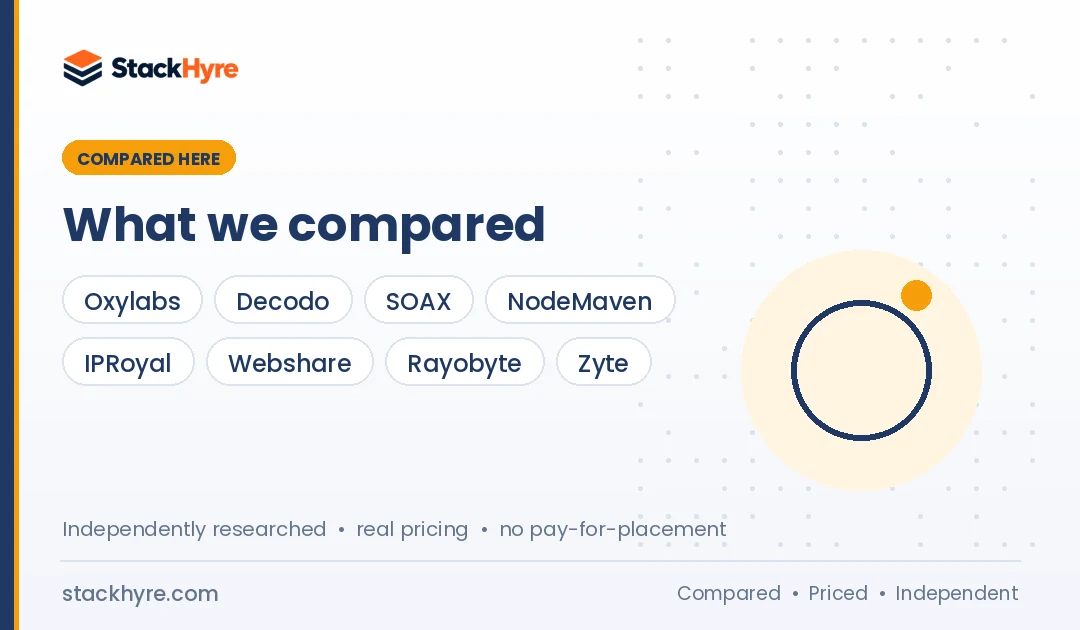
I compared 8 providers that fix one or more of these problems. If you’d rather see the whole market first, start with my guide to the best proxy providers overall. If per-GB and per-IP billing still confuses you, read my proxy pricing guide.
Quick Comparison: 8 Best Bright Data Alternatives
| Provider | Best For | Starting Price | Key Feature |
|---|---|---|---|
| Oxylabs | Enterprise scraping at scale | $30/mo plan (residential $6/GB) | One subscription covers all products |
| Decodo | Best overall value | $3.75/GB (3 GB plan) | Monthly plans plus pay as you go |
| SOAX | Precise geo targeting | $200/mo Builder plan | Per-GB rates by geo tier |
| NodeMaven | Clean IPs for account work | $3.50 trial for 750 MB | Real-time IP quality filtering |
| IPRoyal | Traffic that never expires | $7/GB for 1 GB | No monthly minimum |
| Webshare | Budget datacenter and testing | Free plan, then $2.99/mo | 10 free proxies forever |
| Rayobyte | Very high-volume bandwidth | $3.50/GB pay as you go | Sub-cent Scale residential plans |
| Zyte | Managed scraping API | $5 free credit, then per request | Pay per successful request |
What Makes a Great Bright Data Alternative?
A good Bright Data alternative matches it where you need it and beats it where it hurts you. For most people that means a lower per-GB price, faster self-serve signup, or a product Bright Data no longer sells, like mobile proxies. I also want to see clear IP sourcing, honest pricing pages and real support. Pool size alone should never decide it for you.
Bright Data sets a high bar on features. It offers ZIP and ASN targeting, dedicated residential IPs and no concurrency limits, according to Proxyway’s review. You won’t find all of that somewhere else for less money.
So decide what you can live without. In my view, most teams only need four things:
- Reliable success rates on the sites you actually target.
- Location targeting down to the level your project needs.
- Predictable billing that fits your monthly traffic.
- Ethical sourcing with clear consent and a KYC process that is proportionate.
If a provider covers those four, I count it as a real alternative. Everything else comes down to fit and budget.
Why Do Teams Switch Away From Bright Data?
Most teams leave over price, access rules or a missing product. Bright Data lists residential traffic at $4/GB pay as you go during a 50% promo, with a list price of $8/GB. Its new KYC policy also shuts personal accounts out of residential zones. And it no longer sells mobile proxies, according to Proxyway’s 2026 market research.
Here’s what that means day to day.
Price. Bright Data’s residential pricing page shows $4/GB pay as you go with the RESIGB50 coupon, struck through from $8/GB. Monthly plans start at $499. The same page shows other starting figures in its menu too, so check the live page before you set a budget.
Access. The residential access policy asks for a company email, added funds and a company registration document. The compliance team may also want a government ID and a video call. Freelancers and hobby projects often get stuck right here.
Scope limits. Even once you’re approved, residential access only covers your approved use case. Out-of-scope domains return an “Access denied” error. Government websites are blocked on every network.
Mobile. If you need 4G or 5G IPs, you have to shop elsewhere. Oxylabs, Decodo, SOAX and NodeMaven all sell them.
To be fair, strict KYC is also a trust signal. It keeps abusive traffic off the network. The real question is whether that process fits the way you work.
Best Enterprise-Grade Bright Data Alternatives
These three come closest to Bright Data on scale and features. Oxylabs is the direct peer. Decodo and SOAX give up a few advanced options in exchange for lower prices and simpler dashboards.
#1 Oxylabs: Best for enterprise scraping at scale
If you want a like-for-like swap, Oxylabs is it. The pools are comparable and the scraping API stack is complete.
What it does well. Oxylabs posted the strongest residential numbers in Proxyway’s 2026 benchmark. It hit a 99.93% global success rate and a 0.60 s average response time. It also returned 3,241,404 unique IPs from 3.6 million requests, the most of any provider tested, per Proxyway’s research.
Key features:
- Residential, mobile, ISP and datacenter proxies under one account.
- Web Scraper API, Web Unblocker and Agent Browser products.
- Country, city, ASN, ZIP (US) and coordinate targeting on residential, per Proxyway’s Oxylabs review.
- Spend caps per product, which your finance team will like.
Pricing. Oxylabs moved to a single credit subscription in October 2026, as tracked by PricingSaaS. The Oxylabs pricing page lists Starter at $30/mo, Basic at $100/mo, Flexible at $500/mo and Enterprise from $2,500/mo, as of October 2026. Residential runs $6/GB on Starter and $2.5/GB on Enterprise. Mobile runs $7.5/GB down to $3.5/GB. Proxyway notes that plans expire at the end of each cycle and there’s no pay as you go.
Best for: Companies that want Bright Data-level infrastructure plus a mobile network.
Limitations. It’s still premium priced. Unused plan value doesn’t carry over, so small or irregular projects can waste money. Proxyway also flags that two-factor authentication is missing. My Bright Data vs Oxylabs comparison goes through the head-to-head in detail.
#2 Decodo: Best overall value
Decodo, the former Smartproxy, is where I’d send most people who want near-premium performance at mid-market prices.
What it does well. Decodo hit a 99.92% global residential success rate with a 0.53 s average response in Proxyway’s 2026 tests. That’s the fastest global residential response in the report. Proxyway also named it the fastest mobile provider at 0.74 s.
Key features:
- Residential, mobile, static residential (ISP) and datacenter proxies.
- Web Data API and Site Unblocker for harder targets.
- Decodo claims 115M+ ethically sourced IPs in 195+ locations.
- Rebranded from Smartproxy in April 2025, per Proxyway’s news report.
Pricing. The Decodo residential pricing page lists monthly plans from $3.75/GB (3 GB for $11.25) down to $2.75/GB at 100 GB, as of October 2026. Enterprise plans reach $2.00/GB at 1,000 GB. Pay as you go costs $4/GB through a wallet. Mobile starts from $2.25/GB and static residential from $0.27/IP.
Best for: Small and mid-size teams that want strong success rates without signing an enterprise contract.
Limitations. Targeting isn’t as granular as Bright Data’s top tier. The free trial is small, at 100 MB for 3 days. And the paid plan starts on its own unless you cancel. Read my full Decodo review before you commit.
#3 SOAX: Best for precise geo targeting
SOAX sticks to clean residential and mobile pools, and what you pay depends on the country you target.
What it does well. SOAX posted the best US residential success rate in Proxyway’s 2026 benchmark, at 99.92%. Its US response time averaged 0.55 s. Proxyway’s Bright Data review also names SOAX as a cheaper pick for precise location targeting.
Key features:
- Residential and mobile networks on every plan.
- Geo-tiered per-GB pricing, so cheaper countries cost less.
- A free Sandbox account to test with top-up credits.
- Advertised pools of 155M residential and 33M mobile IPs, per Proxyway.
Pricing. The SOAX pricing page lists Builder at $200/mo, Team at $500/mo, Scale at $1,500/mo and Enterprise at $3,000/mo, as of October 2026. On Builder, Tier 1 countries cost $3.00/GB and Tier 3 countries $1.20/GB. Credits expire 60 days after you add them.
Best for: Ad verification, local SEO and price checks in specific cities or regions.
Limitations. SOAX no longer lists ISP or datacenter proxies on its pricing page. There’s no free trial, only the Sandbox with paid credits. And $200 just to get in is a lot for a small test.
Best Value Bright Data Alternatives for Small Teams
These providers skip enterprise contracts. You can start with a few dollars, which is the opposite of Bright Data’s KYC-first model. If you want the lowest rates in this group, also look at my list of cheap residential proxies.
#4 NodeMaven: Best for clean IPs in account work
NodeMaven filters its residential and mobile IPs for quality before you get them. That makes it a good fit for multi-account and social work.
What it does well. NodeMaven says it screens each IP in real time against fraud scores, blacklists and reputation databases. It claims a 95%+ clean IP rate on its pricing page. Keep in mind these are vendor claims, not independent results.
Key features:
- Residential, mobile and static ISP proxies.
- Unused bandwidth rolls over to the next month, per the vendor.
- NodeMaven claims 30M+ residential and 250K mobile IPs.
- Cashback on used traffic, up to 10% according to the vendor.
Pricing. NodeMaven’s residential and mobile traffic starts at about $2.20/GB, but only on its largest monthly plans. The smallest plan is $8.50 for 2 GB. A paid trial costs $3.50 for 750 MB. Static ISP proxies cost about $2.33 per IP per 30 days, as of October 2026.
Best for: Social media management, ad accounts and antidetect browser setups where IP reputation matters.
Limitations. There’s no free trial. You need a big plan to get the headline per-GB rate. NodeMaven wasn’t in Proxyway’s 2026 benchmark, so there’s little independent performance data.
#5 IPRoyal: Best for traffic that never expires
IPRoyal sells residential traffic that stays on your account until you use it.
What it does well. Traffic that never expires takes away the “use it or lose it” pressure of monthly plans. IPRoyal also had the cleanest pool in Proxyway’s 2026 risk test, with a 16.70% flagged-residential share.
Key features:
- Never-expiring residential traffic with no monthly minimum.
- Pay as you go or subscription at 5% off.
- IPRoyal claims 64M+ residential IPs in 195+ countries.
- Also sells ISP, datacenter and mobile proxies.
Pricing. The IPRoyal residential pricing page lists $7.00/GB for 1 GB on subscription and $5.25/GB at 10 GB, as of October 2026. Custom plans from 10 TB drop to $1.75/GB.
Best for: Freelancers and small teams whose usage jumps around month to month.
Limitations. Performance sits below the premium tier. Proxyway measured a 96.11% global success rate and a 1.24 s response time in 2026.
#6 Webshare: Best for budget datacenter proxies and testing
Webshare is the cheapest way to get started, with a free plan and very low datacenter prices.
What it does well. You get 10 free shared proxies and 1 GB of monthly bandwidth without a card. Proxyway measured a 99.28% global residential success rate and a 0.86 s response in 2026.
Key features:
- Free plan with HTTP and SOCKS5 support.
- Datacenter, rotating residential and static residential proxies.
- Self-serve signup, with no card needed for the free plan.
- Advertised residential pool of 80M IPs, per Proxyway.
Pricing. The Webshare pricing page lists 100 datacenter proxies for $2.99/mo, as of October 2026. Rotating residential costs $3.50/GB on the 1 GB plan and $1.40/GB at 3,000 GB. Static residential starts at $6/mo for 20 proxies.
Best for: Developers testing scrapers, small bots and low-risk targets.
Limitations. Webshare has no mobile proxies. Its targeting is basic next to Bright Data.
Best High-Volume and API Alternatives
Some teams leave Bright Data because the bandwidth bills got too big. Others just want to stop managing proxies. These two options each solve one of those problems.
#7 Rayobyte: Best for very high-volume bandwidth
Rayobyte is a US provider that relaunched its pricing in early October 2026 with very cheap bulk plans.
What it does well. Its new Scale Residential plans start at $0.015/GB and drop to $0.0095/GB, per Proxyway’s October 6, 2026 report. Proxyway called them “significantly cheaper than anything we’ve seen on the market.”
Key features:
- Scale and Premium residential tiers.
- Rotating ISP, rotating datacenter, mobile and static IPs.
- Scraping API and Web Unblocker.
- Free trial on every self-serve product, no card required.
Pricing. The Rayobyte pricing page lists Scale Residential from $100/mo for 6,600 GB, as of October 2026. Premium Residential costs $3.50/GB for 1 to 49 GB, dropping to $0.70/GB at 1,000 GB and up.
Best for: AI data collection and bulk crawling where cost per GB matters most.
Limitations. Scale has no pay as you go, no location filtering and one concurrent connection per dollar spent, per Proxyway. Premium residential scored a 98.02% global success rate with a slow 1.86 s response in Proxyway’s 2026 tests.
#8 Zyte: Best managed scraping API
Zyte replaces Bright Data’s Web Unlocker and Scraper APIs, not its raw proxy network.
What it does well. Zyte API deals with IP rotation, browser rendering and bans for you. You pay per request, and the price depends on how hard the target site is. Rotation across residential, datacenter and mobile IPs is built in.
Key features:
- Five difficulty tiers, from Simple to Advanced.
- HTTP and browser-rendered responses.
- No overage fee beyond your discounted rate.
- Cost calculator and API playground.
Pricing. The Zyte pricing page offers $5 free credit for 30 days. Pay as you go HTTP requests cost $0.13 per 1,000 on simple sites and $1.27 per 1,000 on advanced ones, as of October 2026. Subscriptions from $100/mo bring those rates down.
Best for: Teams that want data, not proxy management.
Limitations. You can’t use Zyte as a general proxy for browsers or account tools. Browser rendering on hard sites gets expensive fast, up to $16.08 per 1,000 requests on pay as you go.
Which Bright Data Alternatives Should You Avoid?
Skip any provider that can’t tell you where its residential IPs come from. The clearest warning in 2026 is NetNut. The FBI seized NetNut’s infrastructure, and KrebsOnSecurity linked it to the Popa botnet of at least two million infected devices. Running traffic through networks like that puts your data, accounts and reputation at risk.
KrebsOnSecurity reported the seizure on July 2, 2026. NetNut was run by Alarum Technologies, a listed company. Being public didn’t make its sourcing safe.
These are the red flags I look for:
- No public statement on how residential IPs are sourced or how users consent.
- Prices far below the market with no catch explained.
- No KYC or abuse policy of any kind.
- Anonymous ownership or crypto-only payment.
My proxy provider buying checklist shows how to vet a vendor before you pay.
How Should You Choose the Right Bright Data Alternative?
Start with why you’re leaving Bright Data. If price is the problem, compare per-GB rates at your real monthly volume. If KYC is blocking you, pick a self-serve vendor. If you need mobile IPs, go with Oxylabs, Decodo, SOAX or NodeMaven. Then run a small paid test on your own targets before you commit.
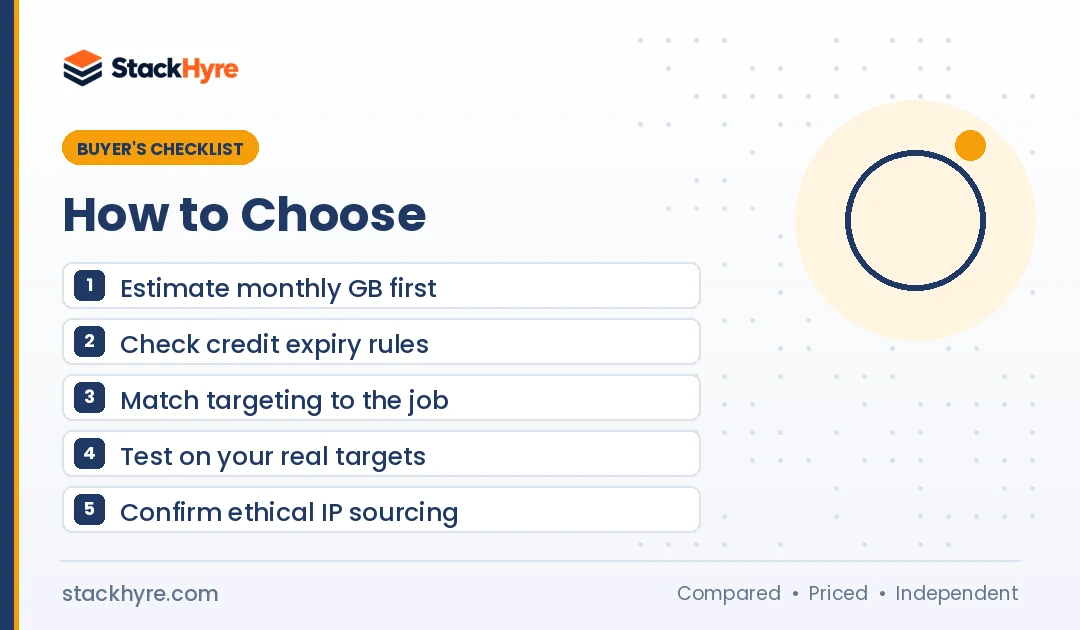
Here’s how I’d work through it:
- Estimate your monthly traffic. A 5 GB project and a 500 GB project have different winners. Entry plans look cheap but cost more per GB.
- Check expiry rules. Oxylabs plan value resets each cycle. SOAX credits last 60 days. IPRoyal traffic never expires. NodeMaven rolls unused bandwidth forward.
- Match targeting to the job. City or ZIP targeting matters for local SEO and ads. It rarely matters for bulk crawling.
- Test on your real targets. Benchmarks on Amazon or Google may not reflect your sites. Use a trial or the smallest plan.
- Read the acceptable use policy. Make sure your use case is allowed. Follow each target site’s terms and your local law.
My quick picks by need:
- Same scale, less friction: Oxylabs.
- Best price-to-performance: Decodo.
- City-level targeting: SOAX.
- Clean IPs for accounts: NodeMaven.
- Irregular usage: IPRoyal.
- Testing on a tiny budget: Webshare.
- Massive bandwidth: Rayobyte Scale.
- No proxy management: Zyte.
How I Evaluated These Bright Data Alternatives
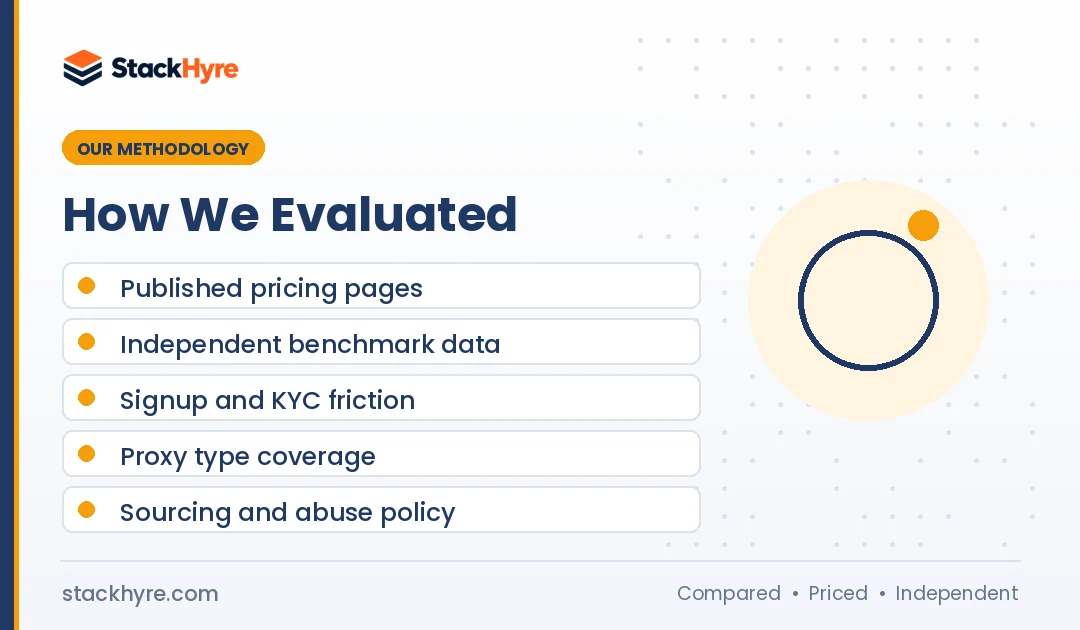
I didn’t run my own speed tests for this guide. I compared published pricing pages, product docs, access policies and independent benchmarks. I checked every price on the vendor’s own page in October 2026. Performance figures come from Proxyway’s 2026 market research, which tested residential pools over 21 days.
I scored each provider on five factors:
- Price transparency: Are rates public, and do they hold at small volumes?
- Independent performance: Success rate and response time from third-party tests.
- Access and onboarding: How fast a normal business can start.
- Product coverage: Residential, mobile, ISP, datacenter and API options.
- Sourcing and compliance: Public statements on ethical IP sourcing, KYC and abuse handling.
Vendor claims, like pool sizes and clean-IP rates, are labeled as the vendor’s. Prices change often, so confirm them before you buy. You can read more in my editorial policy.
The Bottom Line
Bright Data is still a strong network with a lot of features. But it’s expensive, it now requires business KYC for residential access, and it no longer sells mobile proxies.
If you want a true peer, I’d choose Oxylabs. It led Proxyway’s 2026 residential benchmark and adds mobile IPs. If you want the best value, I’d choose Decodo. It matched premium success rates at mid-market prices.
On a smaller budget, NodeMaven, IPRoyal and Webshare let you start with a few dollars. For huge bandwidth, look at Rayobyte Scale. And if you don’t want to touch proxies at all, use Zyte.
Whatever you pick, test it on your own targets first. Then compare it with the rest of the market in my best proxy providers guide. If Oxylabs is on your shortlist, my Oxylabs alternatives list shows what else competes at that tier.
Frequently Asked Questions
What is the best alternative to Bright Data?
For enterprise use, my pick is Oxylabs. It posted a 99.93% global residential success rate in Proxyway’s 2026 benchmark and sells mobile proxies, which Bright Data dropped in April 2026. If value matters more, Decodo offers near-identical success rates from $3.75/GB on small plans, as of October 2026.
Is there a cheaper alternative to Bright Data?
Yes. Decodo, IPRoyal, Webshare and NodeMaven all start lower than Bright Data’s residential plans. Webshare has a free plan and rotating residential from $3.50/GB. Rayobyte’s Scale Residential starts at $0.015/GB with a $100 monthly minimum, though it has no location filtering. Always compare at your real monthly volume.
Does Bright Data require KYC?
Yes, for residential proxies. Since July 7, 2026, new residential zones need a human-reviewed KYC check. You need a company email, added funds and a company registration document. ISP proxies, datacenter proxies and Web Unlocker are still available without residential KYC, according to Bright Data’s network access policy.
Does Bright Data still offer mobile proxies?
No. Proxyway’s 2026 market research reports that Bright Data discontinued its mobile proxy product in April 2026. Its proxy pages now list residential, ISP and datacenter networks only. If you need mobile IPs, Oxylabs, Decodo, SOAX and NodeMaven all sell 4G and 5G mobile proxies.
Is NetNut a good Bright Data alternative?
No. The FBI seized NetNut’s infrastructure, as KrebsOnSecurity reported on July 2, 2026. Security researchers linked the service to the Popa botnet, which includes at least two million infected devices. I’d pick a provider that publishes clear IP sourcing and consent practices instead.
Related Articles


Daniel Brooks writes about proxies, web scraping and email infrastructure at StackHyre. He compares providers on published pricing, documentation and independent benchmarks so you can pick the right setup without overpaying.