

TL;DR: Oxylabs is my pick for the best ISP proxy provider for most people. It has the fastest independent response time, with IPs from $1.10 to $1.50 each. Decodo is the best value for dedicated IPs, and Webshare is the cheapest at about $0.30 per IP. I compare 8 static residential providers below on price, locations, bandwidth and IP quality. Prices are as of October 2026.
ISP proxies give you a home-style IP that never changes and never slows down. That mix is hard to find. Residential IPs look real but can be slow. Datacenter IPs are fast but easy to flag.
Websites have good reason to check. The Imperva 2025 Bad Bot Report found that automated traffic reached 51% of all internet traffic. So sites look hard at who owns each IP.
ISP proxies sit on fast servers but are registered to consumer internet providers. Proxyway explains that this gives them residential trust with datacenter speed. Proxyway’s 2026 market research also says demand for ISP proxies appears to be growing.
The market is shifting fast, though. SOAX stopped selling ISP proxies, and NetNut’s domains were seized by the FBI in July 2026. For the wider market, see my guide to the best proxy providers. To see how ISP proxies stack up against other kinds, read my guide to proxy types.
Quick Comparison: The 8 Best ISP Proxies in 2026
| Provider | Best For | Starting Price | Key Feature |
|---|---|---|---|
| Oxylabs | Speed and scale | $1.50/IP (plus subscription) | 0.18 s response time in Proxyway’s test |
| Decodo | Dedicated IP value | $9.99 for 3 dedicated IPs | 19 dedicated ISP countries |
| Bright Data | Largest ISP pool | $1.80/IP shared (10 IPs) | 1.3M+ static residential IPs, per Bright Data |
| NodeMaven | Clean IPs for accounts | $2.33/IP per 30 days | Fraud-score checks plus one free pack swap |
| IPRoyal | Flexible rental terms | $1.80/IP for 24 hours | 31+ countries with city targeting |
| Webshare | Lowest price per IP | $6 for 20 IPs ($0.30/IP) | Up to 1 Gbps per proxy |
| Evomi | Tiered IP quality | $1.00/IP shared | Unlimited bandwidth on every tier |
| Rayobyte | Unmetered US/EU traffic | $5/IP (5 to 99 IPs) | Unlimited bandwidth with fair usage |

What Makes a Great ISP Proxy Provider?
A great ISP proxy provider sells static IPs registered to real consumer ISPs. They stay fast under load and come with clear bandwidth rules. It offers dedicated IPs, covers the countries you target, and screens IPs for fraud scores before delivery. It also lets you replace bad IPs without paying again.
ISP registration. The whole point is that the IP looks residential. Proxyway’s 2026 research warns that many ISP IPs are geolocated virtually. Some IP databases even label them as hosting addresses. So check a sample before you scale.
Dedicated vs shared. Shared IPs are cheaper but carry other users’ history. Dedicated IPs cost more, but only you use them. For account work, I think dedicated is almost always worth it.
Subnet diversity. Proxyway notes that ISP proxies have low subnet diversity, so one ban can hit a whole range. Ask for IPs spread across several subnets.
Billing model. Most providers charge per IP with unlimited or fair-use bandwidth. Some charge per GB. Proxyway’s research calls traffic-bound rotating ISP pools the biggest packaging mistake in the category, and I agree. Pay per IP if you can.
Best ISP Proxies for Speed and Scale
#1 Oxylabs: Best for Speed and Scale
Oxylabs pairs the fastest measured ISP response time with a large pool across 28 countries.
What it does well. Proxyway’s static residential roundup measured a 0.18-second response time for Oxylabs, with near-perfect success rates. Oxylabs’ ISP page lists about 393,000 US IPs alone. Sessions can stay on one IP for as long as you need.
Key features:
- 28 countries, with dedicated or shared options in most
- Unlimited bandwidth with fair usage on pay-per-IP plans
- HTTP, HTTPS and SOCKS5, plus UDP support
- Dedicated ISP proxies now available in self-service
Pricing. As of October 2026, Oxylabs’ pricing page lists ISP IPs at $1.50 each at low volume. The rate falls to $1.10 above 2,270 IPs. You also need one of its subscriptions, which start at $30 a month. New users get a $5 welcome credit.
Best for: Teams that need fast, stable IPs in many countries.
Limitations. Up to three customers can share one shared ISP IP. The ISP page title and its pricing tiers also show different starting prices, so confirm your quote at checkout.
#2 Decodo: Best for Dedicated IP Value
Decodo, the former Smartproxy, has some of the fairest dedicated ISP prices I found, plus a wide country list.
What it does well. Decodo’s ISP pricing page sells dedicated IPs in 19 countries across the Americas, Europe and Asia. You can also buy shared ISP access per GB or per IP. Every plan comes with unlimited threads and SOCKS5 support.
Key features:
- Dedicated, pay-per-GB and pay-per-IP options
- 19 dedicated ISP countries, including Japan and South Korea
- Unlimited threads and concurrent sessions
- 14-day money-back option
Pricing. As of October 2026, dedicated ISP plans start at $9.99 for 3 IPs ($3.33 each). The rate drops to $2.70 at 50 IPs and $2.00 at 2,000 IPs. Shared access starts from $1.30/GB or $0.27/IP. Prices exclude VAT.
Best for: Small teams that want a few dedicated IPs without a big commitment.
Limitations. Proxyway lists average response time as a weak spot for Decodo’s static residential product. Plans above 500 IPs mean talking to sales.
#3 Bright Data: Best for the Largest ISP Pool
Bright Data has the biggest advertised ISP pool and sells both shared and dedicated plans.
What it does well. Bright Data’s ISP pricing page claims a pool of 1,300,000+ static residential IPs. You can rent shared IPs, rent dedicated IPs or pay per GB. You can keep dedicated IPs for as long as you need them.
Key features:
- 1.3M+ static residential IPs, per Bright Data
- Shared, dedicated and per-GB plans
- 100 GB fair-usage allowance per IP each month
- Free trial button on every plan
Pricing. As of October 2026, shared ISP IPs cost $1.80 each for 10 IPs, falling to $1.30 at 1,000 IPs. Dedicated IPs cost $3.50 each for 10, falling to $2.50 at 1,000. Per-GB plans start at $8/GB pay as you go.
Best for: Large teams that need lots of static IPs from one vendor.
Limitations. Proxyway lists Bright Data under providers it hasn’t tested recently and calls its traffic expensive. Heavy users may hit the 100 GB per-IP allowance.
Best ISP Proxies for Account Management
#4 NodeMaven: Best for Clean IPs on Accounts
NodeMaven is all about IP reputation. That’s what counts most when one bad IP can lock an account.
What it does well. NodeMaven’s ISP page says each IP pack is quality-checked with Scamalytics. Packs that fail its fraud-score check get replaced before delivery. Each order also comes with one free full pack swap from the dashboard.
Key features:
- Dedicated ISP IPs with unlimited traffic
- Fraud-score screening before delivery
- One free IP pack swap per order
- 30-day or 90-day terms with auto-renewal
Pricing. As of October 2026, NodeMaven lists ISP proxies from $2.33 per IP for 30 days. Larger orders come with discount codes. Check NodeMaven’s pricing page for the rate at your quantity.
Best for: Social media and ecommerce account managers who need trusted, stable IPs.
Limitations. Locations are limited to about six or seven countries, and the site lists them inconsistently. Speed and quality figures are NodeMaven’s own claims, not independent tests.
#5 IPRoyal: Best for Flexible Rental Terms
IPRoyal lets you rent ISP proxies for as little as a day. Few rivals do that.
What it does well. IPRoyal’s ISP pricing page offers 24-hour, 30-day, 60-day and 90-day terms. It cites premium ISPs in over 31 countries, with state and city targeting. Proxyway’s 2026 research confirms IPRoyal expanded to 30+ countries.
Key features:
- Rental terms from 24 hours to 90 days
- 31+ countries with state and city targeting
- Unlimited threads and sessions
- HTTP(S) and SOCKS5 support
Pricing. As of October 2026, IPRoyal ISP proxies start at $1.80 per IP for 24 hours. A 30-day IP costs $2.70, a 60-day IP $2.55 and a 90-day IP $2.40.
Best for: Short campaigns, product drops and testing a new market.
Limitations. Proxyway notes one location per plan and lists slow download speed as a con. Volume discounts need a custom quote.
Best Budget and High-Bandwidth ISP Proxies
#6 Webshare: Best for the Lowest Price per IP
Webshare is the cheapest ISP option on my list, and it isn’t close.
What it does well. Webshare’s static residential page names ISPs such as AT&T, Comcast and Cox. Speeds reach up to 1 Gbps. At checkout, you can set replacements and refresh rules for your list.
Key features:
- IPs from named US carriers like AT&T and Comcast
- Up to 1 Gbps speed and up to unlimited bandwidth
- Configurable proxy replacements
- Free tier with 10 proxies to try the dashboard
Pricing. As of October 2026, 20 static residential proxies cost $6 a month ($0.30 each). The rate falls to $0.27 at 1,000 IPs and $0.225 at 10,000 IPs.
Best for: Budget buyers who need lots of static IPs, mostly in the US.
Limitations. The page says private static IPs may be shared with a small number of users. Proxyway notes the pool is mostly US IPs. Bandwidth falls under a fair usage policy.
#7 Evomi: Best for Tiered IP Quality
Evomi sells three grades of ISP IP, so you only pay for the quality you need.
What it does well. Evomi’s static residential page offers shared, private and “virgin” IPs. Private IPs come with a low fraud score. Virgin IPs come with a zero fraud score guarantee, based on third-party databases.
Key features:
- Shared, private and virgin IP tiers
- Unlimited bandwidth on every tier
- HTTP, SOCKS5 and UDP support
- Up to 3,000 concurrent connections
Pricing. As of October 2026, shared IPs start at $1.00 each per month. Private IPs start at $2.50, and virgin IPs at $4.50.
Best for: Buyers who want cheap shared IPs for light tasks and clean dedicated IPs for accounts.
Limitations. Evomi doesn’t list its full country set on the product page. Its trial terms aren’t stated there either.
#8 Rayobyte: Best for Unmetered US and EU Traffic
Rayobyte is a pricier, enterprise-leaning option with unmetered bandwidth.
What it does well. Rayobyte’s ISP page says traffic isn’t metered, with fair usage. That fits bandwidth-heavy jobs like media checks. Proxyway lists good response time and US city-level filtering.
Key features:
- Unmetered bandwidth with fair usage
- Static ISP IPs in the US, UK, Canada, Germany, France and Italy
- Semi-dedicated option shared by up to 3 users
- Committed enterprise rates through sales
Pricing. As of October 2026, Rayobyte charges $5 per IP for 5 to 99 IPs. The rate drops to $4.80 at 100 IPs and $4.60 at 1,000 IPs. Rayobyte says committed enterprise deals can go far lower.
Best for: Companies that push a lot of data through a fixed IP set.
Limitations. Proxyway calls Rayobyte expensive per unit. Static ISP IPs aren’t part of the self-serve free trial, so you have to contact sales to try them.

How Should You Choose the Right ISP Proxy?
Start with the countries you need, then decide between shared and dedicated IPs. Compare the price per IP for your term. Check bandwidth caps and fair-use rules, and make sure you can swap bad IPs. Then try a small batch against your real targets and check fraud scores before you scale.
Do you need ISP proxies at all? If you scrape public pages at volume, rotating residential IPs are often the better fit. See my list of the best residential proxies for that. If raw speed matters most and targets are easy, the best datacenter proxies cost less. My guide to rotating vs static proxies walks through the trade-off.
Pick dedicated for accounts. Logged-in work needs one stable identity per account. A shared IP can carry someone else’s bans. If you run many profiles, pair each dedicated IP with a profile in one of the best antidetect browsers.
Check country coverage first. ISP pools cover far fewer locations than residential pools. Oxylabs covers 28 countries, while NodeMaven and Rayobyte cover about six or seven. If you need a niche market, this shrinks your list fast.
Read the bandwidth fine print. “Unlimited” usually means fair use. Bright Data includes 100 GB per IP each month. Webshare and Rayobyte also apply fair usage policies.
Check IP reputation. Run a sample through a fraud-score checker before you scale. Ask for replacements for any flagged IPs. NodeMaven and Webshare both build replacements into their plans.
Respect platform rules. Social and ecommerce sites set their own limits on multiple accounts. My guide to the best proxies for social media covers those cautions in more detail.
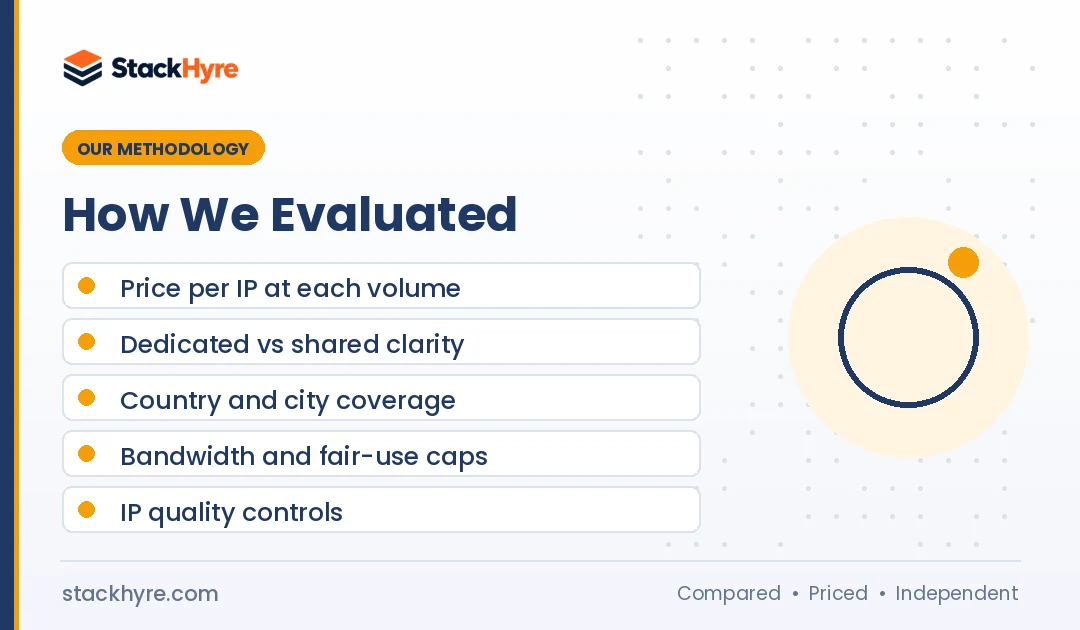
How I Evaluated These ISP Proxies
I didn’t run my own speed tests. I compared each provider’s published ISP pricing, documentation and policies as of October 2026. Then I cross-checked performance against independent sources, mainly Proxyway’s static residential reviews and its 2026 market research.
I scored each provider on six factors:
- Price per IP at small and large volumes
- Dedicated vs shared options and how clearly they’re labeled
- Country coverage and city targeting
- Bandwidth rules, including fair-use caps
- IP quality controls, such as fraud checks and swaps
- Independent performance data where it exists
I left out SOAX because it no longer sells ISP proxies. I excluded NetNut because its domains were seized in July 2026. Pool sizes and quality claims come from vendors unless I name an independent source.
The Bottom Line
Oxylabs is my pick for most people. It combines the fastest measured response time with wide country coverage and fair per-IP pricing. Decodo is the best value for dedicated IPs, with low entry costs and 19 countries. Bright Data makes sense if you need a very large static pool.
For account management, NodeMaven and Evomi stand out for IP quality controls. IPRoyal is the most flexible if you need IPs for a day or a week. Webshare is still the cheapest way to get lots of US static IPs.
Start with a small batch, check fraud scores, and try it on your real targets. Still torn between proxy types? Compare the full field in my guide to the best proxy providers.

Frequently Asked Questions
What is an ISP proxy?
An ISP proxy is a static IP hosted on a fast server but registered to a consumer internet provider. Websites see it as a home connection, yet it runs at datacenter speed. The IP doesn’t change unless you ask. That makes ISP proxies a strong fit for account management, checkouts and any task that needs one stable identity.
Are ISP proxies the same as static residential proxies?
Yes. Most providers use the two names for the same product. Both describe a fixed IP registered to an internet service provider and hosted in a data center. Some vendors, like Webshare and Evomi, use “static residential” in their product names. Others, like Oxylabs and Bright Data, call them ISP proxies. Compare features, not labels.
How much do ISP proxies cost?
ISP proxies usually cost between $0.23 and $5 per IP per month as of October 2026. Webshare starts at $0.30 per IP, and Oxylabs charges $1.10 to $1.50. Decodo’s dedicated plans run from $2.00 to $3.33. Rayobyte charges $5 per IP at low volume. Most plans include unlimited or fair-use bandwidth.
Are ISP proxies better than residential proxies?
ISP proxies win when you need speed and a stable IP, like for logged-in accounts. Rotating residential proxies win for large-scale scraping, because they offer far more IPs and locations. ISP pools also have low subnet diversity, so a site can ban a whole range at once. Plenty of teams use both types.
Should I buy shared or dedicated ISP proxies?
Buy dedicated ISP proxies for account work, checkouts and anything tied to your reputation. Only you use a dedicated IP, so other people’s activity can’t get it banned. Shared ISP proxies cost less and are fine for light scraping or testing. Some providers, like Oxylabs, share each IP with up to three users.
Related Articles

Daniel Brooks writes about proxies, web scraping and email infrastructure at StackHyre. He compares providers on published pricing, documentation and independent benchmarks so you can pick the right setup without overpaying.