
TL;DR: The best MySQL alternatives in 2026 are PostgreSQL for most new projects, MariaDB or Percona Server if you want a near drop-in swap, and SQLite for embedded and small apps. TiDB, PlanetScale and Amazon Aurora cover scale without managing shards yourself. CockroachDB fits multi-region apps. The open-source options are free; managed plans start at $0 to about $5 a month, as of November 2026.
MySQL is still everywhere. The DB-Engines ranking places it second among all databases, behind only Oracle.
But 2026 forced a lot of teams to look again. MySQL 8.0 reached end of life in April 2026, as The Register reported ahead of the deadline. If you’re on 8.0, you have to migrate anyway. So it’s a fair moment to ask whether the next stop should be MySQL at all.
Oracle’s new release model adds to the question. MySQL now ships two tracks, LTS and Innovation. Innovation releases can change SQL syntax, reserved words and query behavior, and you can’t skip an LTS series when upgrading.
Some people also just want a database with a community-run license, or one that scales out without hand-built sharding.
I compared 8 MySQL alternatives on compatibility, license, pricing and migration effort. If you’re also moving document data, read my guide to MongoDB alternatives.
Quick Comparison: 8 Best MySQL Alternatives
| Database | Best For | Starting Price | Key Feature |
|---|---|---|---|
| PostgreSQL | Most new projects | Free, open source | Advanced SQL and extensions |
| MariaDB | Community fork of MySQL | Free, open source | Familiar MySQL syntax |
| Percona Server for MySQL | Truest drop-in swap | Free, open source | Enterprise features at no cost |
| SQLite | Embedded and small apps | Free, public domain | One file, zero setup |
| TiDB | MySQL protocol at scale | Free Starter tier | Distributed, auto-sharding |
| PlanetScale | Managed Vitess or Postgres | Postgres from $5/mo | Branching and online schema changes |
| Amazon Aurora | AWS teams on MySQL | Pay per ACU-hour | MySQL compatible, managed storage |
| CockroachDB | Multi-region apps | 30-day trial; from $0.092/vCPU-hr | Survives zone and region loss |

What Makes a Good MySQL Alternative?
A good MySQL alternative runs your workload with less risk, cost or limits than MySQL, without a painful migration. Judge it on SQL compatibility, license terms, scaling model and the tools your team already uses. A near drop-in fork saves time now. A different engine like PostgreSQL can save more later, but asks for real migration work.
Here’s what I weigh most.
Compatibility. How much of your SQL, stored procedures, drivers and ORM config carries over unchanged?
License and governance. Who controls the project, and could the license change?
Scaling. Do you need read replicas, or true horizontal write scale?
Operations. Will you run it yourself or pay a managed service?
Best Open-Source MySQL Alternatives
#1 PostgreSQL: Best overall MySQL alternative
PostgreSQL is where I’d start any new project today.
What it does well. It handles complex queries, strict data types and JSON in one engine. Window functions, CTEs, partial indexes and a deep extension ecosystem are all mature. And it’s released under the PostgreSQL License, a permissive license similar to BSD or MIT, with the project committed to keeping it free.
Key features:
- Rich SQL with CTEs and window functions
- JSONB with GIN indexes
- Extensions for geospatial, vectors and more
- Strong transactional consistency
- Managed on every major cloud
Pricing. PostgreSQL is free. Managed prices vary by provider. As one example, PlanetScale Postgres starts at $5 a month for a single node, as of November 2026.
Best for: New apps, analytics-heavy apps and teams that want one database to grow into.
Limitations. It’s not a drop-in swap. Syntax, data types and auto-increment handling differ, so plan for schema and query changes. Tools like pgloader can move MySQL schema and data in one command, but app code still needs review.
#2 MariaDB: Best community fork of MySQL
MariaDB was forked from MySQL by its original developers, and it still feels like home to MySQL users.
What it does well. Most MySQL syntax, clients and connectors work. It adds extra storage engines and Galera clustering. Linux distributions often ship it as their default MySQL-family database.
Key features:
- MySQL-style SQL and client protocol
- Galera multi-primary clustering
- Several storage engines
- Community governance through the MariaDB Foundation
- Enterprise support available
Pricing. MariaDB Community Server is free. Enterprise subscriptions are quoted, so check the current price with MariaDB.
Best for: Teams that want to stay close to MySQL but leave Oracle’s stewardship.
Limitations. The two have drifted apart since MySQL 8. MariaDB’s own compatibility notes describe it as a limited drop-in for MySQL 5.7 and earlier. JSON is stored as text, Group Replication and the X protocol aren’t supported, and some syntax differs. Test carefully if you’re on MySQL 8.
#3 Percona Server for MySQL: Best true drop-in replacement
If you like MySQL and just want a better build of it, use Percona Server.
What it does well. Percona calls it a complete drop-in replacement for MySQL Community Edition, with no code or config changes needed. It adds features that MySQL reserves for its paid Enterprise Edition, without license fees.
Key features:
- Drop-in for MySQL Community
- Extra performance and diagnostics features
- Security features without Enterprise fees
- XtraDB Cluster for Galera clustering
Pricing. Percona Server is free and open source. Paid support is available from Percona, so check the current price with them.
Best for: MySQL shops that want the lowest migration risk.
Limitations. It follows upstream MySQL, so it doesn’t escape MySQL’s design limits or Oracle’s roadmap. It’s a better MySQL, not a different database.
#4 SQLite: Best for embedded and small apps
Many apps use MySQL when a single file would do.
What it does well. SQLite runs inside your app with no server, no config and no admin. The SQLite team’s guide on when to use it says sites under about 100,000 hits a day should work fine, calls that estimate conservative, and lists a maximum database size of 281 TB.
Key features:
- Serverless, single-file database
- Zero configuration
- Public domain source code
- Unlimited readers
- Great for tests, edge and mobile
Pricing. Free. SQLite is in the public domain.
Best for: Desktop and mobile apps, small websites, internal tools, tests and edge deployments.
Limitations. It allows only one writer at a time. The SQLite team says to use a client/server database for many clients over a network, high write concurrency or data near the terabyte range.
Best Scalable and Managed MySQL Alternatives
#5 TiDB: Best for MySQL protocol at scale
TiDB speaks MySQL but scales out like a distributed system.
What it does well. PingCAP’s compatibility docs say TiDB supports common features and syntax of MySQL 5.7 and 8.0, and tools like MySQL Workbench and DBeaver work with it. It splits data across nodes automatically, so you stop hand-sharding.
Key features:
- MySQL wire protocol
- Automatic horizontal scaling
- Row and columnar storage for mixed workloads
- Open source self-managed edition
- TiDB Cloud on AWS, Google Cloud and Azure
Pricing. The TiDB Cloud pricing page lists a Starter tier at $0 a month with a free usage allowance, Essential from $400 a month in compute, and Dedicated from $1,376 a month, as of November 2026. Self-managed TiDB is free.
Best for: Fast-growing MySQL apps that have outgrown one primary.
Limitations. Stored procedures, triggers, events, user-defined functions and spatial types aren’t supported, per PingCAP’s docs. Check your schema against that list first.
#6 PlanetScale: Best managed Vitess or Postgres
PlanetScale runs Vitess, the sharding layer for MySQL, and now PostgreSQL too.
What it does well. It gives you database branches and online schema changes, so migrations stop locking tables. On the MySQL side, Vitess handles sharding behind one endpoint. You get scale-out without building it yourself.
Key features:
- Managed Vitess for MySQL
- Managed PostgreSQL
- Branching and deploy requests
- Metal plans with local NVMe
- Option to run in your own AWS or GCP account
Pricing. PlanetScale’s pricing page lists Postgres single node from $5 a month and Metal from $50 a month, as of November 2026. Vitess pricing depends on cluster size and storage, so check the current price on the page.
Best for: Teams that want managed MySQL scale-out and safer schema changes.
Limitations. Vitess has its own rules on cross-shard queries and foreign keys.
#7 Amazon Aurora: Best for AWS teams on MySQL
Aurora keeps MySQL compatibility but swaps in AWS’s own storage layer.
What it does well. You point your MySQL app at Aurora and keep most of your code. AWS handles storage growth, replicas and failover. The serverless option scales capacity with load.
Key features:
- MySQL and PostgreSQL compatible editions
- Storage that grows automatically
- Read replicas and fast failover
- Serverless capacity scaling
- Global database across regions
Pricing. AWS’s Aurora pricing page uses $0.12 per ACU-hour for serverless, $0.10 per GB-month for storage and $0.20 per million I/O requests in its US East Aurora Standard examples, as of November 2026.
Best for: AWS teams that want managed MySQL with less tuning.
Limitations. I/O charges can surprise you on busy workloads. It’s AWS-only. And it’s still MySQL, so it doesn’t fix MySQL’s feature gaps.
#8 CockroachDB: Best for multi-region apps
CockroachDB is distributed SQL built to keep running when a zone or region goes down.
What it does well. It speaks the PostgreSQL wire protocol, replicates data across nodes and handles failover on its own. You can pin data to regions for latency or data residency rules.
Key features:
- PostgreSQL wire compatibility
- Automatic replication and rebalancing
- Multi-region data placement
- Serializable transactions
- Cloud or self-hosted
Pricing. The CockroachDB pricing page offers a 30-day trial with $400 in credit. Standard is $0.092 per vCPU-hour, about $203 a month for 2 vCPUs and 100 GB on AWS, and Mission Critical is $0.162 per vCPU-hour, as of November 2026.
Best for: Global apps that need strong consistency and high uptime.
Limitations. It’s a move to PostgreSQL-style SQL, not MySQL, so expect a rewrite. Costs are higher than a single MySQL server for small apps.
Should You Switch From MySQL to NoSQL?
Usually not. MongoDB and DynamoDB show up on many MySQL alternative lists, but they solve a different problem. They fit flexible documents or key-value lookups at scale. If your data has relationships and you rely on joins, a relational alternative is the safer move.
If part of your app really is document-shaped, keep the core in SQL and move that part. My MongoDB alternatives guide covers the trade-offs.
How Should You Choose the Right MySQL Alternative?
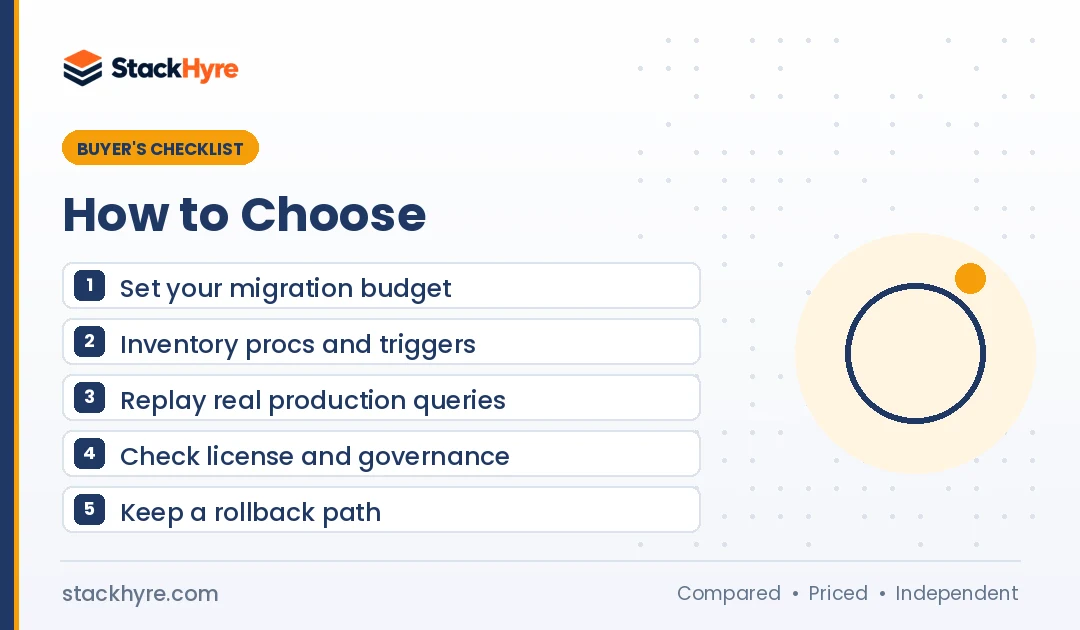
Pick by migration budget first. With little time, choose Percona Server for a true drop-in, or MariaDB if you’re on MySQL 5.7. With time to migrate, choose PostgreSQL. For small or embedded apps, choose SQLite. For scale without hand-sharding, choose TiDB or PlanetScale. On AWS, Aurora is the easiest managed path. For multi-region, choose CockroachDB.
Here’s how I’d rate migration effort.
| Target | Migration Effort | What Changes |
|---|---|---|
| Percona Server | Very low | Swap binaries; same config |
| Amazon Aurora (MySQL) | Low | Endpoint and tuning |
| MariaDB | Low to medium | JSON, replication and syntax checks |
| TiDB | Medium | Remove procedures, triggers, spatial types |
| PostgreSQL | Medium to high | Schema types and SQL rewrite |
| CockroachDB | High | Postgres SQL plus distributed design |
A few habits make any migration safer.
Inventory your features. List stored procedures, triggers, JSON columns and spatial types. Those cause most breakages.
Replay real traffic. Capture production queries and run them against the new database before cutover.
Watch error rates after the switch. Error tracking catches broken queries fast. See my Sentry alternatives guide if you need a tool.
Keep a rollback path. Replicate back to the old database for a week so you can undo the switch.
How I Evaluated These MySQL Alternatives
I didn’t run benchmarks for this guide. I compared each database using public sources and link to them for every price and claim.
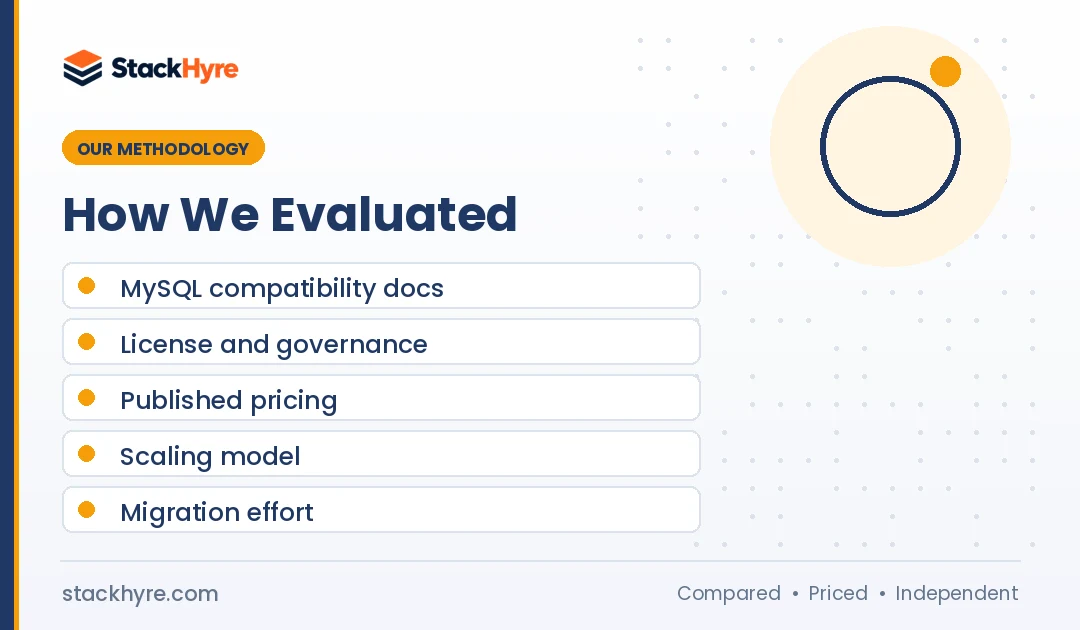
- MySQL compatibility. Based on each vendor’s own compatibility docs.
- License and governance. Who owns the project and under what license.
- Published pricing. Vendor pricing pages, checked in November 2026.
- Scaling model. Single primary, replicas or distributed writes.
- Migration effort. How much schema, SQL and app code must change.
I also read the top ranking guides for this keyword and included the databases that appeared on most of them. My editorial policy explains how I research and update these guides.
The Bottom Line
If you’re starting fresh, choose PostgreSQL. It has the richest SQL, a permissive license and a huge ecosystem.
If you’re on MySQL and just need off 8.0 with low risk, Percona Server is the easiest move, and MariaDB works well from 5.7. Pick SQLite when a server is overkill. Choose TiDB or PlanetScale when one primary can’t keep up, Aurora on AWS, and CockroachDB for multi-region uptime.
Start with a feature inventory and a test copy of production. If you’re also rethinking where your database runs, see my guide to Kubernetes alternatives.
Frequently Asked Questions
What is the best free alternative to MySQL?
PostgreSQL is the best free alternative for most new projects. It’s released under the permissive PostgreSQL License and offers richer SQL, JSONB and many extensions. If you want to stay MySQL-compatible, Percona Server for MySQL and MariaDB are both free and open source. SQLite is free too and fits small or embedded apps.
Is MariaDB a drop-in replacement for MySQL?
Only partly. MariaDB’s own docs describe it as a limited drop-in for MySQL 5.7 and earlier. Since MySQL 8, the two have drifted. MariaDB stores JSON as text, lacks Group Replication and the X protocol, and differs in some syntax. If you need a true drop-in for MySQL 8, Percona Server is the closer match.
Is PostgreSQL better than MySQL?
For most new apps, I think so. PostgreSQL has richer SQL, stronger JSON support, a large extension ecosystem and a permissive community license. MySQL is still simpler for many read-heavy web apps and has huge hosting support. If your team knows MySQL well and your app works, a switch only pays off if you need PostgreSQL’s features.
What happens now that MySQL 8.0 is end of life?
MySQL 8.0 reached end of life in April 2026, so it no longer gets regular fixes from Oracle. You should move to a supported version such as MySQL 8.4 LTS, or to an alternative. Percona Server and Amazon Aurora offer low-effort paths. PostgreSQL is a bigger move but removes future MySQL upgrade worries.
Which MySQL alternative scales best?
For MySQL-compatible scale-out, TiDB and PlanetScale’s managed Vitess both spread data across nodes so you avoid hand-built sharding. TiDB speaks the MySQL protocol and supports most MySQL 5.7 and 8.0 syntax. For global, multi-region apps that can move to PostgreSQL-style SQL, CockroachDB handles replication and failover on its own.
Related Articles



The StackHyre Editorial Team writes about proxies, web scraping and email infrastructure. We compare providers using published pricing, official documentation and third-party reviews. All content is for educational and informational purposes only.