
TL;DR: As of October 2026, sending 10,000 transactional emails a month costs about $1 on Amazon SES and $15 to $20 on most managed services. At 100,000 emails, list prices run from $10 on SES to $115 on Postmark Basic. At 1 million, the spread is $100 to several hundred dollars. Below I show prices at four volumes, free tiers, dedicated IP costs and the hidden fees that inflate a bill.
The cheapest list price in transactional email is hard to beat. Amazon SES pricing sits at $0.10 per 1,000 emails on its pay-as-you-go option. That’s $100 for a million messages.
Yet plenty of SaaS teams pay five or ten times that on purpose. They’re buying logs, dashboards, support and less engineering work.
So the real question isn’t “who is cheapest?” It’s “what do I get for the extra money, and do I need it?”
I pulled current list prices from nine providers’ own pricing pages. Below you’ll find the cost at 10k, 50k, 100k and 1M emails a month, plus the extras that change the total.
If you still need a shortlist of providers, start with my guide to the best transactional email services for SaaS, then come back here to check the math.
Every price is as of October 2026 and comes from the vendor’s site. Prices change, so confirm on the vendor page before you commit.
Quick Comparison: Transactional Email Pricing at 10k, 50k, 100k and 1M Emails
| Provider | 10k/mo | 50k/mo | 100k/mo | 1M/mo |
|---|---|---|---|---|
| Amazon SES (pay as you go) | $1 | $5 | $10 | $100 |
| Postmark (Basic) | $15 | $55 | $115 (125k tier) | $775 (1.5M tier) |
| Resend | $20 (Pro, 50k) | $20 | $35 (Pro) | $650 (Scale) |
| Mailgun | $15 (Basic) | $35 (Foundation) | $90 (Scale) | Custom quote |
| SendGrid (Twilio) | $19.95 (Essentials entry) | From $19.95 | See calculator | Pro, from $89.95 |
| MailerSend | $35 (Starter, 50k) | $35 | $35 plus overage | Custom quote |
| SMTP2GO | $10 (Starter) | See calculator | $75 (Professional) | Custom quote |
| Bird (ex-SparkPost) | $15 deposit | About $20 | About $40 | About $350 to $450 |

Notes on the table: SES figures are my math from the $0.10 per 1,000 rate and exclude attachment data. Bird figures are my math from its published per-1,000 rates, not included allowances. “Custom quote” means the vendor shows no public price at that volume.
How Much Does Transactional Email Cost?
Transactional email costs between $0.10 and about $1.80 per 1,000 emails in October 2026. Amazon SES is the floor at $0.10 per 1,000 on pay as you go. Managed services usually charge $15 to $20 a month for 10,000 to 50,000 emails. Unit costs drop as volume grows, and overage rates on small plans run $0.90 to $1.80 per 1,000.
Here’s the pattern I saw across vendors.
At low volume, the monthly minimum dominates. You pay $15 to $20 whether you send 3,000 emails or 30,000.
At mid volume, around 100,000 a month, plan design starts to matter. Resend’s Pro plan covers 100,000 for $35. Mailgun’s Scale plan is $90 for the same volume, but adds 30-day logs and a dedicated IP.
At high volume, unit price wins. Resend’s 1M tier works out to $0.65 per 1,000. Postmark’s 1.5M Basic tier works out to about $0.52 per 1,000. SES stays at $0.10.
How Do Transactional Email Pricing Models Work?
Most providers use one of four pricing models: tiered monthly plans with an email allowance, pure pay per email, prepaid deposits that become a spendable balance, or contact-based marketing plans that also cover transactional mail. Tiered plans are the most common. Pay per email suits spiky or very high volume. Know which model you’re on, because overages work differently in each.
Tiered monthly plans
Postmark, Resend, Mailgun, SendGrid, MailerSend and SMTP2GO use this model. You pick a volume tier, pay a flat monthly fee and pay overage past the allowance.
The catch is overage pricing. Postmark’s pricing page lists Basic overage at $1.80 per 1,000, Pro at $1.30 and Platform at $1.20. That’s well above its per-email rate on bigger tiers.
Pay per email
Amazon SES charges by the message. There’s no monthly minimum on the pay-as-you-go option. You also pay $0.12 per GB of attachment data.
SES now also lists bundled plans. Its pricing page shows Essentials from $0.16 per 1,000, Pro from $0.22 and Enterprise from $0.23 for the first 10 million emails. Check what each bundle includes before you pick it over plain pay as you go.
Prepaid deposits
Bird’s email pricing page uses a wallet model. A paid plan adds a monthly deposit to your Bird balance: $15 on Startup, $250 on Growth and $1,000 on Scale.
You then pay per email from that balance: $0.40 per 1,000 on Startup, $0.45 on Growth and $0.35 on Scale. Unused balance carries forward. The same balance can pay for other Bird products, like SMS.
Marketing plans that include transactional
Brevo bundles transactional email into its marketing plans. Brevo’s pricing page says its Starter plan includes from 5,000 emails a month, and its FAQ says every plan includes transactional email features. Prices scale by email volume, so check its calculator for your number. This model can work if you want one tool for both. But I’d still keep transactional mail on its own subdomain.
Which Transactional Email Services Have Free Tiers?
Most providers offer a free tier or trial, but the limits are small and best for testing. Resend gives 3,000 emails a month, SMTP2GO gives 1,000, Bird gives 1,000, MailerSend gives 500, and Postmark gives 100. Mailgun allows 100 a day. SendGrid offers a 60-day trial at 100 a day. Amazon SES works through AWS Free Tier credits for new accounts.
- Resend: 3,000 emails a month, capped at 100 a day, with 30-day data retention.
- SMTP2GO: up to 1,000 emails a month, capped at 200 a day, per SMTP2GO’s pricing page.
- Bird: 1,000 emails a month and 50 a day. Sending stops at the limit.
- MailerSend: 500 emails a month, per MailerSend’s pricing page.
- Mailgun: 100 emails a day, with 1 day of logs and one custom domain.
- Postmark: 100 emails a month, with no overages allowed and no expiry.
- SendGrid: a 60-day free trial at 100 emails a day, no credit card needed, per SendGrid’s pricing page.
- Amazon SES: new AWS customers get up to $200 in Free Tier credits that apply to SES and other services.
A free tier is fine for development and staging. For production, don’t run a SaaS app on a 100-per-day cap. One busy sign-up day and your resets stop.
What Do Dedicated IPs Cost?
Dedicated IPs cost from about $25 to $59 per IP per month, or come bundled with higher plans. Amazon SES charges $24.95 per IP. Resend charges $30. Postmark starts at $50 for senders above 300,000 emails a month. Mailgun includes one at 100,000+ volume and charges $59 for extras. SendGrid includes one on Pro.
| Provider | Dedicated IP Price | Who Can Get One |
|---|---|---|
| Amazon SES | $24.95/mo per IP, or managed from $15/mo plus per-email fee | Any account |
| Resend | $30/mo add-on | Scale plan, aimed at 3,000+ emails a day |
| Postmark | From $50/mo per IP | Pro or higher, 300,000+ emails a month |
| Mailgun | One included at 100k+, extras $59/mo | Foundation 100k and up |
| SendGrid | One included, more as add-on | Pro and Premier |
| MailerSend | Contact support | Enterprise, over 100k emails a week |
Don’t buy one just to feel safe. A dedicated IP with thin traffic can deliver worse than a good shared pool. My email deliverability guide explains when one starts to pay off.
What Hidden Costs Push Up Your Bill?
The biggest hidden costs are overage fees, paid log retention, attachment data charges, extra sending domains, single sign-on and premium support. A plan that looks $10 cheaper can cost more once you add the log history your support team needs. Price the full stack of add-ons you’ll use, not just the base plan.
- Overages. Small plans charge $0.90 to $1.80 per extra 1,000. Mailgun lists overage from $1.80 on Basic down to $1.10 on Scale.
- Log retention. SendGrid sells extra activity history on all paid plans. Postmark’s custom retention add-on starts at $5 a month on Pro or higher.
- Attachments. SES charges $0.12 per GB of attachment data. Invoice PDFs add up at scale.
- Extra domains. Resend’s pricing page lists extra domains at $20 a month beyond plan limits.
- SSO. Resend lists single sign-on at $150 a month. SendGrid includes SSO on Pro and Premier.
- Your engineering time. SES is cheapest per email, but you build logs and dashboards yourself.
Provider-by-Provider Pricing Notes
Here’s what each main provider charges, what the price includes, and where to read more if you’re comparing or switching.
Amazon SES: Lowest per-email price
SES charges $0.10 per 1,000 emails on pay as you go. Dedicated IPs are $24.95 a month each. The Virtual Deliverability Manager adds a per-email fee, from $0.07 per 1,000 for the first 10 million.
New accounts start in a sandbox. AWS’s sandbox docs limit you to 200 messages per 24 hours and verified recipients until you request production access.
If SES feels too bare, my list of Amazon SES alternatives covers managed options. For a direct match-up, see Amazon SES vs SendGrid.
Postmark: Clear tiers and long logs
Postmark publishes its full volume table. Basic costs $15 for 10,000, $55 for 50,000, $115 for 125,000 and $775 for 1.5 million. Pro and Platform cost a bit more at each tier, but cut overage rates and allow longer retention.
Basic keeps 45 days of data. Pro and Platform can extend that to 365 days. ActiveCampaign acquired Postmark in 2022.
Weighing other options? See my Postmark alternatives and Postmark vs SendGrid comparison.
SendGrid: Feature-rich, less transparent pricing
SendGrid, owned by Twilio since its 2019 acquisition, lists Essentials from $19.95 a month for 50,000 to 100,000 emails. Pro starts at $89.95 a month for 100,000 to 2.5 million emails. Premier is custom.
Exact prices at each volume sit behind a calculator. Pro adds a dedicated IP, SSO and 7 days of activity history. Essentials keeps 3 days.
If you’re leaving, my SendGrid alternatives guide lists the main options. You can also compare SendGrid vs Mailgun directly.
Mailgun: Logs scale with the plan
Mailgun lists Basic from $15 for 10,000 emails, Foundation at $35 for 50,000 and Scale at $90 for 100,000. Foundation and Scale come with a free first month.
Log retention grows with the plan: 1 day on Basic, 5 on Foundation, 30 on Scale. Above 100,000, Mailgun quotes Enterprise pricing. Sinch bought Mailgun’s parent in 2021.
Shopping around? Read my list of Mailgun alternatives.
Resend: Strong value from 100k to 1M
Resend’s Pro plan costs $20 for 50,000 and $35 for 100,000. Scale runs $90 for 100,000, $350 for 500,000 and $650 for 1 million. Overage drops from $0.90 per 1,000 on Pro to $0.65 at the 1M Scale tier.
All self-serve plans keep 30 days of data. Dedicated IPs cost $30 a month on Scale.
MailerSend, SMTP2GO, Brevo and Bird
MailerSend lists Hobby at $7 a month for 5,000 emails and Starter at $35 for 50,000. Professional costs $110 a month, also with 50,000 emails, but longer data retention.
SMTP2GO lists Starter at $10 a month for 10,000 and Professional at $75 for 100,000. Overage runs $1.20 per 1,000 on Starter and $0.85 on Professional.
Brevo fits teams that want marketing and transactional mail in one tool. Bird suits teams that want one balance for email, SMS and other channels. MessageBird, now Bird, acquired SparkPost in 2021.

How Should You Estimate Your Transactional Email Bill?
Estimate your bill by counting emails per active user per month, multiplying by expected users a year from now, and adding a 30% buffer for spikes. Then price that volume on two or three providers, including log retention, dedicated IPs and overage. Pick the plan that covers your normal month without overage, not your smallest month.
Here’s the method I’d use:
- Count emails per user. Add up sign-up, login codes, resets, receipts and alerts for an average user in a month.
- Project users 12 months out. Use your growth plan, not today’s count.
- Add a buffer. Launches and billing days spike volume. I add about 30%.
- List must-have add-ons. Log retention, extra domains, SSO, dedicated IP.
- Price it on two or three vendors. Use their own calculators, at your projected volume.
For example, 20,000 active users at 5 emails each is 100,000 emails a month. On the list prices above, that’s $10 on SES, $35 on Resend Pro, $90 on Mailgun Scale or $115 on Postmark Basic.
Then ask what each price buys. The SES figure doesn’t include the logging and dashboards you’d build. The Mailgun figure includes 30-day logs and a dedicated IP. My guide on how to choose a transactional email service helps you weigh those extras.
How I Evaluated These Prices
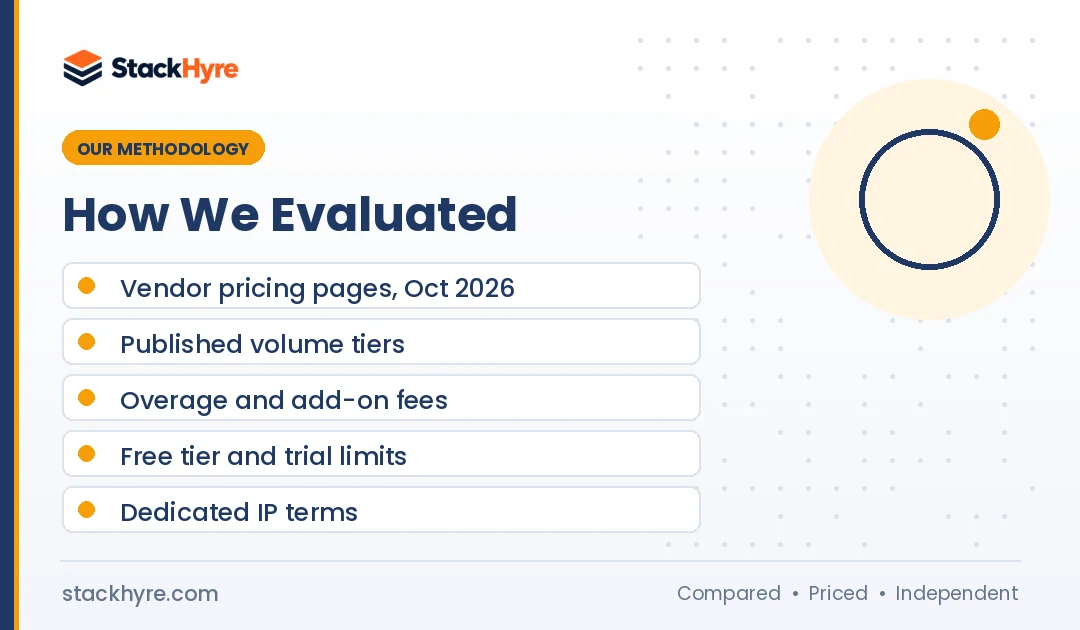
I read each vendor’s own pricing page in October 2026 and recorded the list price at each volume. Where a vendor publishes a full table, like Postmark and Resend, I used it as is.
Where a vendor only publishes a rate, like Amazon SES and Bird, I did the multiplication myself and labeled it. Where a vendor hides a price behind a calculator or sales call, I said so rather than guess.
I didn’t include taxes, promotions or negotiated discounts. I also didn’t send test traffic. You can read how I research and update guides in my editorial policy.
The Bottom Line
Transactional email is cheap in raw terms. Even at 1 million emails, most list prices land between $100 and $800 a month.
The real cost differences come from what’s bundled. SES gives you the lowest per-email price and leaves the tooling to you. Resend offers strong value from 100,000 to 1 million emails. Postmark costs more per email but includes long logs and clear tiers. Mailgun and SendGrid bundle dedicated IPs on higher plans.
My advice: price your volume a year from now, add the log retention you need, and compare two or three vendors on the same terms.
Then read my full ranking of the best transactional email services for SaaS to see which fits beyond price.
Frequently Asked Questions
What is the cheapest transactional email service?
Amazon SES has the lowest list price in October 2026, at $0.10 per 1,000 emails on pay as you go. That’s $10 for 100,000 emails. You also pay $0.12 per GB of attachments. The trade-off is setup work: you build logs, dashboards and bounce handling yourself. Among managed services, Resend’s $35 Pro plan for 100,000 emails is one of the lower prices.
How much does it cost to send 100,000 transactional emails a month?
Based on October 2026 list prices, 100,000 emails a month costs about $10 on Amazon SES, $35 on Resend Pro, $75 on SMTP2GO Professional, $90 on Mailgun Scale and $115 on Postmark Basic’s 125,000 tier. SendGrid shows its exact price through a calculator. Add-ons like extra log retention or a dedicated IP can raise these totals.
Is there a free transactional email service?
Several providers have free tiers, but they’re small. Resend allows 3,000 emails a month with a 100-per-day cap. SMTP2GO and Bird allow 1,000 a month. MailerSend allows 500, and Postmark allows 100. Mailgun’s free plan allows 100 a day, and SendGrid offers a 60-day trial. These work for testing, not for a production SaaS app.
How much does a dedicated IP cost for transactional email?
A dedicated IP usually costs $25 to $59 a month as of October 2026. Amazon SES charges $24.95 per IP, Resend charges $30 and Postmark starts at $50. Mailgun includes one at 100,000+ volume and charges $59 for extras. Most providers also set a volume floor, because a dedicated IP needs steady traffic to build a good reputation.
Why do transactional email prices vary so much?
Prices vary because providers bundle different things. Amazon SES sells raw sending and leaves tooling to you. Managed services add searchable logs, dashboards, templates, support and deliverability help, then charge more per email. Plan design matters too: some include dedicated IPs or long log retention, while others charge extra. Compare total cost at your volume, not the headline rate.
Related Articles

Daniel Brooks writes about proxies, web scraping and email infrastructure at StackHyre. He compares providers on published pricing, documentation and independent benchmarks so you can pick the right setup without overpaying.