
TL;DR: As of October 2026, residential and mobile proxies cost about $2 to $8 per GB on self-serve plans. Datacenter IPs run from a few cents to about $2 per IP each month. ISP proxies cost about $0.30 to $5 per IP. Below I explain each pricing model and give you a vendor price table. I also cover the hidden costs and a simple way to estimate your bill.
Proxy prices fell hard over the last few years. Proxyway’s 2026 market research found that residential proxy rates dropped by up to 75% between 2023 and 2025.
Sounds great. But the same report says the slide has stopped. Some big providers pulled long-running coupon codes and raised their entry prices.
So the price on a vendor’s homepage rarely matches what you’ll pay. That “from $1.75/GB” headline often applies only to a 10 TB custom plan.
Here I break down what proxies really cost, by type and by billing model. If you still need to pick a provider, start with my best proxy providers guide and come back here to check the math.
I cover per GB, per IP and per port billing. I show published prices from ten vendors. And I list the traps that pad a bill, like expiring traffic and paid targeting.
Every price below comes from a vendor’s own pricing page or a dated independent report. Prices change a lot, so treat each number as a snapshot from October 2026.
Quick Comparison: Proxy Prices by Type in 2026
| Proxy Type | Billing Unit | Typical Self-Serve Price | Best For |
|---|---|---|---|
| Residential (rotating) | Per GB | About $2 to $8/GB | Scraping protected sites, geo checks |
| Mobile (3G/4G/5G) | Per GB or per port | About $2.20 to $7.50/GB | Mobile-only content, social, ad checks |
| ISP (static residential) | Per IP per month | About $0.30 to $5/IP | Long sessions, account work |
| Datacenter | Per IP or per GB | About $0.02 to $2/IP | High-volume, low-protection targets |
| Scraping or unblocker API | Per request or result | Varies by vendor | Teams that want success, not IPs |
How Much Do Proxies Cost by Type?
Proxy cost depends mostly on where the IP comes from. Residential and mobile IPs come from real home and carrier connections, so they’re billed per GB and cost the most. ISP proxies are static residential IPs billed per IP each month. Datacenter IPs come from cloud servers and are the cheapest. In 2026, median residential pricing sits near $3.75/GB at small volumes.
That median comes from Proxyway’s standardized benchmark. It also shows how volume pulls the price down. Here’s what the report found for the median residential rate:
- 5 GB plan: $3.75/GB
- 50 GB plan: $3.00/GB
- 500 GB plan: $2.25/GB
Residential proxy pricing
Residential proxies are billed by traffic. You pay for every GB that goes through the network, including page assets you never needed.
Most mainstream providers land between $2 and $4 per GB on mid-size plans. Decodo, for example, lists $3.75/GB on its 3 GB plan down to $2/GB at 1,000 GB, with pay as you go at $4/GB.
Budget sellers go much lower. DataImpulse advertises $1 per GB with no subscription. Evomi lists Core Residential at $0.49/GB on a $49 monthly plan for 100 GB. If you want the cheapest options and their catches, read my guide to cheap residential proxies.
Mobile proxy pricing
Mobile proxies used to cost far more than residential. That gap is closing. Proxyway reports that rotating mobile prices keep hitting new lows, and some mobile pools now cost less than residential ones.
The report puts the median mobile rate at $4.38/GB at 5 GB and $2.48/GB at 500 GB. Some vendors, like SOAX and NodeMaven, now charge one rate for both residential and mobile traffic.
Dedicated mobile ports work differently. You rent one modem connection for a set time. IPRoyal lists mobile proxies from $117/month on that model.
ISP proxy pricing
ISP proxies are static IPs registered to consumer internet providers but hosted in data centers. You pay per IP, per month, and traffic is often unlimited or very generous.
Prices are all over the place. Webshare starts static residential at $6/month for 20 proxies, or $0.30 per proxy. Rayobyte lists Static ISP at $5/IP for 5 to 99 IPs. Proxyway notes that some sellers pass off shared, multi-tenant IPs as “dedicated,” so a low price can hide shared use. Ask before you buy.
Datacenter proxy pricing
Datacenter proxies are the cheapest. They work fine on sites with light bot protection.
Webshare’s shared datacenter list starts at $2.99/month for 100 proxies. Bright Data’s shared datacenter IPs run $1.40/IP for 10 IPs, dropping to $0.90/IP at 1,000. Some vendors also sell datacenter traffic per GB, often under $1/GB.
What Pricing Models Do Proxy Providers Use?
Providers use four main models: pay per GB, pay per IP, pay per port, and credit subscriptions. Per GB fits rotating residential and mobile traffic. Per IP fits static ISP and datacenter proxies. Per port fits dedicated mobile modems. Credit subscriptions roll several products into one monthly budget, which makes billing simpler but can waste money you don’t use.
Pay per GB
You buy a traffic allowance. Pay as you go has no commitment but the highest rate. Monthly plans lower the rate as your commitment grows.
This model is fair for light pages. It gets expensive fast if your scraper loads images, scripts and video.
Pay per IP
You rent a fixed list of IPs for 30 days or longer. Bandwidth is often unlimited or very high. This model rewards long sessions and heavy traffic on a small set of IPs.
Pay per port or per time period
Some mobile and ISP products bill by connection slot and time. You might pay per day or per month for one modem. It’s predictable, but poor value if the port sits idle.
Credit subscriptions
Oxylabs moved its products to one credit plan. As of October 2026, its pricing page lists Starter at $30/month, Basic at $100, Flexible at $500 and Enterprise from $2,500. Credits work across proxies and scraper APIs.
There’s a catch. Oxylabs’ own billing documentation says unused balance expires when the cycle ends, unless it’s carried over in an upgrade. If you’re weighing Oxylabs against rivals on cost, my Bright Data vs Oxylabs comparison puts both models side by side.
Proxy Price Table: Major Vendors as of October 2026
The table below lists entry and volume rates from each vendor’s own pricing page. “Not public” means the vendor doesn’t publish a self-serve price. Always check the live page before you buy.
| Provider | Residential | Mobile | ISP | Datacenter |
|---|---|---|---|---|
| Bright Data | $4/GB PAYG, $2.50/GB at $1,999/mo | Not public | $1.80 to $1.30/IP | $1.40 to $0.90/IP |
| Oxylabs | $6/GB down to $2.50/GB | $7.50/GB down to $3.50/GB | $1.50 to $1.10/IP | $1 to $0.60/IP |
| Decodo | $4/GB PAYG, $2/GB at 1,000 GB | $4/GB PAYG, $2.75/GB at 100 GB | Check pricing page | Check pricing page |
| SOAX | $5/GB (no fee) to $1.50/GB ($1,500/mo plan) | Same rate as residential | Not offered | Not offered |
| IPRoyal | $7.35/GB PAYG for 1 GB | From $117/month | From $1.80/proxy | From $1.39/proxy |
| Webshare | $3.50/GB down to $1.40/GB | Not listed | $0.30 to $0.225/proxy | From $0.0299/proxy |
| Rayobyte | $3.50/GB PAYG (1 to 49 GB) | $3/GB on $250/mo plan | $5/IP (5 to 99 IPs) | $1/IP semi-dedicated |
| NodeMaven | From $2.20/GB (largest plan) | From $2.20/GB (largest plan) | From $2.33/IP per 30 days | Not offered |
| Evomi | $0.49/GB Core, $3.98/GB Premium PAYG | $3.98/GB PAYG | $1 to $4.50/IP | $0.45/GB PAYG |
| DataImpulse | $1/GB | Check pricing page | Not offered | Check pricing page |
Sources: Bright Data pricing, Oxylabs pricing, Decodo mobile pricing, SOAX pricing, IPRoyal residential pricing, NodeMaven pricing and the other vendor pages linked above.
A few notes on the table. Bright Data showed its $4/GB pay as you go rate as a discount from $8 when I checked. Decodo’s mobile page showed similar struck-through prices. Promos like these can end without notice, so don’t plan a budget around them.
SOAX now charges a monthly platform fee plus tiered per GB rates. Its free Sandbox tier has no subscription but the highest rate. SOAX no longer lists ISP or datacenter proxies.
Want vendor-level detail? Read my Decodo review, IPRoyal review and Webshare review for plan breakdowns and limits.
What Hidden Costs Should You Watch For?
The biggest hidden costs are expiring traffic, paid targeting, minimum commitments and wasted bandwidth. Many plans reset unused GB each month. Some vendors charge double for city or ASN targeting. Others want a monthly platform fee before you pay for traffic. Heavy pages also burn GB fast, so your real cost per page can be several times the sticker rate.
Expiring traffic
Monthly plans often wipe unused GB at renewal. If you buy 50 GB and use 20, you paid for 30 GB of nothing.
Some vendors avoid this. IPRoyal says its residential traffic never expires. NodeMaven says unused bandwidth carries forward to the next month on its monthly plans.
Targeting surcharges
City, ZIP or ASN targeting can cost extra. Proxyway’s report flags DataImpulse charging 2x for location filters. It also notes Evomi’s Core Residential applies multipliers of up to 15x for more IPs and filters.
So a $0.49/GB headline can turn into several dollars per GB once you add the targeting you need. Other vendors include it. Bright Data says city, state and ZIP targeting is free on its network.
Platform fees and minimums
Some vendors charge a fee before any traffic. SOAX’s Builder plan costs $200/month plus VAT and then $3/GB at its first usage tier. Proxyway also found that several providers hid or dropped pay as you go plans, raising entry points by up to 25 times.
Wasted bandwidth
Per GB billing counts everything. Images, fonts, video, tracking scripts and failed retries all eat paid traffic.
Block images and media in your scraper when you can. Cache static assets. Retry with backoff instead of hammering a blocked page.
Refund rules and KYC
Refunds are narrow in this market. IPRoyal refuses residential refunds once more than 100 MB is used. Decodo limits refunds to first purchases within 14 days and caps usage at 20% of the plan.
Major networks also run KYC checks before you can use residential IPs. That protects the network, but it can push your start back a day or two. My guide to proxy free trials shows which vendors let you test before paying.
How Should You Choose the Right Proxy Pricing Plan?
Pick the billing model that matches your traffic first, then compare rates. If you move lots of data through many IPs, buy residential per GB. If you hold a few IPs for long sessions, buy ISP per IP. If your targets are lightly protected, datacenter is cheapest. My advice: start on pay as you go, measure real usage for two weeks, then commit to a plan.
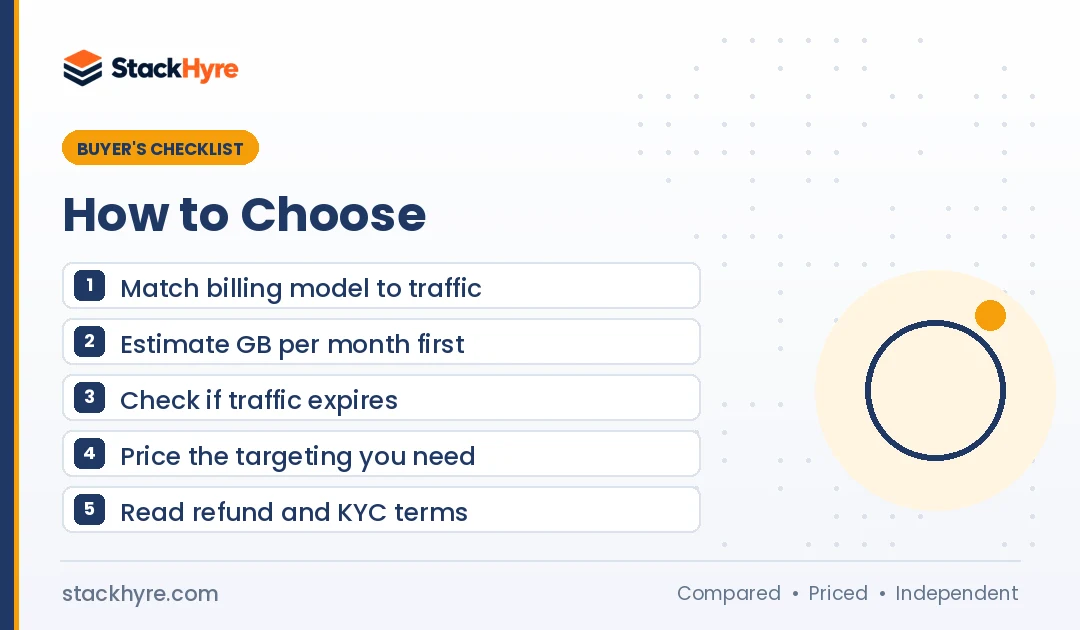
Run through this checklist before you buy:
- Estimate GB per month. Multiply average page size by pages per day by 30. Add 20% to 30% for retries.
- Check traffic expiry. Non-expiring traffic is worth a slightly higher rate if your usage is uneven.
- Price the targeting you need. Ask whether city, state, ZIP or ASN targeting costs extra.
- Read the refund policy. Note the time window and the usage cap.
- Check IP sourcing. Ask how residential IPs are recruited and whether users consent.
That last point matters more in 2026. In July, KrebsOnSecurity reported that the FBI seized domains tied to NetNut and the Popa botnet. Security researchers linked the network to software that turned home devices into proxy nodes. I don’t recommend NetNut.
Very cheap residential traffic deserves a harder look. Proxyway notes that grey-market sellers offer gigabytes for $0.30 or less, sometimes sourced from botnets. My guide to choosing a proxy provider lists the red flags to watch for.
A worked cost example
Here’s a simple illustration, not a benchmark. Say each product page you scrape weighs 2 MB with images blocked. You scrape 5,000 pages a day.
- Daily traffic: 5,000 x 2 MB = 10 GB
- Monthly traffic: about 300 GB, or about 375 GB with 25% retry overhead
- At $3/GB: about $1,125 per month
- At $2/GB: about $750 per month
The same job on datacenter IPs billed per IP could cost far less, if the target allows it. That’s why I’d always try a cheap tier first. It can save you real money.
How I Researched These Proxy Prices
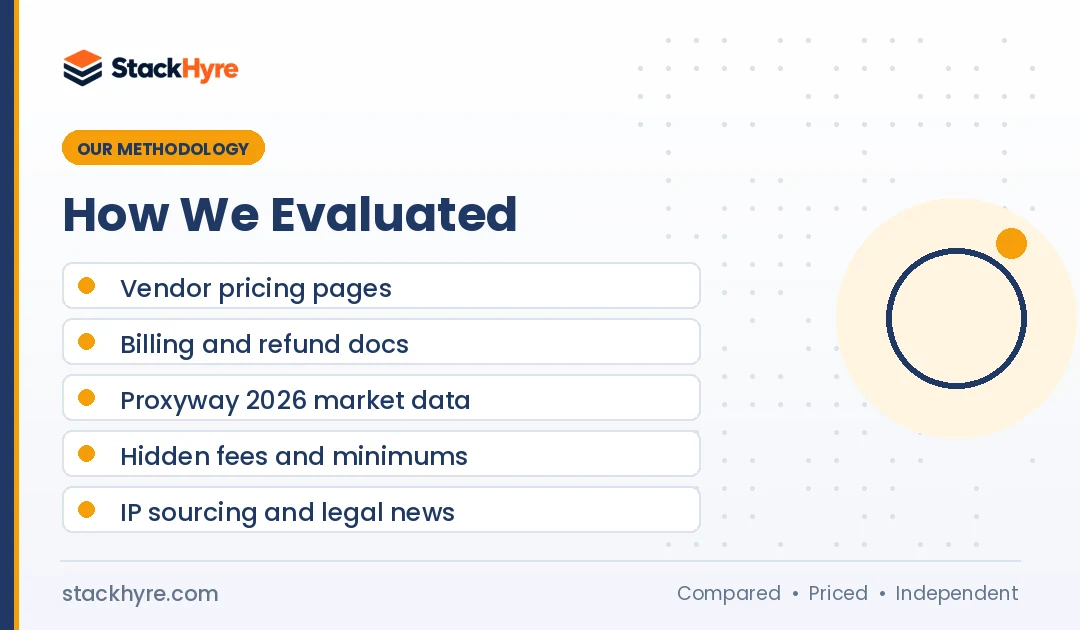
I didn’t run paid speed or success tests for this guide. I compared published pricing pages, billing docs, refund policies and independent market research. Every price links to the vendor page where I saw it in October 2026. When a vendor hid a price, I said so instead of guessing.
My process had four steps:
- Vendor pages. I read each provider’s live pricing page and wrote down entry and volume rates.
- Billing docs. I checked help centers for expiry rules, refunds and KYC.
- Independent data. I used Proxyway’s 2026 market research for medians and trends.
- Ethics check. I flagged providers with sourcing or legal problems.
You can read more about how I work in the editorial policy.
Buying and Pricing Guides
This page is the hub for my buying guides. Each one below goes deeper on a single cost or vendor question.
- My cheap residential proxies list ranks the lowest real per GB rates and the traps behind them.
- The proxy free trial roundup shows which vendors offer free, paid or refund-based trials.
- My Bright Data alternatives guide covers cheaper and simpler options to the best-known enterprise network.
- The Oxylabs alternatives guide helps if credit-based billing doesn’t suit you.
- My Decodo alternatives list compares rivals to the former Smartproxy.
- The Bright Data vs Oxylabs head-to-head picks a winner by use case.
- My full Decodo review covers plans, limits and who should skip it.
- The IPRoyal review explains non-expiring traffic and its refund rules.
- My Webshare review covers its free plan and low datacenter prices.
- The proxy provider buying checklist covers KYC, red flags and trial testing.
Not sure which proxy type you need yet? Start with my guide to the types of proxies, then compare residential vs datacenter proxies.
The Bottom Line
In October 2026, a fair self-serve price for residential proxies is about $2 to $4 per GB. Mobile is now close to residential at volume. ISP proxies cost a few dollars or less per IP each month, and datacenter IPs are the cheapest of all.
The headline rate is only part of the bill. Expiring traffic, targeting fees, platform fees and wasted bandwidth often matter more. Most people overpay because they ignore those.
So start small on pay as you go or a trial. Measure your real GB per page. Then commit to the plan that fits your usage.
If you want ready-made picks, compare vendors in my best proxy providers roundup. If budget is your top concern, go straight to my cheap residential proxies guide.
Frequently Asked Questions
How much does a residential proxy cost per GB?
As of October 2026, most mainstream residential proxies cost about $2 to $4 per GB on monthly plans. Small pay as you go buys can reach $8 per GB. Proxyway’s 2026 research puts the median at $3.75/GB for 5 GB and $2.25/GB for 500 GB. Budget sellers advertise $1/GB or less, often with targeting surcharges.
Why are mobile proxies more expensive than datacenter proxies?
Mobile proxies route traffic through real carrier connections on phones or modems. Those IPs are scarce and shared by many real users, so websites trust them more. Datacenter IPs come from cloud servers that are cheap to add in bulk. That supply gap is why mobile is billed per GB while datacenter often costs cents per IP.
Is pay as you go or a monthly plan cheaper for proxies?
Monthly plans have lower per GB rates, but only if you use the traffic. Many plans expire unused GB at renewal. Pay as you go costs more per GB but wastes nothing. I’d start on pay as you go, track your usage for two to four weeks, then switch to a plan that matches your real volume.
Do proxy providers charge extra for city or ASN targeting?
Some do. Proxyway’s 2026 research found DataImpulse charges double for location filters. Evomi’s Core Residential product uses multipliers of up to 15x for extra filters. Bright Data says it offers city, state and ZIP targeting for free. Always check the targeting terms before you compare per GB rates between vendors.
Are very cheap proxies safe to use?
Not always. Proxyway notes grey-market residential traffic can cost $0.30 per GB or less, sometimes sourced from botnets. In July 2026, the FBI seized domains tied to NetNut after researchers linked it to the Popa botnet. Pick vendors that explain how they source IPs, run KYC checks and publish clear terms.
Related Articles



Daniel Brooks writes about proxies, web scraping and email infrastructure at StackHyre. He compares providers on published pricing, documentation and independent benchmarks so you can pick the right setup without overpaying.