
TL;DR: The best proxies for ad verification give you real residential and mobile IPs with city, carrier and ASN targeting. For big programs, I’d pick Bright Data, Oxylabs or Decodo. SOAX and NodeMaven are my mobile-first picks. Rayobyte and Evomi fit smaller teams. Expect to pay about $2 to $8 per GB as of October 2026. Below I compare 8 providers on coverage, targeting, pricing and trials.
Ad fraud costs real money. Juniper Research estimated that ad fraud would cost marketers $84 billion in 2023, about 22% of online ad spend.
Ad verification is how brands and ad networks fight back. You check that your ads show up where they should, in the right country, next to safe content, and that they lead to honest landing pages.
Here’s the problem. Bad actors often show clean content to known verification servers and something else to real users. If you want to see what a real user sees, you have to look like one.
That’s the job of a proxy. A good one lets you load an ad from a home or mobile IP in a specific city, on a specific carrier.
This guide is part of my proxy use-case series. For the full provider ranking, see my best proxy providers guide. For the bigger data-collection picture, start with the best proxies for web scraping.
Below, I compare 8 providers. I looked at IP types, targeting depth, published prices and trial terms. I didn’t run my own ad tests, and every claim links to its source.
Quick Comparison: Best Proxies for Ad Verification in 2026
| Provider | Best For | Starting Price | Key Feature |
|---|---|---|---|
| Bright Data | Enterprise ad verification | $4/GB residential PAYG | Carrier and ASN targeting |
| Oxylabs | Mobile ad checks at scale | $30/month credit plan | 20M+ mobile IPs (vendor claim) |
| Decodo | Balanced price and coverage | $4/GB PAYG | 700+ mobile carriers (vendor claim) |
| SOAX | Flexible rotation rules | $5/GB Sandbox tier | Same rate for mobile and residential |
| NodeMaven | Clean, filtered IPs | $3.50 paid trial | IP quality filtering |
| IPRoyal | Dedicated mobile ports | From $117/month mobile | Non-expiring residential traffic |
| Rayobyte | Teams that want a free trial | $3.50/GB residential PAYG | No-card free trial on self-serve |
| Evomi | Budget spot checks | $3.98/GB mobile PAYG | 30-day refund window (capped) |
What Makes a Great Proxy for Ad Verification?
A great ad verification proxy makes your checks look like real people in real places. So you want residential and mobile IPs, tight targeting by country, city, carrier and ASN, and control over rotation and sticky sessions. You also want a clean, ethically sourced pool. Flagged or botnet IPs can trigger cloaking and hand you false results.
Here’s why each of these matters for ad work:
- Real IP types. Fraudsters and cloakers often filter out datacenter ranges. Residential and mobile IPs blend in with normal traffic.
- Geo depth. Ads are bought by country, region and city. You need to check from those same places.
- Carrier and ASN targeting. In-app and mobile campaigns can target specific carriers. You have to match them.
- Session control. Sticky sessions let you follow a redirect chain from one IP. Rotation lets you sample many users.
- Clean sourcing. A network built on consenting users protects both your results and your name.
Google takes cloaking seriously. Its Circumventing systems policy defines cloaking as showing different content to different people, or to Google, to hide rule breaking. Google says it suspends accounts for this upon detection and without prior warning.
That’s exactly what verification teams are hunting for. Your proxy has to look ordinary enough that a cloaker shows you the real page.
Best Enterprise Networks for Large Ad Verification Programs
These three have the biggest pools and the deepest targeting. I’d point ad tech firms, agencies and brand safety teams that check thousands of placements a day here first.
#1 Bright Data: Best for enterprise ad verification
Bright Data runs one of the biggest proxy networks, and it has the finest targeting controls I found.
What it does well. Bright Data covers all four proxy types. Its proxy services page lists country, city, ZIP code, carrier and ASN targeting. With that mix, you can match almost any ad targeting setup.
Key features:
- Bright Data says it has 400M+ residential, datacenter and ISP IPs
- Carrier and ASN targeting for mobile campaign checks
- City, state and ZIP targeting, which Bright Data says is free
- KYC compliance review before residential and mobile use
Pricing. As of October 2026, Bright Data lists residential at $4/GB pay as you go, shown as a discount from $8. Plans drop to $2.50/GB at $1,999 per month. There’s no public mobile price, so you’ll need to check Bright Data’s pricing page or ask sales.
Best for: Large ad tech and brand safety teams that need carrier-level precision.
Limitations. The dashboard and product range take a while to learn. KYC needs a company email, and Bright Data’s FAQ says reviews can take up to 2 business days.
#2 Oxylabs: Best for mobile ad checks at scale
Oxylabs pairs a large mobile pool with ASN targeting and one credit plan that covers every product.
What it does well. Mobile ad checks need real carrier IPs. Oxylabs says its mobile network has 20M+ IPs in 140+ countries, with targeting down to city, coordinates and ASN.
Key features:
- Mobile targeting by continent, country, state, city, coordinate and ASN
- HTTP(S), HTTP3 and SOCKS5 support
- One credit budget covers proxies and scraper APIs
- $5 welcome credit for verified companies
Pricing. The Oxylabs pricing page lists plans at $30, $100, $500 and $2,500+ per month as of October 2026. Mobile works out to $7.50/GB on Starter and $5/GB on Enterprise. Residential runs $6/GB down to $4/GB on those same tiers.
Best for: Teams that verify mobile web and app ads across lots of countries.
Limitations. Oxylabs’ billing docs say unused credit expires at the end of each cycle. If your volume is low, you may waste budget.
#3 Decodo: Best balance of price and coverage
Decodo, the former Smartproxy, gives you big residential and mobile pools at mid-market prices.
What it does well. Decodo pairs wide coverage with simple self-serve plans. Its residential pool claims 115M+ IPs in 195+ locations with ZIP and ASN targeting. Decodo says its mobile pool has 10M+ IPs across 700+ carriers.
Key features:
- Targeting by continent, country, state, city, ZIP and ASN
- Sticky sessions from minutes to days
- 3-day free trial with 100 MB for new users
- 14-day refund on first purchases, with usage caps
Pricing. As of October 2026, Decodo residential runs $3.75/GB on 3 GB down to $2/GB at 1,000 GB, with $4/GB pay as you go. Mobile shows $3.75/GB on 2 GB and $2.75/GB on 100 GB, listed as discounts.
Best for: Agencies and mid-size ad networks that want strong coverage without an enterprise contract.
Limitations. Mobile prices were shown as promotions when I checked, so they may go up. Carrier-level targeting is less clearly documented than Bright Data’s.
Best Mobile-First Options for In-App and Mobile Ad Checks
Mobile inventory is where a lot of ad fraud hides. These providers either focus on mobile IPs or price mobile the same as residential.
#4 SOAX: Best for flexible rotation rules
SOAX charges one rate for residential and mobile traffic and gives you detailed rotation controls.
What it does well. Ad checks often need custom rotation. SOAX lets you rotate per request, after N requests, after a set time, or on error. You can also lock onto one node for a sticky session.
Key features:
- SOAX says it has over 191 million residential and mobile IPs
- 195+ countries with region, city, ISP and ASN targeting
- One price for mobile and residential traffic
- Rotation on error, which suits redirect-chain checks
Pricing. SOAX’s pricing page lists a free Sandbox tier at $5/GB with no subscription. Paid plans start at $200/month plus VAT, with tier rates from $3/GB. As of October 2026, there’s no free trial.
Best for: Teams that verify mobile ads and want fine control over when IPs change.
Limitations. SOAX no longer sells ISP or datacenter proxies. Billing mixes a platform fee with usage tiers, so model your costs first. Payments are generally non-refundable.
#5 NodeMaven: Best for clean, filtered IPs
NodeMaven filters its pool for IP quality. That helps when cloakers block low-reputation addresses.
What it does well. One flagged IP can make a cloaker show you a “safe” page. NodeMaven describes its 30M+ residential, mobile and ISP IPs as filtered. That focus on IP quality is a good fit for ad checks.
Key features:
- Residential, mobile and static ISP proxies in one account
- Same starting rate for residential and mobile
- Unused bandwidth rolls over on monthly plans
- Paid trial usable across residential and mobile
Pricing. NodeMaven lists residential and mobile from $2.20/GB, but you only get that rate on its largest plan. Its FAQ says the lowest monthly plan starts at $8.50 for 2 GB. ISP proxies start at $2.33/IP per 30 days. The paid trial is $3.50 for 750 MB.
Best for: Smaller verification teams and affiliates who care more about clean IPs than pool size.
Limitations. NodeMaven doesn’t publish a refund policy on its pricing page. There’s no free trial, and the pool is smaller than the enterprise networks.
#6 IPRoyal: Best for dedicated mobile ports
IPRoyal rents dedicated mobile proxies by the month, so you get a stable carrier IP for repeat checks.
What it does well. Some verification jobs need the same mobile IP for a long time, like testing frequency caps or following a user journey. IPRoyal’s dedicated mobile model fits that. Its residential traffic also never expires.
Key features:
- Dedicated mobile proxies on a monthly rental
- Residential, ISP and datacenter options too
- Non-expiring residential traffic
- Pay as you go or subscription billing
Pricing. IPRoyal lists mobile from $117/month as of October 2026. Residential starts at $7.35/GB pay as you go for 1 GB. The advertised $1.75/GB only kicks in from 10 TB.
Best for: Teams that need a fixed mobile identity for long tests.
Limitations. Small residential buys are pricey. IPRoyal refuses residential refunds after 100 MB of use.
Best Value Picks for Smaller Teams and Agencies
Not every team checks millions of impressions. These two make it cheap to start and easy to test first.
#7 Rayobyte: Best for teams that want a free trial
Rayobyte has a no-card free trial on self-serve products and low mobile rates on monthly plans.
What it does well. You can test before you pay. Rayobyte says every self-serve product has a free trial with no credit card. Proxyway also reported that Rayobyte cut mobile proxy rates by up to 98%.
Key features:
- Residential, ISP, datacenter and mobile proxies
- Free trial with no card on self-serve products
- Pay as you go residential with volume tiers
- Published Terms of Service, AUP and SLA
Pricing. As of October 2026, Rayobyte lists Premium Residential at $3.50/GB for 1 to 49 GB, dropping to $0.70/GB at 1,000 GB or more. Mobile is $3/GB on a $250 monthly plan and $1.75/GB on a $1,000 plan.
Best for: Small agencies that want to trial ad checks before they commit.
Limitations. Mobile is sold through sales, and the page doesn’t say whether mobile has a trial. Rayobyte doesn’t state a refund policy on its pricing page.
#8 Evomi: Best for budget spot checks
Evomi has low pay as you go mobile rates and a free trial on every product.
What it does well. Spot checks don’t use much traffic. With Evomi you can buy small amounts of mobile or premium residential traffic without a plan, and there’s a refund window too.
Key features:
- Mobile and premium residential at the same pay as you go rate
- Free trial on every proxy product
- 30-day refund window, capped at 10% of data or 1 GB
- Static residential IPs from $1/IP
Pricing. Evomi lists mobile and premium residential at $3.98/GB pay as you go as of October 2026. Both drop to $2.20/GB on its largest monthly plans.
Best for: Freelancers and small teams running the odd geo check.
Limitations. Proxyway notes that Evomi’s cheaper Core Residential product uses price multipliers of up to 15x for extra filters. Trials roll into the plan price unless you cancel in time.
How Should You Choose the Right Ad Verification Proxy?
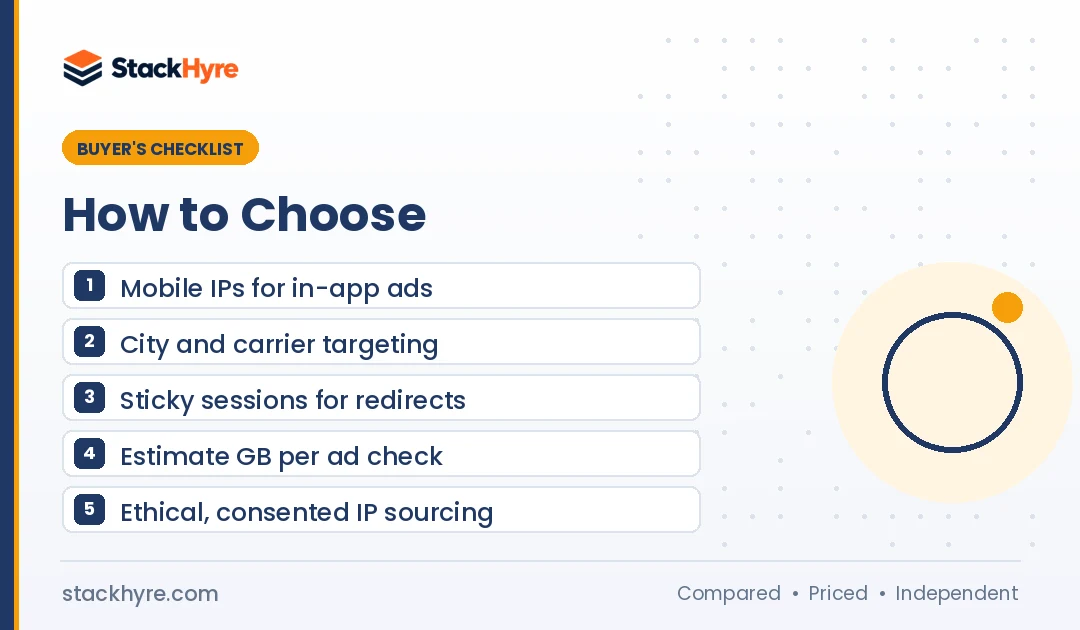
Start with where your ads run. If they run in mobile apps, buy mobile proxies with carrier targeting. If they run on desktop web, residential proxies with city targeting will do. Then match targeting depth to your campaigns. Test the pool against your own ad tags during a trial, and make sure the provider sources its IPs ethically.
These questions will narrow your list fast:
- Which devices matter? Mobile campaigns need mobile IPs. Desktop campaigns can use residential. My best mobile proxies guide goes deeper on mobile pools.
- How precise is your targeting? If you buy by city or carrier, your proxy has to target at that same level.
- Do you need rotation or stickiness? Rotate for broad sampling. Stick to one IP to follow redirects. My guide on rotating vs static proxies walks through the trade-off.
- How much traffic will you use? Ad creatives are heavy. Block what you can and estimate GB per check.
- Is the pool clean and legal? Ask the vendor how it recruits residential and mobile users.
Sourcing gets its own warning. In July 2026, KrebsOnSecurity reported the FBI seized domains tied to NetNut and the Popa botnet. Researchers linked the network to software that turned home devices into proxy nodes. I don’t recommend NetNut for anything.
Verification also overlaps with other jobs. If you track search ads and rankings, see my best proxies for SEO. If you watch competitor offers, my price monitoring proxies guide covers that.
Follow each ad platform’s terms and local law when you run checks. The point of verification is to see the truth, not to game anything.
How I Evaluated These Ad Verification Proxies
I didn’t run my own ad verification tests for this guide. I compared each provider’s published targeting options, IP types, pool claims, pricing and trial terms. I also used independent research from Proxyway and looked for legal or sourcing problems. Pool sizes are vendor claims, and I’ve labeled them that way.
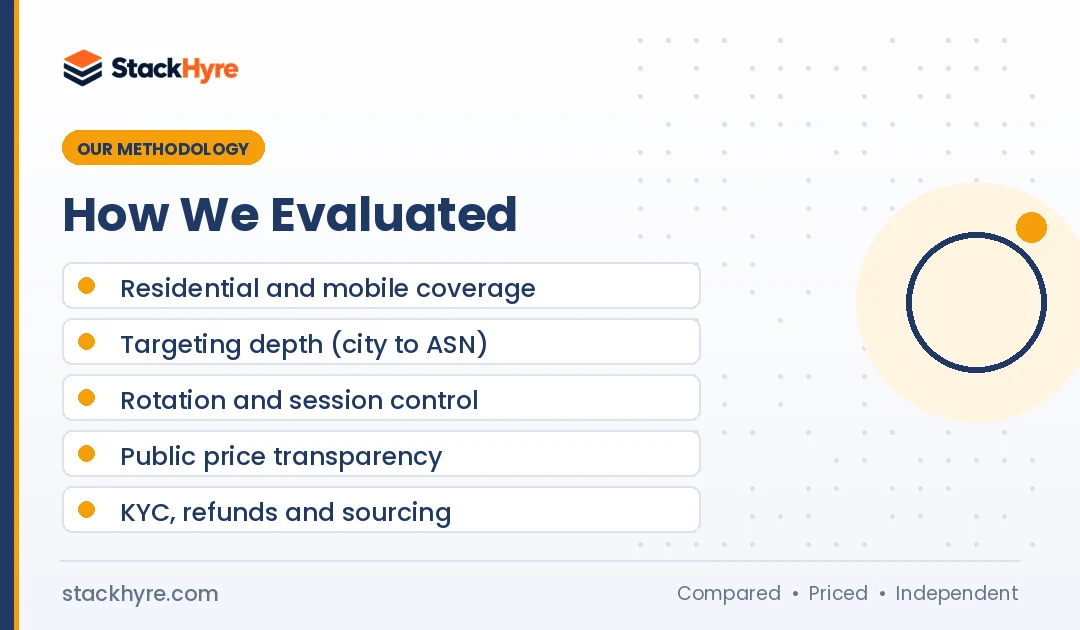
My criteria:
- IP types. Residential and mobile coverage scored highest.
- Targeting depth. I favored city, ZIP, carrier and ASN targeting.
- Session control. I looked at rotation and sticky session options.
- Price transparency. Clear public pricing scored well. Hidden rates lost points.
- Trust. I checked KYC, refund terms and sourcing news.
Read my editorial policy to see how I research and update guides. Prices reflect vendor pages as of October 2026.
The Bottom Line
For large programs, my pick is Bright Data, mainly for its carrier and ASN targeting. Oxylabs is a close second for mobile-heavy work, as long as you use your credits each month. For agencies, Decodo gives the best balance of price and coverage.
If mobile is your focus, SOAX and NodeMaven price mobile like residential. IPRoyal suits long tests on one mobile IP. Rayobyte and Evomi are easy, low-risk places to start.
Whatever you pick, test the pool against your real ad tags during a trial. My proxy free trials guide shows which vendors let you do that cheaply.
Frequently Asked Questions
Why do you need proxies for ad verification?
Fraudsters and cloakers often show clean content to known verification servers and something different to real users. Proxies let you load ads from real residential or mobile IPs in the same places your campaign targets. So you see what genuine users see, including wrong placements, unsafe content and misleading landing pages.
Are mobile or residential proxies better for ad verification?
It depends on where your ads run. Mobile proxies are best for in-app and mobile web campaigns, because they use real carrier IPs and can match carrier targeting. Residential proxies are fine for desktop web ads and cost about the same per GB at many vendors in 2026. Plenty of teams use both.
Can datacenter proxies work for ad verification?
Rarely. Many cloaking tools and fraud schemes filter out datacenter IP ranges, so you may get a sanitized page instead of the real one. Datacenter proxies can still handle basic checks, like confirming an ad tag loads. For fraud and cloaking detection, residential or mobile IPs give you far more reliable results.
How much do ad verification proxies cost?
As of October 2026, the residential and mobile proxies in this guide cost about $2 to $8 per GB, depending on plan size. Oxylabs plans start at $30 per month. IPRoyal dedicated mobile starts at $117 per month. Bright Data publishes no public mobile price, so you’ll have to ask sales.
Is ad verification with proxies legal?
Ad verification is a standard, legitimate practice for brands, agencies and ad networks. Using proxies to view public ads is generally lawful, but follow each platform’s terms and local law. Pick a provider that sources IPs with user consent and runs KYC checks, so your work doesn’t rely on hijacked devices.
Related Articles



Daniel Brooks writes about proxies, web scraping and email infrastructure at StackHyre. He compares providers on published pricing, documentation and independent benchmarks so you can pick the right setup without overpaying.