TL;DR: For most scraping jobs, rotating residential proxies are the safest default. Bright Data and Oxylabs lead for scale, Decodo and NodeMaven give strong value, and Webshare is the cheapest way to start. Residential traffic runs from about $2 to $8 per GB as of October 2026. Below I compare 9 providers, explain which proxy type fits which target, and link to every scraping use-case guide I’ve written.
Bots now make up more than half of all web traffic. Imperva’s 2025 Bad Bot Report found automated traffic hit 51% for the first time in a decade.
If you scrape, that affects you. Sites have answered with tougher bot defenses. Rate limits, IP reputation checks and browser fingerprinting now block plain requests within minutes.
The right proxy network fixes most of this. It spreads your requests across many IP addresses, so no single address looks suspicious. It also lets you see the page the way a local visitor sees it.
The wrong network burns money. You pay for bandwidth on failed requests, retries and blocked pages.
This page is the scraping hub of my best proxy providers guide. Below, you’ll find 9 providers sorted by job size, real published prices, and a short path to the right guide for your exact use case, from SEO tracking to price monitoring.
Quick Comparison: Best Proxies for Web Scraping in 2026
| Provider | Best For | Starting Price | Key Feature |
|---|---|---|---|
| Bright Data | Enterprise scraping at scale | $8/GB PAYG list (promo pricing on page) | Proxies plus Web Unlocker and Scraper APIs |
| Oxylabs | Teams that want one bill for every product | $30/month subscription | Shared credits across proxies and APIs |
| Decodo | Best price to performance | $3.75/GB (3 GB plan) | Large pool, 3-day trial |
| NodeMaven | Clean IPs and long sticky sessions | $3.50 paid trial (750 MB) | IP quality filter, sessions up to 24 hours |
| IPRoyal | Irregular or seasonal scraping | $7.35/GB (1 GB PAYG) | Traffic never expires |
| SOAX | Residential plus mobile on one rate | $200/month (Builder) | Geo-tiered per-GB pricing |
| Webshare | Beginners and small budgets | Free plan, then $2.99/month | Cheap datacenter IPs |
| Rayobyte | High-volume datacenter scraping | $3.50/GB residential PAYG | Wide product range, US-based |
| Zyte API | Hands-off unblocking | $5 free credit, then pay per request | Priced by site difficulty |

What Makes a Great Proxy for Web Scraping?
A great scraping proxy gets you a high share of successful responses on your target sites at a cost per page you can live with. That comes down to four things: a large and clean IP pool, smart rotation with sticky session options, precise geo-targeting, and a pricing model that fits your traffic. Pool size alone doesn’t decide it. IP quality and sourcing do.
Here’s how I’d weigh those factors.
IP type. Residential IPs come from real home connections, so they pass reputation checks better. Datacenter IPs are faster and far cheaper, but protected sites flag them sooner. My guide to every proxy type explains the tradeoffs in detail.
Rotation control. You need a new IP per request for broad crawls. You need the same IP for several minutes when you paginate, log in or fill a cart.
Targeting. Prices, search results and stock levels change by location. Country targeting is the minimum. City or ZIP targeting helps for local data.
Ethical sourcing. This isn’t optional anymore. On July 2, 2026, the FBI seized NetNut’s domains after researchers linked its network to the Popa botnet, according to KrebsOnSecurity’s report on the NetNut seizure. If your provider rents infected devices, your scraper can stop overnight. I don’t recommend NetNut.
Best Premium Proxy Networks for Large Scraping Jobs
#1 Bright Data: Best for enterprise scraping at scale
Bright Data is the biggest all-in-one option, with proxies, unblockers and ready-made scrapers under one account.
What it does well. Bright Data covers every layer of a scraping stack. You can start with raw residential proxies, then move hard targets to its Web Unlocker when blocks pile up. The company says its residential network has 400M+ rotating residential IPs in 195 countries. Country, state, city and ZIP targeting come at no extra cost.
Key features:
- Residential, datacenter, ISP and mobile networks
- Web Unlocker that bills only for successful requests
- Prebuilt Scraper APIs for sites like Amazon and Walmart
- Monthly spend limits and unlimited concurrency on API products
Pricing. As of October 2026, residential pay-as-you-go lists at $8/GB, and plans start at $499/month for 141 GB, per Bright Data’s residential pricing page. The same page shows a 50% promo code for three months. Web Unlocker costs $1.50 per 1,000 requests on pay-as-you-go, with a free tier of 5,000 requests a month.
Best for: Data teams that scrape lots of hard targets and want proxies and unblocking from one vendor.
Limitations. List prices are steep without promos. The dashboard takes time to learn, and Bright Data publishes no public price for mobile proxies.
#2 Oxylabs: Best for teams that want one subscription for everything
Oxylabs is a premium enterprise network that now sells all of its products through a single credit subscription.
What it does well. You buy one plan and spend its credits on residential proxies, datacenter IPs, Web Unblocker or the Web Scraper API. That suits teams that mix raw proxies with managed scraping. Oxylabs also placed among the top unblockers in Proxyway’s Web Scraping API Report 2025, with a success rate above 80% on protected targets.
Key features:
- One credit balance across proxies and scraping APIs
- Residential, mobile, datacenter and ISP networks
- Web Scraper API with Amazon and Google endpoints
- $5 of free welcome credit to try it
Pricing. As of October 2026, Oxylabs’ pricing page lists Starter at $30/month, Basic at $100, Flexible at $500 and Enterprise from $2,500. Residential traffic runs from $6/GB on Starter down to $2.50/GB on Enterprise. UsagePricing logged the switch to a single subscription on October 15, 2026.
Best for: Companies that need steady monthly volume and want proxies plus a scraper API on one invoice.
Limitations. Small plans pay a high per-GB rate. The model is new, so check how unused credits carry over before you commit.
#3 Decodo: Best price to performance for most scrapers
Decodo, the company formerly known as Smartproxy, offers near-premium performance at mid-market prices.
What it does well. For small and mid-sized teams, Decodo is the sweet spot in my view. Its plans start small, and the per-GB price drops steadily as you grow. Decodo says it offers 115M+ IPs across 195+ locations, with advanced targeting on every plan. It also beat the 80% success mark in Proxyway’s 2025 scraping API tests.
Key features:
- Rotating and sticky residential sessions
- Cheap shared datacenter plans
- Web Scraping API with a free plan
- 3-day trial with 100 MB and a 14-day money-back option
Pricing. As of October 2026, Decodo’s residential plans start at $3.75/GB for 3 GB ($11.25) and fall to $2.00/GB at 1,000 GB. Pay-as-you-go costs $4/GB. Shared datacenter traffic starts at $0.60/GB.
Best for: Startups, agencies and freelancers who want strong success rates without enterprise contracts.
Limitations. The trial is small at 100 MB. And you can’t hold a monthly plan and pay-as-you-go at the same time.
Best Value Residential Proxies for Scraping
#4 NodeMaven: Best for clean IPs and long sticky sessions
NodeMaven puts IP quality ahead of raw pool size, which helps on sites that score IP reputation.
What it does well. NodeMaven runs an IP quality filter on all plans and says it delivers a 95% clean IP rate. Sticky sessions last up to 24 hours. That helps when your scraper has to keep one identity through logins, carts or long pagination.
Key features:
- IP quality filter on every rotating plan
- Sticky sessions up to 24 hours
- Country, city and ISP targeting
- Unused traffic rolls over to the next period
- Free scraping browser for NodeMaven users
Pricing. As of October 2026, NodeMaven’s pricing page lists residential and mobile traffic from $2.20/GB. That rate is for the largest plan, and smaller plans cost more per GB. A $3.50 paid trial gets you 750 MB. Static ISP proxies start at $2.33 per IP for 30 days.
Best for: Scrapers that need sessions to survive, and anyone tired of burning traffic on flagged IPs.
Limitations. There’s no free trial. The pool is smaller than the enterprise networks, at a claimed 30M+ residential IPs.
#5 IPRoyal: Best for irregular or seasonal scraping
IPRoyal sells residential traffic that never expires, so you only pay when you scrape.
What it does well. Lots of scraping jobs come in bursts. You might run a big crawl one month and nothing the next. With IPRoyal, your residential traffic stays available until you use it, with no monthly commitment. The company claims 64M+ residential IPs in 195+ countries.
Key features:
- Non-expiring residential traffic
- Pay-as-you-go or a 5% cheaper subscription
- Rotating and sticky sessions
- Datacenter, ISP and mobile products too
Pricing. As of October 2026, IPRoyal charges $7.35/GB for 1 GB on pay-as-you-go, $5.51/GB at 10 GB, and down to $1.84/GB on custom volumes above 10,000 GB.
Best for: Freelancers and small teams with uneven monthly volume.
Limitations. Small purchases are pricey per GB. The best rates need very large volumes.
#6 SOAX: Best for residential and mobile traffic on one rate
SOAX bills residential and mobile traffic at the same per-GB price, set by the country tier of the IP.
What it does well. If some targets need mobile IPs, SOAX lets you switch without a second contract. Its geo-tiered pricing also means cheaper traffic in lower-cost regions. Targeting covers country, region, city and ISP.
Key features:
- One rate across residential and mobile
- Cheaper per-GB rates for Tier 2 and Tier 3 countries
- ISP-level targeting
- Dedicated IP pools as a plan feature
Pricing. As of October 2026, the Builder plan costs $200/month with Tier 1 traffic at $3.00/GB. Team costs $500 at $2.20/GB, and Scale costs $1,500 at $1.50/GB. A $0 Sandbox option lets you top up credits at higher rates.
Best for: Teams that scrape mobile-first apps or sites and want one bill.
Limitations. SOAX no longer lists ISP or datacenter proxies. There’s no free trial, and plans start at $200.
Best Budget and Datacenter Proxies for Scraping
#7 Webshare: Best for beginners and small budgets
Webshare is the cheapest way to start scraping with real proxies, thanks to a permanent free plan.
What it does well. Webshare’s free plan gives you 10 shared proxies and 1 GB of monthly bandwidth with no card. That’s enough to learn rotation and check your parser. Paid datacenter plans scale cheaply after that.
Key features:
- Free plan with HTTP and SOCKS5 support
- Very low-cost shared datacenter proxies
- Static residential (ISP) proxies
- Rotating residential billed by GB
Pricing. As of October 2026, datacenter plans start at $2.99/month for 100 proxies. Static residential starts at $6/month for 20 proxies. Rotating residential costs $3.50/GB on a 1 GB plan and drops to $1.40/GB at 3,000 GB.
Best for: Learners, hobby projects and light scraping of sites with weak bot protection.
Limitations. Shared datacenter IPs get blocked fast on protected sites. Support and targeting are thinner than at premium vendors.
#8 Rayobyte: Best for high-volume datacenter scraping
Rayobyte is a US-based provider with a deep datacenter lineup and its own scraping API.
What it does well. Rayobyte offers static, semi-dedicated and rotating datacenter options. That range suits large crawls of lightly protected sites, where cost per page matters most. It also sells residential, ISP and mobile proxies and a pay-per-request Scraping API.
Key features:
- Static, semi-dedicated and rotating datacenter IPs
- Premium residential with tiered per-GB pricing
- Scraping API with 5,000 free requests
- Web Unblocker billed per GB
Pricing. As of October 2026, Rayobyte’s pricing page lists premium residential at $3.50/GB for 1 to 49 GB, down to $0.70/GB at 1,000 to 4,999 GB. Semi-dedicated datacenter IPs cost $1 per IP a month in the US and Canada.
Best for: Teams running millions of requests against sites that accept datacenter traffic.
Limitations. The product list is long and can confuse new buyers. Some products are price on request.
Best Managed Option When Proxies Alone Fail
#9 Zyte API: Best for hands-off unblocking
Zyte API isn’t a proxy pool you manage. It picks the proxy, browser and retry logic for you and bills per successful response.
What it does well. Zyte ranked first in Proxyway’s 2025 test of 11 scraping APIs across 15 protected targets. It was also the fastest. If you spend more time fighting blocks than parsing data, this is the switch I’d make.
Key features:
- Automatic proxy and browser selection
- Billing only for successful responses
- Five price tiers based on how hard a site is
- $5 free credit for 30 days
Pricing. As of October 2026, Zyte’s pay-as-you-go rates run from $0.13 to $1.27 per 1,000 plain HTTP requests, and $1.01 to $16.08 per 1,000 browser-rendered requests. Monthly commitments from $100 bring those rates down.
Best for: Developers who want results, not proxy management.
Limitations. Costs climb fast on the hardest sites with browser rendering. You get less low-level control than with raw proxies.
Web Scraping Proxy Guides by Use Case
Scraping isn’t one job. Each use case puts different stress on a proxy network, so I wrote a separate guide for each one.
- Search data: My guide to the best proxies for SEO covers SERP scraping, rank tracking and local results by city.
- Retail data: The best proxies for price monitoring guide shows how to track competitor prices and stock without getting blocked.
- Social platforms: Read the best proxies for social media guide for multi-account work and the platform rules to respect.
- Advertising: The best proxies for ad verification guide covers geo coverage, mobile IPs and ad fraud checks.
- Managed scraping: If you’d rather not manage proxies at all, compare the best web scraping APIs side by side.
- Browser identity: Pair your proxies with one of the best antidetect browsers when you need separate browser fingerprints.

How Should You Choose the Right Proxy for Web Scraping?
Start with your target, not the vendor. Run a small batch of real URLs through a trial, then compare cost per successful page, not cost per GB. Use datacenter IPs for easy sites, rotating residential for protected sites, and a scraping API for the hardest targets. Pick a provider with clear IP sourcing and a trial or refund policy.
These are the questions I’d use to narrow your shortlist.
How protected is the site? Send 100 requests with a cheap datacenter proxy. If most succeed, stay there. If many return 403 errors or CAPTCHAs, move up to residential. My residential vs datacenter comparison shows where each type wins.
Do you need sessions? Broad crawls want a fresh IP on each request. Logged-in flows and carts want sticky sessions. Read my guide on rotating vs static proxies to set this up right.
How much will you really spend? Estimate average page size times monthly pages. Then add 20% to 30% for retries. My proxy pricing guide breaks down per-GB, per-IP and per-request models.
Does traffic expire? Monthly plans often reset unused GB. If your volume swings, look at IPRoyal’s non-expiring traffic or NodeMaven’s rollover.
Is the network ethical? Ask how residential IPs are sourced and whether the provider runs KYC checks. The NetNut seizure shows what happens when sourcing goes wrong.
Are you scraping responsibly? Respect robots.txt, which is now a formal standard in RFC 9309. Keep request rates polite and stay away from personal data. In the US, a federal court found that logged-out scraping of public data did not breach Meta’s terms in Meta v. Bright Data. Laws differ by country, so check yours.
How I Evaluated These Web Scraping Proxies
I didn’t run my own speed or success tests for this guide. I read each provider’s published pricing, product docs and policies, and compared them against independent benchmark data.
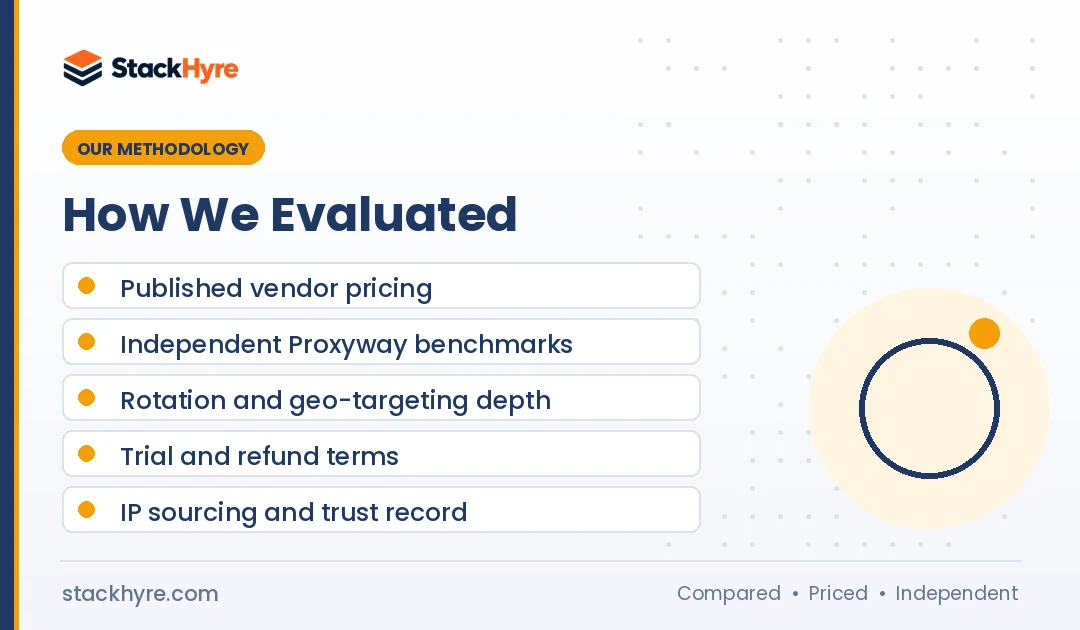
I scored each provider on these factors:
- Published pricing: I read every price from the vendor’s own pricing page in October 2026 and noted the plan size each rate needs.
- Independent performance data: I used Proxyway’s public research, including its Proxy Market Research 2025 and its 2025 scraping API report.
- Scraping features: Rotation control, sticky session length, geo-targeting depth and protocol support.
- Trial and refund terms: Whether you can try it on your own targets before you pay full price.
- Sourcing and trust: Public statements on IP sourcing, plus any security incidents.
Vendor claims, like pool sizes and success rates, are labeled as the vendor’s. You can read more about how I work in my editorial policy.
The Bottom Line
For most scraping projects, start with rotating residential proxies and a short trial on your real targets.
Pick Bright Data or Oxylabs if you scrape at enterprise scale and want proxies and scraping APIs in one place. Choose Decodo for the best balance of price and performance. Go with NodeMaven when clean IPs and long sticky sessions matter, or IPRoyal when your volume is uneven. Webshare is the cheap place to learn.
If blocks still eat your budget, stop adding proxies. Move hard targets to a managed unblocker instead. My guide to the best web scraping APIs compares your options, and the full proxy provider rankings cover every other proxy job.

Frequently Asked Questions
What type of proxy is best for web scraping?
Rotating residential proxies are my best all-round pick for web scraping. They use IPs from real home connections, so protected sites block them less often. Datacenter proxies are cheaper and faster, and they work well on sites with light bot protection. For the hardest targets, a managed scraping API that handles proxies, browsers and retries for you often costs less per successful page.
How much do web scraping proxies cost?
As of October 2026, rotating residential proxies cost about $2 to $8 per GB on published pricing pages, depending on vendor and volume. Shared datacenter proxies are far cheaper, with Webshare starting at $2.99 a month for 100 proxies. Your real cost depends on page size, retries and success rate, so compare cost per successful page during a trial.
Are free proxies safe for web scraping?
Public free proxy lists aren’t safe for scraping. They’re slow, often already blocked, and some log or change your traffic. A free plan from a known provider is different. Webshare’s free plan gives you 10 proxies and 1 GB each month, which is fine for learning. For real projects, use a paid network with clear IP sourcing.
How many proxies do I need for web scraping?
With a rotating residential network, you don’t buy individual IPs. You buy bandwidth, and the provider rotates through its whole pool. With datacenter or ISP proxies, a common starting point is enough IPs to keep each one under a few requests per minute on your target. Start small, watch your block rate, and add IPs when errors rise.
Is web scraping with proxies legal?
Using proxies is legal in most countries, and scraping public data is often allowed. The details depend on where you are, the site’s terms, and the data you collect. Avoid personal data, logged-in areas you aren’t permitted to access, and reuse of copyrighted content. Follow robots.txt and polite rate limits. For commercial projects, get advice from a lawyer in your jurisdiction.
Related Articles



Daniel Brooks writes about proxies, web scraping and email infrastructure at StackHyre. He compares providers on published pricing, documentation and independent benchmarks so you can pick the right setup without overpaying.