
TL;DR: Oxylabs and Decodo lead the independent 2026 benchmarks for residential proxies. Bright Data has the widest product range. If IP quality is your priority, I’d look at NodeMaven and SOAX, while Webshare, DataImpulse and Evomi win on price. Residential rates run from about $0.49 to $7 per GB as of October 2026. I compare 10 providers here, with their real pricing and how to choose.
Bots now make up a huge share of web traffic. Imperva’s 2025 Bad Bot Report found that bad bots alone made up 37% of internet traffic in 2024.
That’s why websites block so hard. And it’s why the proxy provider you pick matters so much.
A good provider gives you clean IPs, honest pricing and IPs sourced with consent. A bad one burns your budget on blocked requests. Or worse, it routes your traffic through hacked devices.
That risk is not theoretical. In July 2026, the FBI seized hundreds of NetNut domains after reports tied it to the Popa botnet.
I went through published pricing, product docs, sourcing policies and independent benchmarks for the biggest names. This page is the hub for my whole proxy library, so every guide I publish links back here. If you’re still learning the basics, start with my guide to the different types of proxies.
Below you’ll find a quick table, a short review of each provider and a buying checklist.
Quick Comparison: Top 10 Proxy Providers in 2026
| Provider | Best For | Starting Price | Key Feature |
|---|---|---|---|
| Bright Data | Enterprise data teams | $4/GB residential (promo) | 400M+ residential IPs claimed |
| Oxylabs | Top benchmark results | $30/mo Starter plan | One subscription for all products |
| Decodo | Best overall value | $3.75/GB on 3 GB plan | 3-day trial with 100 MB |
| SOAX | Residential plus mobile at one rate | Free Sandbox, pay per GB | Tiered rates by location |
| NodeMaven | Clean, filtered IPs | $3.50 paid trial | IP quality filter, traffic rollover |
| IPRoyal | Traffic that never expires | $7/GB at 1 GB | Non-expiring residential traffic |
| Webshare | Cheap datacenter proxies | Free plan, then $2.99 | 10 free proxies, no card |
| DataImpulse | Low-cost residential | $1/GB | Traffic never expires |
| Evomi | Budget bulk traffic | $0.49/GB on 100 GB plan | Swiss-based, ethics focus |
| Rayobyte | US datacenter and ISP | $3.50/GB residential | Free trials on self-serve products |
What Makes a Great Proxy Provider?
A great proxy provider pairs a large pool of ethically sourced IPs with high success rates and fast responses. It posts clear per-GB or per-IP prices, offers precise geo-targeting, and supports both HTTP and SOCKS5. It also runs a know-your-customer check, so abusers don’t share and burn the same IPs you depend on.
Pool size on its own tells you very little. Many vendors count every IP they see in a month. What you care about is how many unique, working IPs you actually get.
Independent testing helps here. In its 2026 proxy market research, Proxyway sent 3.6 million residential requests over 21 days. Oxylabs returned about 3.24 million unique IPs. Decodo returned about 2.85 million.
Pricing models matter too. Residential and mobile proxies are usually sold per GB. Datacenter and ISP proxies are often sold per IP. My proxy pricing guide breaks down each model and the hidden costs behind it.
Finally, check sourcing. Google’s threat team disrupted the IPIDEA network in January 2026. It said over 550 threat groups used that network’s exit IPs in a single week. Cheap IPs from shady pools carry real legal and reputation risk.
Best Premium Proxy Networks for Teams at Scale
These three providers sell every major proxy type, plus scraping tools and serious compliance programs. They cost more at small volume but scale well.
#1 Bright Data: Best for Enterprise Data Teams
Bright Data is the broadest proxy and data platform on this list, and it’s built for large companies.
What it does well. Bright Data covers residential, datacenter, ISP and mobile proxies, plus scraping APIs and datasets. Its residential pricing page claims over 400 million rotating residential IPs in 195 countries. It also runs a formal KYC process, laid out in its residential network access policy.
Key features:
- Residential, ISP, datacenter and mobile networks in one account
- Country, city, ZIP and ASN targeting on residential IPs
- Scraping browser, unblocker and ready-made datasets
- Compliance review before full residential access
Pricing. As of October 2026, Bright Data’s page lists residential pay-as-you-go at $4/GB under a promotion, down from $8/GB. The first monthly plan costs $499 for 141 GB. Datacenter starts from $0.90/IP and ISP from $1.30/IP. The mobile proxy page claims 7M+ mobile IPs but lists no public per-GB price.
Best for: Companies running large, regulated data projects that need many proxy types and real compliance.
Limitations. Plans are pricey for small users. Promo pricing can change, and you have to talk to sales for mobile pricing. Proxyway left Bright Data out of its 2026 benchmark tables. See how it compares in my Bright Data vs Oxylabs comparison.
#2 Oxylabs: Best for Top Benchmark Performance
Oxylabs is a premium provider that came out on top in independent 2026 residential tests.
What it does well. In Proxyway’s 2026 research, Oxylabs posted a 99.93% residential success rate with a 0.60 second average response. It also returned the most unique residential and mobile IPs in that test. Oxylabs co-founded the Ethical Web Data Collection Initiative, an industry group focused on responsible data collection.
Key features:
- One subscription that covers every proxy and scraping product
- Residential, mobile, ISP, dedicated ISP and datacenter proxies
- Web Unblocker and scraper APIs on the same credits
- $5 of free welcome credits to start
Pricing. In October 2026, Oxylabs switched to a single credit subscription. Plans are Starter at $30/month, Basic at $100, Flexible at $500, and Enterprise from $2,500. Residential runs $6/GB on Starter and drops to $2.50/GB on Enterprise. Mobile runs $7.50/GB down to $3.50/GB. Datacenter IPs start at $1 each. Find out how unused credits carry over before you commit.
Best for: Teams that want top success rates and one bill for proxies and scraping tools.
Limitations. Per-GB rates on small plans are higher than budget rivals. The credit model takes a little getting used to. Compare your options in my Oxylabs alternatives guide.
#3 Decodo: Best Overall Value
Decodo, the former Smartproxy, matches premium performance at mid-market prices. It’s where I’d tell most people to start.
What it does well. Proxyway measured Decodo at a 99.92% success rate with 0.53 second responses in 2026. That’s nearly a tie with Oxylabs at a lower entry price. Decodo also publishes an ethical residential sourcing policy.
Key features:
- 115M+ residential IPs in 195+ locations, per Decodo
- Residential, ISP, mobile and datacenter proxies
- Site Unblocker and a Web Data API
- 3-day trial with 100 MB on residential
Pricing. As of October 2026, Decodo’s residential pricing starts at $11.25 for 3 GB ($3.75/GB). Pay-as-you-go is $4/GB. Rates fall to $2/GB at 1,000 GB. Its product pricing page lists ISP from $0.27/IP, mobile from $2.25/GB and datacenter from $0.02/IP.
Best for: Small and mid-size teams that want premium results without an enterprise contract.
Limitations. The trial auto-renews into a paid plan unless you cancel. The 14-day refund doesn’t apply if you used the trial. My full Decodo review covers the fine print.
Best Mid-Market Providers for Quality and Flexibility
These providers focus on IP quality, targeting and flexible billing. They’re a good fit for growing teams and multi-account work.
#4 SOAX: Best for Residential and Mobile at One Rate
SOAX bills residential and mobile traffic at the same rate through a credit platform.
What it does well. SOAX posted a 99.78% residential success rate in Proxyway’s 2026 tests. Proxyway lists its residential pool at 155 million IPs. You can target by country, region, city and ISP.
Key features:
- One per-GB rate across residential and mobile
- Location rates split into three price tiers
- Free Sandbox plan with pay-as-you-go top-ups
- Scraping services alongside proxies
Pricing. As of October 2026, SOAX pricing starts with a free Sandbox. You pay $5, $4 or $2 per GB depending on the location tier. The Builder plan costs $200/month and cuts those rates to $3, $2.25 and $1.20 per GB.
Best for: Teams that move between residential and mobile IPs and want one simple rate.
Limitations. SOAX no longer lists ISP or datacenter proxies. There’s no free trial. If you need static IPs, check my best ISP proxies list instead.
#5 NodeMaven: Best for Clean, Filtered IPs
NodeMaven screens every IP for fraud risk before you get it.
What it does well. NodeMaven’s IP quality filter checks fraud scores, blacklist status and reputation data before it hands you an IP. That’s what you want when one flagged IP can ruin an account. Unused traffic rolls over to the next billing period. Proxyway ranked it fifth overall in its 2026 provider list for IP quality filtering.
Key features:
- 30M+ residential and 250K mobile IPs, per NodeMaven
- IP quality filter based on fraud and blacklist data
- Traffic rollover on monthly and pay-as-you-go plans
- Static ISP proxies with unlimited traffic
Pricing. As of October 2026, NodeMaven’s pricing page shows residential and mobile from $2.20/GB, but only on its largest plan. The smallest monthly plan is $8.50 for 2 GB. A $3.50 paid trial gets you 750 MB. ISP proxies cost $2.33 per IP for 30 days.
Best for: Social media managers, ad checkers and anyone who needs low-risk IPs for logged-in sessions.
Limitations. There’s no free trial. The pool is smaller than the premium rivals. The 95% clean rate and 99.54% success figures are NodeMaven’s own claims. For multi-account work, pair it with a tool from my antidetect browser roundup.
#6 IPRoyal: Best for Traffic That Never Expires
IPRoyal sells residential traffic you can use at your own pace.
What it does well. IPRoyal’s residential pricing page says your traffic stays available until you use it. That fits irregular or seasonal projects. It sells residential, ISP, datacenter and mobile proxies under one account.
Key features:
- 64M+ residential IPs, per IPRoyal
- Non-expiring residential traffic
- Pay-as-you-go or subscription with 5% off
- Mobile proxies sold by the day
Pricing. As of October 2026, residential costs $7/GB for 1 GB on subscription and falls to $1.75/GB at 10 TB. ISP proxies start from $1.80 per proxy. Datacenter starts from $1.39 per proxy. Mobile starts from $10.11 per day.
Best for: Freelancers and small teams whose usage changes month to month.
Limitations. Proxyway measured a 96.11% residential success rate in 2026, behind the leaders. Small packages cost more per GB. Read my IPRoyal review for the full picture.
Best Budget Proxy Providers
These four providers keep costs down. They work for high-volume jobs on easier targets, for testing, and for small budgets.
#7 Webshare: Best for Cheap Datacenter Proxies
Webshare is the easiest cheap way in, and it even has a free plan.
What it does well. Webshare’s free plan gives you 10 shared proxies and 1 GB of monthly bandwidth with no card. You choose the exact number of proxies and the bandwidth you need. Proxyway recorded a 99.28% residential success rate for Webshare in 2026.
Key features:
- Free plan with HTTP and SOCKS5 support
- Highly customizable datacenter plans
- Rotating residential and static residential (ISP) options
- Self-serve dashboard and API
Pricing. As of October 2026, 100 shared datacenter proxies cost $2.99/month. Rotating residential starts at $3.50/GB on a 1 GB plan and falls to $1.40/GB at 3,000 GB. Static residential starts at $6/month for 20 proxies.
Best for: Developers, hobby scrapers and anyone testing on a budget.
Limitations. The lowest prices are for shared proxies. Private and dedicated options cost more. My Webshare review explains when it’s worth upgrading.
#8 DataImpulse: Best for Low-Cost Residential Traffic
DataImpulse has some of the lowest flat residential rates you’ll find.
What it does well. DataImpulse charges a flat $1/GB on residential with no monthly commitment. Its pricing says traffic never expires. Proxyway measured a 99.74% residential success rate in 2026, ahead of several pricier names.
Key features:
- 90M+ residential IPs, per DataImpulse
- Residential, mobile and datacenter traffic by the GB
- HTTP(S) and SOCKS5 support
- Non-expiring traffic
Pricing. As of October 2026, residential costs $1/GB on intro plans and $0.80/GB on advanced plans. Mobile costs $2/GB. Datacenter costs $0.50/GB. Volumes above 5 TB get custom rates.
Best for: Budget scraping and bulk jobs where cost per GB is what counts.
Limitations. You get fewer extras, like scraping APIs, than with the premium players. Response times were slower than the leaders in Proxyway’s tests. You’ll find more options in my cheap residential proxies list.
#9 Evomi: Best for Budget Bulk Traffic
Evomi is a Swiss provider with very low bulk residential rates.
What it does well. Evomi’s Core Residential plan costs $49/month for 100 GB on its pricing page. That works out to $0.49/GB. Evomi says it’s an EWDCI member and lists ISO 27001 and SOC 2 Type II work. Proxyway logged a 99.58% residential success rate in 2026.
Key features:
- 54M+ residential IPs, per Evomi
- Core and Premium residential tiers
- Mobile, datacenter and static ISP proxies
- Static ISP grades: shared, private and virgin IPs
Pricing. As of October 2026, Core Residential pay-as-you-go is $0.99/GB. Premium Residential and mobile are $3.98/GB pay-as-you-go. Datacenter is $0.45/GB. Static ISP runs $1 to $4.50 per IP per month by grade.
Best for: High-volume jobs on targets with light bot protection.
Limitations. The cheapest tier is a separate, lower-grade pool. Refunds are capped at a small share of your data. The compliance claims are Evomi’s own.
#10 Rayobyte: Best for US Datacenter and ISP Proxies
Rayobyte is a US provider with a wide range of static and rotating IPs.
What it does well. Rayobyte sells rotating and static datacenter, ISP, residential and mobile proxies. Its pricing page says every self-serve product has a free trial with no card needed. Proxyway found it among the top sources of unique US datacenter IPs in 2026.
Key features:
- Static and rotating datacenter and ISP proxies
- Semi-dedicated datacenter IPs for US and Canada
- Premium residential pay-as-you-go
- Free self-serve trials
Pricing. As of October 2026, Premium Residential is $3.50/GB for 1 to 49 GB, falling to $0.70/GB at 1,000 GB. Static ISP is $5 per IP per month for 5 to 99 IPs. Rotating datacenter starts at $0.30/GB. Mobile starts at $250/month for 83 GB.
Best for: US-focused teams that need lots of static datacenter or ISP IPs.
Limitations. Proxyway measured a slow 1.86 second residential response time in 2026. Some bulk tiers need a compliance review first. For more static picks, see my best datacenter proxies guide.
Which Proxy Providers Should You Avoid?
Avoid any provider that can’t explain where its residential IPs come from. In 2026, two large networks were taken down for using hacked or unaware devices. The FBI seized NetNut’s domains in July. Google disrupted IPIDEA in January. If a service is cheap, vague about consent and skips KYC, walk away.
I don’t recommend NetNut. KrebsOnSecurity reported that the FBI seized hundreds of NetNut domains on July 2, 2026. That came two weeks after security firms linked it to the Popa botnet.
Google’s threat intelligence report named brands tied to IPIDEA. They include 360 Proxy, Luna Proxy and ABC Proxy. Google also said ethical sourcing claims need transparent, auditable proof of user consent.
Warning signs I watch for:
- No public sourcing or consent policy
- No identity check before you get residential access
- Pool size claims far above every known rival
- Prices far below the market with no clear reason
- Free VPN or “earn from bandwidth” apps tied to the brand
My guide to choosing a proxy provider has the full red flag checklist.
Proxy Guides by Type
Each proxy type solves a different problem. These guides help you find the right one.
- My hub on the types of proxies explains every option and when to use it.
- See the best residential proxies for scraping protected sites with real home IPs.
- My datacenter proxy rankings cover the fastest, cheapest IPs for easy targets.
- The best ISP proxies list compares static residential IPs for long sessions.
- My best mobile proxies guide ranks 4G and 5G providers for apps and social media.
- The best rotating proxies roundup shows which pools switch IPs most reliably.
- My SOCKS5 proxy picks help when you need non-HTTP traffic or UDP.
- Read residential vs datacenter proxies to choose between the two main IP sources.
- My proxy vs VPN comparison explains which tool fits privacy and which fits data work.
- See rotating vs static proxies to decide when to keep or change your IP.
- Follow my proxy setup tutorial for Windows, macOS, browsers, phones and code.
Proxy Guides by Use Case
The best provider depends on the job. These guides rank providers for specific tasks.
- My hub on the best proxies for web scraping covers every major data collection use case.
- See the best proxies for SEO for SERP scraping and local rank tracking.
- My social media proxy guide covers multi-account work and platform rules.
- The price monitoring proxies list helps ecommerce teams track competitors.
- My ad verification proxies guide focuses on geo coverage and mobile checks.
- Compare the best web scraping APIs if you’d rather have unblocking handled for you.
- My best antidetect browsers roundup pairs browser profiles with proxies.
Buying and Pricing Guides
Before you pay, use these guides to compare costs, trials and vendors side by side.
- My proxy pricing guide explains per-GB, per-IP and per-port billing.
- See cheap residential proxies for the lowest real per-GB rates and their traps.
- My proxy free trials list shows which providers let you test before you buy.
- Compare Bright Data alternatives if enterprise pricing is too steep.
- Browse Oxylabs alternatives for similar quality at different price points.
- My Decodo alternatives guide covers other value-focused providers.
- Read Bright Data vs Oxylabs for a head-to-head verdict by use case.
- My full Decodo review covers products, pricing and who should skip it.
- The IPRoyal review explains its non-expiring traffic model.
- My Webshare review covers its free plan and paid upgrades.
- Use my proxy provider buying checklist to avoid risky vendors.
How Should You Choose the Right Proxy Provider?
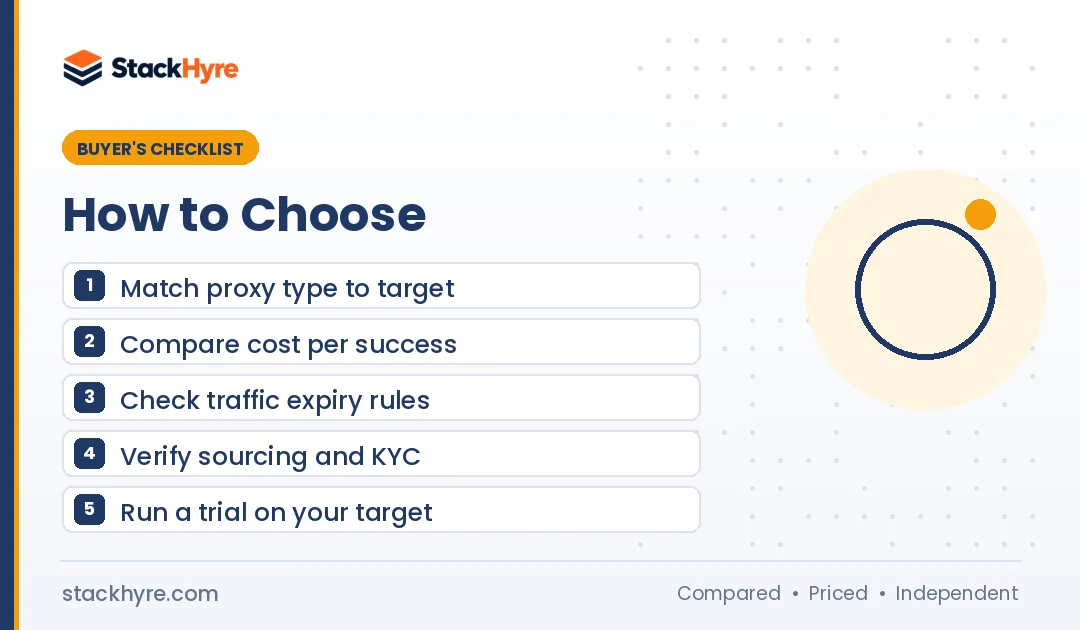
Start with your target website and task, not the vendor. Easy sites work with cheap datacenter IPs. Protected sites need residential or mobile IPs. Next, compare the real cost per successful request. Check sourcing and KYC. Then run a small trial on your own target before you buy a big plan.
Here’s the order I’d work through it.
1. Match the proxy type to the target. Datacenter proxies are fast and cheap but easy to detect. Residential and mobile IPs look like real users. ISP proxies give you a static residential IP for long sessions. My residential vs datacenter breakdown explains the trade-off.
2. Check the billing unit. Per-GB plans punish heavy pages like video or image-rich stores. Per-IP plans suit long sessions with light traffic. Estimate your monthly GB before you compare prices.
3. Watch for expiry rules. Some providers wipe unused traffic every month. IPRoyal and DataImpulse say traffic never expires. NodeMaven rolls unused traffic into the next period.
4. Test success rate, not pool size. A provider with a smaller pool can still beat a bigger one on your target. Run 1,000 requests and count the clean responses.
5. Confirm geo-targeting depth. Local SEO and ad checks need city or ZIP targeting. Make sure the plan you buy includes it, not only the top tier.
6. Verify ethics and compliance. Look for a published sourcing policy, a KYC process and industry membership, such as the EWDCI. Respect each website’s terms and local law, especially for logged-in or personal data.
7. Check protocol and tool support. Most scrapers use HTTP(S). Some apps and games need SOCKS5. Using browser profiles or scraping frameworks? Make sure the provider has clear setup docs and an API for users and IP lists.
8. Judge support and account rules. Ask how fast support replies and whether you get a dedicated manager. Read the refund terms before you buy. Many refunds vanish once you use a set share of your traffic, so test with a trial first.
9. Use a trial. Decodo, NodeMaven, Webshare and Rayobyte all offer some kind of trial. My free trial roundup lists the exact terms.
How I Evaluated These Proxy Providers
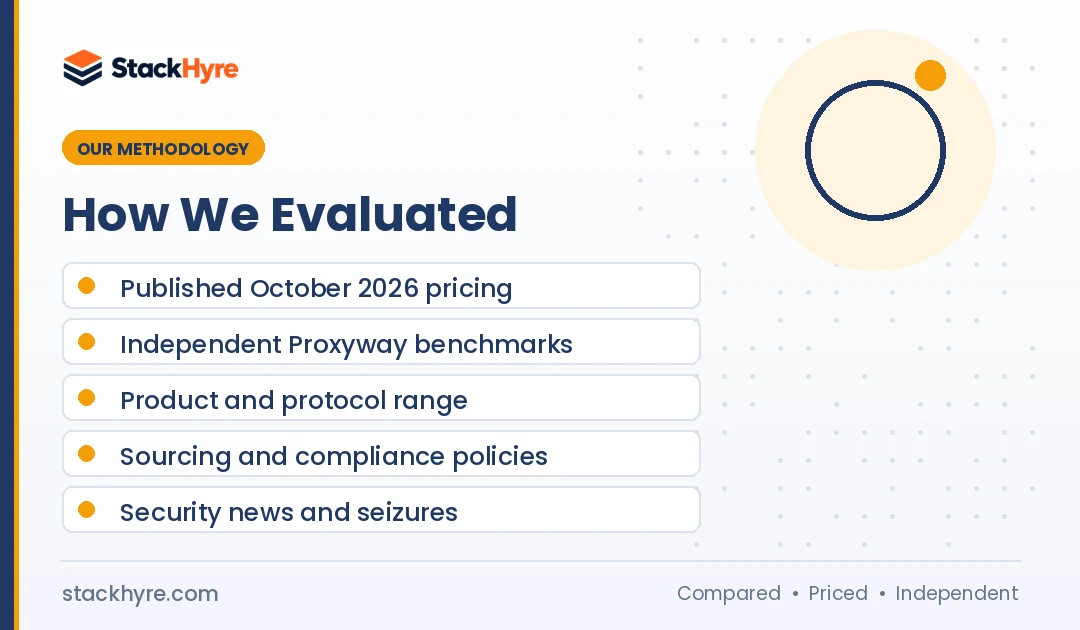
I didn’t run my own lab tests for this guide. I compared each provider using public information you can check. Every price and claim links to its source.
Here’s what I looked at:
- Published pricing. I read each vendor’s own pricing page in October 2026. I noted entry price, volume discounts, trials and expiry rules.
- Independent benchmarks. I used Proxyway’s 2026 market research for success rates, response times and unique IP counts.
- Product range. I checked which proxy types, protocols and scraping tools each provider sells.
- Sourcing and compliance. I looked for consent policies, KYC steps and industry memberships.
- Security news. I checked reporting from KrebsOnSecurity and Google’s threat team for seizures and disruptions.
Vendor claims, like pool sizes and clean rates, are labeled as the vendor’s. I update this page when pricing or ownership changes. The site’s editorial policy explains how I review products.
The Bottom Line
For most teams, Decodo is the best place to start. It matched premium benchmark results in 2026 at a lower entry price.
Pick Oxylabs if you want top success rates and one subscription for proxies and scraping tools. Pick Bright Data if you need every product and a serious compliance process at enterprise scale.
NodeMaven and SOAX are smart picks for logged-in work and mixed residential and mobile use. Webshare, DataImpulse and Evomi win when price per GB is what you care about most.
Whatever you choose, test on your real target first. And skip any vendor that can’t prove consent for its IPs.
Next step: pick a proxy type in my proxy types guide, then compare costs in my proxy pricing breakdown.
Frequently Asked Questions
Which proxy provider is the best overall in 2026?
For most people, Decodo has the best mix of performance and price. Proxyway’s 2026 research measured it at a 99.92% residential success rate with 0.53 second responses. Oxylabs scored slightly higher at 99.93% but costs more on small plans. Bright Data leads for enterprise teams that need every proxy type and a formal compliance review.
How much do proxies cost in 2026?
Residential proxies cost about $0.49 to $7 per GB as of October 2026, depending on volume and quality. Datacenter proxies can cost a few cents per IP, like Webshare’s $2.99 for 100 shared IPs. ISP proxies run from about $0.27 to $5 per IP per month. Mobile proxies often cost about $2 to $7.50 per GB.
Are free proxies safe to use?
Most free public proxies aren’t safe. You don’t know who runs them, and they can log or change your traffic. A free plan from a known vendor is a different story. Webshare offers 10 free shared proxies with 1 GB of monthly bandwidth. That’s fine for testing, but I wouldn’t use it for sensitive data or logins.
What is the difference between residential and datacenter proxies?
Residential proxies use IP addresses that internet providers give to real homes. Websites trust them more, so they get blocked less. Datacenter proxies come from cloud servers. They’re faster and much cheaper, but sites spot them more easily. Use datacenter IPs for easy targets and residential IPs for protected sites.
Why should I avoid NetNut?
KrebsOnSecurity reported that the FBI seized hundreds of NetNut domains on July 2, 2026. That followed reports linking the service to the Popa botnet, which compromised at least two million devices. A provider tied to hacked devices puts your data, accounts and reputation at risk. Pick a vendor with a public consent policy and KYC instead.
Related Articles


Daniel Brooks writes about proxies, web scraping and email infrastructure at StackHyre. He compares providers on published pricing, documentation and independent benchmarks so you can pick the right setup without overpaying.